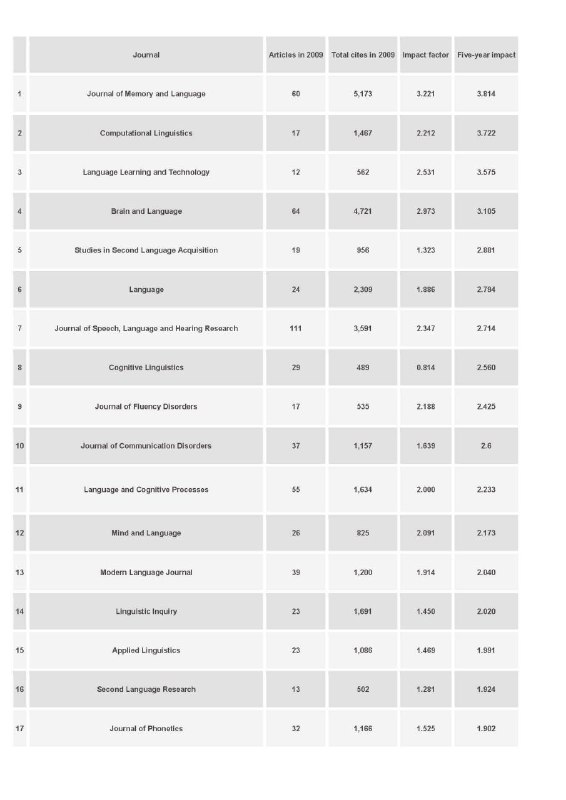
Top journals in Linguistics
October 21, 2010
Data provided by Thomson Reuters from its Journal Citation Reports – Social Sciences, 2009
Journal Articles in 2009 Total cites in 2009 Impact factor Five-year impact
1 Journal of Memory and Language 60 5,173 3.221 3.814
2 Computational Linguistics 17 1,467 2.212 3.722
3 Language Learning and Technology 12 562 2.531 3.575
4 Brain and Language 64 4,721 2.973 3.105
5 Studies in Second Language Acquisition 19 956 1.323 2.881
6 Language 24 2,309 1.886 2.794
7 Journal of Speech, Language and Hearing Research 111 3,591 2.347 2.714
8 Cognitive Linguistics 29 489 0.814 2.560
9 Journal of Fluency Disorders 17 535 2.188 2.425
10 Journal of Communication Disorders 37 1,157 1.639 2.6
11 Language and Cognitive Processes 55 1,634 2.000 2.233
12 Mind and Language 26 825 2.091 2.173
13 Modern Language Journal 39 1,200 1.914 2.040
14 Linguistic Inquiry 23 1,691 1.450 2.020
15 Applied Linguistics 23 1,086 1.469 1.991
16 Second Language Research 13 502 1.281 1.924
17 Journal of Phonetics 32 1,166 1.525 1.902
18 Applied Psycholinguistics 31 1,001 1.238 1.887
19 International Journal of Language and Communication Disorders 45 670 1.330 1.859
20 American Journal of Speech-Language Pathology 30 825 1.879 1.829
Thomson Reuters classifies 93 journals in the linguistics category in its Journal Citation Reports – Social Sciences for 2009. The table above lists the top 20 publications ranked by their five-year impact, which is defined as the total number of citations in 2009 made to papers published in the journals in 2004-08, divided by the number of citable items (research articles and reviews) from 2004 to 2008.
This measure is different from the more traditional impact factor, which is defined as total citations in Year 3 to papers in a journal in Years 1 and 2, divided by the number of citable items in Years 1 and 2. The five–year impact factor measures average influence over a longer period than the traditional impact factor, and is particularly useful in examining journal influence for those fields in the sciences and social sciences that require a relatively longer period of time to elapse before they typically achieve their peak level of citations post-publication.
The number of citable items recorded from each journal in 2009 is provided to give the reader some idea about the size and reach of the journals in question. The number of total citations in 2009 represents citations recorded that year to papers in the journal of any year to illustrate the publications’ contemporary gross influence.
Of course, as the results indicate, those journals with a long history and ones that have published larger numbers of papers have more opportunity to receive citations than those with shorter histories and smaller output.
For more information and insights into Thomson Reuters’ Journal Citation Reports, visit:
http://go.thomsonreuters.com/jcr