Мое утешение сегодня — поэтические параболы Стивена Крейна (Stephen Crane, 1871-1900).
***
A man feared that he might find an assassin;
Another that he might find a victim.
One was more wise than the other.
***
I walked in a desert.
And I cried,
"Ah, God, take me from this place!"
A voice said, "It is no desert."
I cried, "Well, But --
The sand, the heat, the vacant horizon."
A voice said, "It is no desert."
***
Yes, I have a thousand tongues,
And nine and ninety-nine lie.
Though I strive to use the one,
It will make no melody at my will,
But is dead in my mouth.
***
God fashioned the ship of the world carefully.
With the infinite skill of an All-Master
Made He the hull and the sails,
Held He the rudder
Ready for adjustment.
Erect stood He, scanning His work proudly.
Then -- at fateful time -- a wrong called,
And God turned, heeding.
Lo, the ship, at this opportunity, slipped slyly,
Making cunning noiseless travel down the ways.
So that, forever rudderless, it went upon the seas
Going ridiculous voyages,
Making quaint progress,
Turning as with serious purpose
Before stupid winds.
And there were many in the sky
Who laughed at this thing.
***
Behold, the grave of a wicked man,
And near it, a stern spirit.
There came a drooping maid with violets,
But the spirit grasped her arm.
"No flowers for him," he said.
The maid wept:
"Ah, I loved him."
But the spirit, grim and frowning:
"No flowers for him."
Now, this is it --
If the spirit was just,
Why did the maid weep?
***
The ocean said to me once,
"Look!
Yonder on the shore
Is a woman, weeping.
I have watched her.
Go you and tell her this --
Her lover I have laid
In cool green hall.
There is wealth of golden sand
And pillars, coral-red;
Two white fish stand guard at his bier.
"Tell her this
And more --
That the king of the seas
Weeps too, old, helpless man.
The bustling fates
Heap his hands with corpses
Until he stands like a child
With a surplus of toys."
***
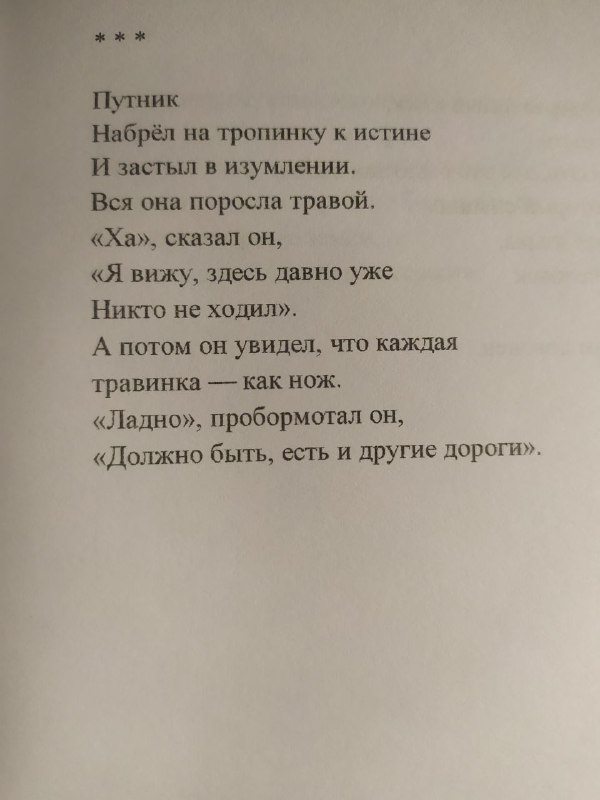
The wayfarer,
Perceiving the pathway to truth,
Was struck with astonishment.
It was thickly grown with weeds.
"Ha," he said,
"I see that none has passed here
In a long time."
Later he saw that each weed
Was a singular knife.
"Well," he mumbled at last,
"Doubtless there are other roads."
***
Do not weep, maiden, for war is kind.
Because your lover threw wild hands toward the sky
And the affrighted steed ran on alone,
Do not weep.
War is kind.
Hoarse, booming drums of the regiment,
Little souls who thirst for fight,
These men were born to drill and die.
The unexplained glory flies above them,
Great is the battle-god, great, and his kingdom—
A field where a thousand corpses lie.
Do not weep, babe, for war is kind.
Because your father tumbled in the yellow trenches,
Raged at his breast, gulped and died,
Do not weep.
War is kind.
Swift, blazing flag of the regiment,
Eagle with crest of red and gold,
These men were born to drill and die.
Point for them the virtue of slaughter,
Make plain to them the excellence of killing
And a field where a thousand corpses lie.
Mother whose heart hung humble as a button
On the bright splendid shroud of your son,
Do not weep.
War is kind.
***
A man said to the universe:
“Sir, I exist!”
“However,” replied the universe,
“The fact has not created in me
A sense of obligation.”