Post #41
105
Channel Public Channel
 FL
FL Fluent Future SAT
@satacerssquad
- Subscribers
- 53
- Photos
- 30
- Videos
- 0
- Links
- 3
Showing posts older than #42 · Back to latest
Older Posts 18 shown
Post #40
91

Post #39
82
Post #38
84

Post #37
96

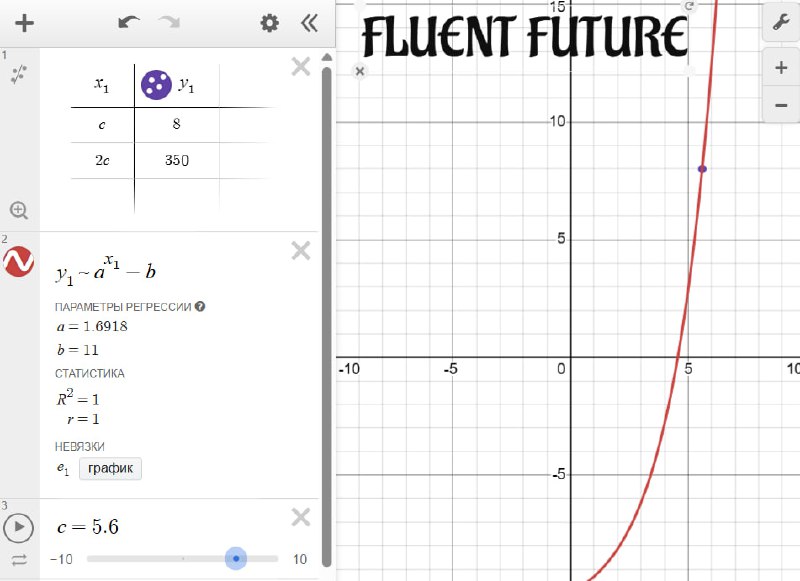
Here comes our explanation on DESMOS😮😮
- ❤ 2
Post #36
105
Post #33
94

Question from our subscriber!
- ❤ 2
Post #32
103
Sleep on it.pdf1.1 MB
Are you encountering difficulties in enhancing your comprehension of SAT texts? Consider reading articles
- ❤ 4
Post #31
138
Post #30
136
I will share the only book that you need for the 800 Math.
Please, PLEASE! Do at least half of the book for 750+ and all of the book for 800. This is ALL what you need!
Nothing extra, one book=800.
Please, PLEASE! Do at least half of the book for 750+ and all of the book for 800. This is ALL what you need!
Nothing extra, one book=800.
- ❤ 2
Post #29
121
Post #27
111


Day 2
SAT Math
Module: Hard
Alright, starts getting a little spicy.
Algorithm:
1. Type your equation (DO THIS ALL THE TIME!)
2. Satisfy the condition f(n)/f(n-1)
3. Subtract everything from 1, because they are asking "p% less" question, inversed percentage.
JMSN - Love Me
SAT Math
Module: Hard
Alright, starts getting a little spicy.
Algorithm:
1. Type your equation (DO THIS ALL THE TIME!)
2. Satisfy the condition f(n)/f(n-1)
3. Subtract everything from 1, because they are asking "p% less" question, inversed percentage.
JMSN - Love Me
- ❤ 2
Post #26
84
Post #24
84


Day 2
SAT Math
Module: Mid
Quite straightforward, innit?
That is the same type of questions that I showed you previously. Acing this type of questions is already 70% of your success.
Eminem - Superman
SAT Math
Module: Mid
Quite straightforward, innit?
That is the same type of questions that I showed you previously. Acing this type of questions is already 70% of your success.
Eminem - Superman
- ❤ 1
Post #23
87
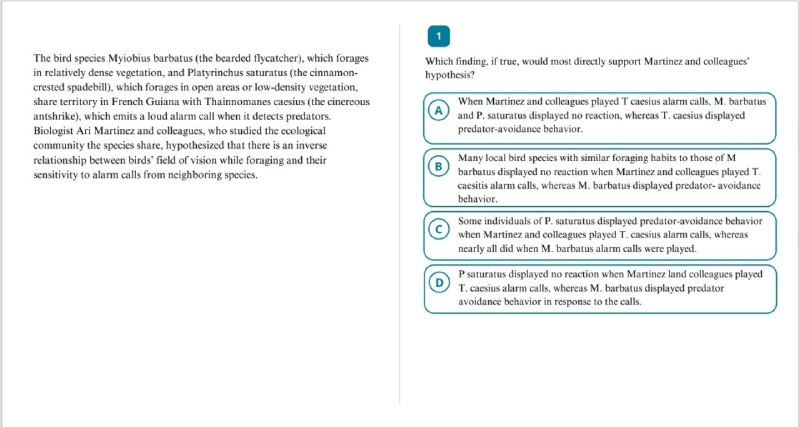
If the answer choices make no sense to you, you didn’t read the passage carefully.
Core concept:
Biologist Ari Martinez and colleagues,who studied the ecological community the species share, hypothesized that there is an inverse relationship between birds' field of vision while foraging and their sensitivity to alarm calls from neighboring species.
An inverse relationship is when one variable increases (UP) while the other decreases (DOWN).
Thus, it can be concluded that the wider the field of vision, the lower the sensitivity to sound.
The text says that M. Barbatus forages in relatively dense vegetation, which means it has narrower field of vision (plants limit visibility because they block the line of sight).
In contrast, P. Saturatus forages in open areas or low-density vegetation (it is logical that you can see more and farther in open areas).
A) contradicts the hypothesis. If neither reacts, there is no inverse relationship at all.
B) shifts focus to other species, not the comparison between M. barbatus and P. saturatus. The text gives NOT the slightest hint of any other birds, so you can cross that option out right away
C) Firstly, the text generalizes M. barbatus and P. saturatus, so we cannot refer to ‘some individuals’. It is either all or none. Secondly, P. Saturatus should not react to the sound because it has low sensitivity.
D) directly matches the hypothesis species by species; compares birds with different fields of vision reacting differently to the same alarm call; tests the predicted mechanism.
Core concept:
Biologist Ari Martinez and colleagues,
An inverse relationship is when one variable increases (UP) while the other decreases (DOWN).
Thus, it can be concluded that the wider the field of vision, the lower the sensitivity to sound.
The text says that M. Barbatus forages in relatively dense vegetation, which means it has narrower field of vision (plants limit visibility because they block the line of sight).
In contrast, P. Saturatus forages in open areas or low-density vegetation (it is logical that you can see more and farther in open areas).
A) contradicts the hypothesis. If neither reacts, there is no inverse relationship at all.
B) shifts focus to other species, not the comparison between M. barbatus and P. saturatus. The text gives NOT the slightest hint of any other birds, so you can cross that option out right away
C) Firstly, the text generalizes M. barbatus and P. saturatus, so we cannot refer to ‘some individuals’. It is either all or none. Secondly, P. Saturatus should not react to the sound because it has low sensitivity.
D) directly matches the hypothesis species by species; compares birds with different fields of vision reacting differently to the same alarm call; tests the predicted mechanism.
- ❤ 1
Post #22
64
- ❤ 1
Post #21
64
- ❤ 1
Post #20
87
The text sets up a contrast between two groups of artists. The first group, contemporary artists like Dyani White Hawk, uses traditional motifs like beadwork, so you can identify their work as indigenous just by looking at the style.However, the second group, like Fritz Scholder in the mid 20th century, did the opposite. They used "abstract expressionism", which is a "European-American style". Because they did not use traditional visual markers, you cannot identify their work as indigenous just by looking at the painting itself.
Therefore, the answer is C: since the style does not look indigenous, identifying the art as "indigenous" depends entirely on knowing who the artist is (his identity), rather than what the painting looks like (stylistic details).
A focuses on "merit" that was not discussed.
B contradicts the text. It suggests that the style used by Scholder has indigenous roots that are being hidden, while the text suggests the opposite: that Scholder adopted a totally foreign style.
D is logically backwards. It would make no sense to say "identifying this painting as indigenous art denies that the artist is indigenous"
Therefore, the answer is C: since the style does not look indigenous, identifying the art as "indigenous" depends entirely on knowing who the artist is (his identity), rather than what the painting looks like (stylistic details).
A focuses on "merit" that was not discussed.
B contradicts the text. It suggests that the style used by Scholder has indigenous roots that are being hidden, while the text suggests the opposite: that Scholder adopted a totally foreign style.
D is logically backwards. It would make no sense to say "identifying this painting as indigenous art denies that the artist is indigenous"
- ❤ 2