
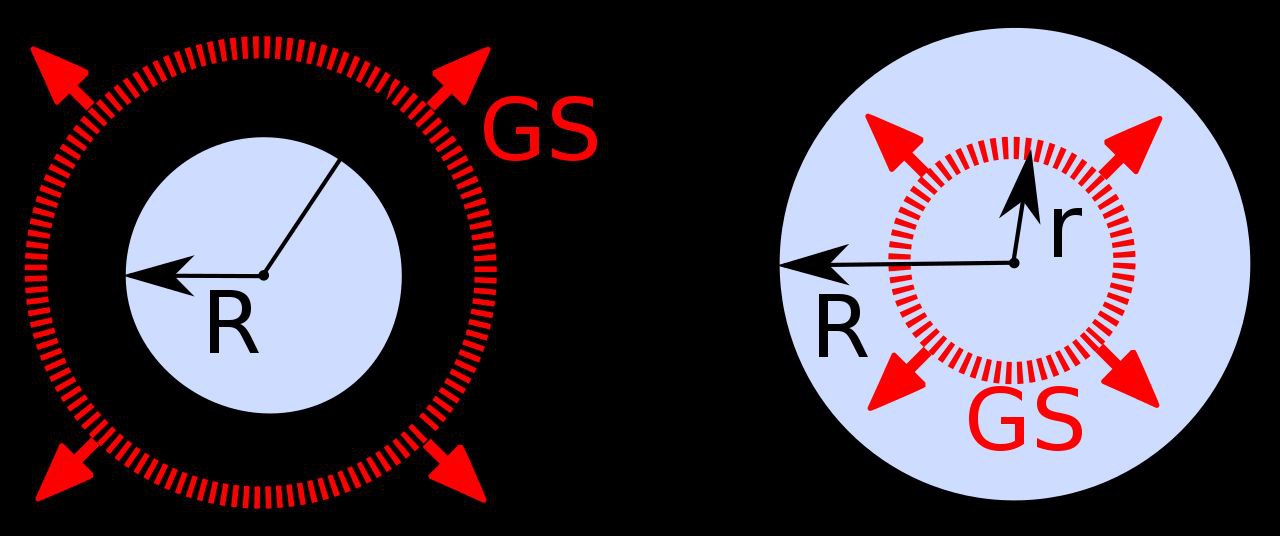
In physics (specifically electromagnetism), Gauss's law, also known as Gauss's flux theorem, (or sometimes simply called Gauss's theorem) is a law relating the distribution of electric charge to the resulting electric field. In its integral form, it states that the flux of the electric field out of an arbitrary closed surface is proportional to the electric charge enclosed by the surface, irrespective of how that charge is distributed. Even though the law alone is insufficient to determine the electric field across a surface enclosing any charge distribution, this may be possible in cases where symmetry mandates uniformity of the field. Where no such symmetry exists, Gauss's law can be used in its differential form, which states that the divergence of the electric field is proportional to the local density of charge.
The law was first formulated by Joseph-Louis Lagrange in 1773, followed by Carl Friedrich Gauss in 1835, both in the context of the attraction of ellipsoids. It is one of Maxwell's equations, which forms the basis of classical electrodynamics. Gauss's law can be used to derive Coulomb's law, and vice versa.
━━━━━━━━━━━
☢ @Physics ⚡
Post #1529
9.03K
- 👍 14
- ❤ 9
- 🔥 6
- 😁 2
- 😱 2