Zahra Birashk, Ph.D. Researcher in Comparative Philosophy
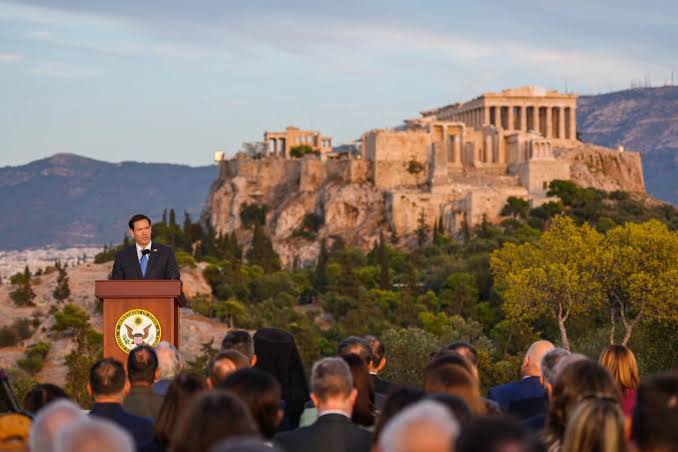
🔸Standing before the Acropolis, Marco Rubio spoke of ancient Greece in order to lend present-day American politics a glorious lineage. In his address of 7 October, the Athenians’ resistance to Xerxes, heroic virtue, the will to prevail, and the necessity of reviving Western power were set along a single continuous line. The oration was no mere homage to the legacy of Greece; it summoned the past onto the stage of present-day politics, so that power might present itself as the heir of civilization and the rival might appear in the guise of an age-old enemy.
🔻The historical and philosophical critiques of this speech—from Touraj Daryaee’s objection to the recasting of a war between an empire and city-states as a confrontation between East and West, to Hamid Aboutalebi’s critique of the severing of thumos from reason and justice—arrive by two paths at a single problem: the appropriation of heritage to legitimize warmongering.
🔻Yet ardor and courage, without judgment as to end and action, are not virtue; just as the antiquity of an enmity is no proof of the rightfulness of its continuation. Rubio invoked Socrates as well; but the Socratic question cannot be answered by a merely nominal invocation of Socrates: power for what end, and in the service of which justice?
📌Full text available at:
https://paiab.org/?p=3196
@Paiab_org