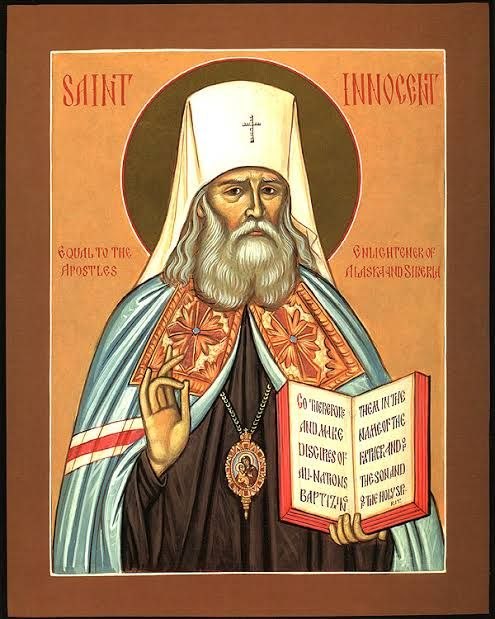
"The Kingdom of God is in your midst. Let us believe and see that Jesus is present. If we cannot touch His hand, let us prostrate ourselves at His feet. If we cannot reach His head, let us at least wash His feet with our tears. Our penance is an ointment for the Savior. See how great His mercy is. Our sins stink; they are putrefaction; yet, if we do penance for our sins, if we weep over them, our putrid sins are transformed into an ointment for the Lord. Let us, therefore, ask the Lord to take us by the hand."
Saint Innocent (Innokentii), Metropolitan of Moscow
Saint Innocent (born Ivan Popov-Veniaminov), Metropolitan of Moscow (1797–1879), was a notable missionary and educator of the peoples of the Americas and Siberia. Over the course of 45 years, he baptized tens of thousands of people, built churches and schools, and studied the languages, customs, and traditions of local populations. His ethnographic and linguistic works achieved worldwide renown: he created a grammar of the Aleut language and translated liturgical texts into it. In 1868, he became Metropolitan of Moscow, founded the Missionary Society, and promoted the development of missions, including the mission in Japan. He was canonized by the Russian Orthodox Church in 1977.
The Conception of the Venerable Prophet, Forerunner and Baptist of the Lord, John
This was the prophecy of Isaiah referring to the Forerunner:
"A voice of one crying in the wilderness: Prepare the way of the LORD; make straight in the desert a highway for our God" (Isaiah 40:3)
His father, the Priest Zechariah was offering incense at the altar in the Temple, he saw an Angel of the Lord who announced the coming of a son to be named John. Joy overflowed in Zechariah's heart, yet he doubted for a moment that this could be possible, as his wife was already of very advanced age. The Angel then told him that, for he had doubted, he would remain unable to speak or hear until the word of God was fulfilled. And indeed, Elizabeth gave birth to a son. Eight days later, when the boy was taken to be circumcised, relatives wanted to give him his father's name, Zechariah. Noticing this, Zechariah wrote the name "John" on a tablet; immediately, he regained his speech and hearing, and joy once again filled everyone.
"If you see a murderer, a prostitute, and a drunkard fallen in the street, do not judge anyone; for God has loosened their reins, but He keeps yours firm."
"Laziness is not simply the absence of action—it is the fertile ground where temptation and sin flourish. By fleeing from work, we fail to cultivate the discipline that guards our hearts. True rest comes from a clear conscience and the peace that follows fulfilling our vocation."
The Holy Martyr Phocas was born in the city of Sinope. From his youth, he led a virtuous Christian life, and in adulthood, he was elevated to the position of Bishop of Sinope. Saint Phocas converted many pagans to the faith in Christ. During the persecution of Christians under Emperor Trajan (98–117), the governor demanded that the Saint renounce Christ. After enduring fierce torture, Saint Phocas was cast into a bath of boiling water, where he met a martyr's death in the year 117. In the year 404, the Saint's relics were transferred to Constantinople (the commemoration of the transfer of relics takes place on July 22). Saint Phocas is especially venerated as a protector against fires, as well as a helper to those in danger of drowning.
The Holy Prophet Jonah lived in the 8th century before Christ and was a successor to the Prophet Elisha. His book, included in Holy Scripture, contains prophecies concerning Israel, the sufferings of the Savior, the fall of Jerusalem, and the end of the world. It recounts Jonah’s mission to Nineveh, where he preached repentance and the people repented. Christ clearly revealed Jonah’s story when the scribes and Pharisees demanded a sign. He gave them the sign of Jonah: as Jonah remained three days and three nights in the great fish, so the Son of Man would be three days in the heart of the earth. Thus Jonah’s experience prefigures Christ’s death, descent into Hades, and Resurrection. The Lord declared that the repentant Ninevites would rise in judgment against the unrepentant generation, for they believed Jonah’s preaching, while one greater than Jonah was present among them at that time.
"Though the path is plain and smooth for men of good will, he who walks it will not travel far, and will do so only with difficulty, if he does not have good feet: that is, courage and a persevering spirit."
Saint Codratus, one of the Seventy Disciples, preached Christ in Athens and Magnezia and served as Bishop of Athens. Through his preaching he converted many pagans, provoking the hostility of those who rejected the Gospel. An angry crowd attacked him with stones, but God preserved him; he was then imprisoned and died of starvation. His body was buried in Magnezia. In 126, Codratus wrote an Apologia defending Christianity and presented it to Emperor Adrian. The work influenced the emperor to issue a decree requiring proof before Christians could be condemned. The 4th century historian Eusebius knew the Apologia and preserved part of it in his history. Codratus testified that Christ's miracles, healings, and raisings from the dead were publicly witnessed and remained known even after His departure. His testimony affirmed Christ's works and strengthened defenses against pagan opposition.
Saint Dimitrii, Metropolitan of Rostov, arrived at Rostov cathedral in 1702. He visited the monastery of Saint Jakov and at the cathedral celebrated the Divine Liturgy, then pointed out his future burial place, saying, “Behold my repose, here settle I for eternity.” He reposed on 28 October 1709. Although his will requested burial at the monastery, clergy wished to bury him in the cathedral beside Saint Joasaph. Metropolitan Stefan Yavorsky upheld Dimitrii’s wish, and the saint was buried on 25 November in a hastily prepared wooden frame. In 1752, during repairs, his undecayed body was discovered despite dampness that had destroyed the coffin. His vestments and rosary were also preserved. Many healings followed, prompting a Synodal investigation. On 29 April 1757 the Holy Synod decreed his glorification, establishing feasts on 28 October and 21 September, the day his relics were uncovered.
Saint Michael was known for piety, justice, compassion, and firmness. Miraculously healed in youth by the prayers of Saint Nikita of Pereyaslavl, he later became Prince of Chernigov, Prince of Novgorod, and Grand Prince of Kiev. During the Mongol invasion, he sought alliances to defend Rus’, but foreign support failed. As a Christian prince, he accepted the need to submit politically to the khan while refusing to renounce his faith or worship pagan idols. In 1246 he went to the Horde with the boyar Theodore and was commanded to perform pagan rites. Both steadfastly confessed Christ and refused, accepting martyrdom rather than apostasy. Michael was beaten and beheaded, and Theodore was likewise tortured and killed. Their bodies were miraculously preserved until Christians buried them. Their relics were later transferred to Moscow. Saint Michael is remembered as a prince-martyr and confessor, and his descendants included Saint Euphrosyne of Suzdal and Saint Oleg of Bryansk.
Saint Eustathius, Placidus, a was a charitable pagan who helped the poor. While hunting, he saw Christ crucified between a stag’s antlers and heard Him call him to faith. He was baptized with his wife Theopistia and their sons. Christ foretold that Eustathius would be tested like Job. Soon he lost his servants and possessions, his wife was taken by a shipowner, and his sons were carried away by a lion and wolf. Remaining faithful, he lived humbly. Emperor Trajan recalled him to command the army. By God’s providence, Eustathius served with his sons, while his wife was found, and the family reunited. After victory, Emperor Adrian demanded pagan sacrifice, but Eustathius confessed Christ and refused. He and his family were condemned. Wild beasts spared them, so they were cast into a red-hot bronze ox. After three days, their bodies were found unharmed, and many witnesses believed in Christ.
"The fruits of the earth are not brought to perfection immediately, but by time, rain and care; similarly, the fruits of men ripen through ascetic practice, study, time, perseverance, self-control and patience."
Saint Theodore (Feodor) of Smolensk and Yaroslavl'
The Holy Prince Theodore the Black of Smolensk and Yaroslavl was born around 1237–1239 during the Mongol invasion and was named for the warrior-martyr Theodore Stratilates. Raised in Mozhaisk, he received both spiritual and military education. In 1260 he became Prince of Yaroslavl, but after being widowed he spent much time on military campaigns. His victories in the Caucasus brought him favor at the Golden Horde, where he spent several years and married Anna, the baptized daughter of Khan Mengu-Temir. Through his influence, Orthodoxy and Russian culture gained greater acceptance among the Tatars. Returning to Yaroslavl in 1290, Theodore strengthened the city, supported the Church, and worked for peace among rival Russian princes. Before his death in 1299, he entered monastic life, publicly repented of his sins, and forgave those who had wronged him. His relics and those of his sons were uncovered in 1463, and his veneration spread throughout Russia.
Holy Martyrs Trophymos, Sabbatios and Dorimedontos
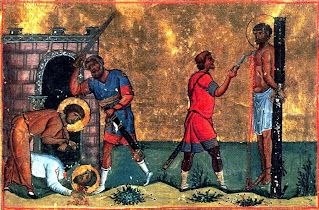
Saints Trophimus and Sabbatius were Christian martyrs who suffered around 278 under Heliodorus, Governor of Antioch. While in Antioch, they boldly denounced the people’s immoral lives and worship of Apollo, openly proclaiming their faith in Christ. Arrested and brought before the governor, they were brutally scourged. Sabbatius died from his wounds, while Trophimus was imprisoned and continued to endure torture. There, a public official named Dorimedon witnessed his steadfastness and converted to Christianity. Enraged, Heliodorus ordered both men to undergo even harsher torments. Trophimus and Dorimedon were then thrown before hungry beasts in the amphitheater, but the animals miraculously remained gentle and refused to attack them. Their executioners therefore resorted to beheading Trophimus and Dorimedon, who thus completed their martyrdom with steadfast faith in Christ.
"The chief end of our life is to live in communion with God. To this end the Son of God became incarnate, in order to return us to this divine communion, which was lost by the fall into sin. Through Jesus Christ, the Son of God, we enter into communion with the Father and thus attain our purpose."
"A true Christian behaves in this life so that it may be a preparation for the future one and not only a life here below. In his actions, he does not think what will be said of him here but of what will be said there in heaven."
The Holy Martyress Ariadna was a servant of Tertillos, a city-father of Promyssia (Phrygia) during the reign of the emperor Adrian (117-161). One time, when on the occasion of the birth of a son the master made a sacrificial offering to the pagan gods, the Christian Ariadna refused to participate in the impious solemnity. For this they subjected her to beatings, and suspending her, they lacerated her body with sharp iron hooks. Then they threw the martyress into prison and for a long while they exhausted her with hunger, demanding worship to the gods. When they released the saint from prison, she left the city, but Tertillos sent pursuers after her. Seeing that they were chasing her, she ran, calling out to God that He defend her from her enemies. Suddenly through her prayers there opened in the mountain a fissure, and Saint Ariadna hid in it. This miracles brought the pursuers into confusion and fear, and they in their depravity of mind began to strike one another with spears.
How can I read @orthodoxiconography without a Telegram account?
TGViewer shows the public web preview Telegram publishes for Orthodox Icons: recent posts, photos, videos and the subscriber count, with no app, login or account.
How many subscribers does Orthodox Icons have?
Orthodox Icons (@orthodoxiconography) has 933 subscribers on Telegram, refreshed roughly every 30 minutes.
Does Orthodox Icons know I viewed it here?
No. Public channel previews carry no viewer identity, and TGViewer has no accounts or tracking of what you look up.
 OR
OR