Homolje Rusalkas: Part I
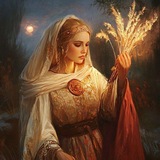
After a short break from social media and writing, I am returning with new texts about folk beliefs, folklore, old customs, and traditions that have survived over time in different parts of the Balkans. For my return, I chose one of the most fascinating rituals of eastern Serbia, the ritual of the Homolje Rusalkas, a custom associated with the holiday of Pentecost and the Vlach population of the Homolje region. At the center of the ritual is the Rusalka, a woman who enters a trance while music, dancing, and special ritual practices take place around her.
This is the first part of the story of the Homolje Rusalkas, their ritual, the beliefs surrounding them, and the testimonies of women who experienced this tradition themselves.
The Rusalka Ritual
In the area around the village of Duboka, in Homolje, people would gather in front of the cave on the holiday of Pentecost. Musicians would play, people would dance the kolo, and the leader of the dance would guide the dancers while carrying a sword and greenery in his hands. During the ritual, one of the women would fall into a trance and become a Rusalka. While she was in this altered state, the music and dancing continued, and the other participants addressed her with special cries. Among them were Epša jaraša and Mudata jaraša, expressions whose meaning has been explained as again, once more, or one more time. These cries were part of the ritual and accompanied the Rusalka while she remained in her altered state.
After some time, the Rusalka would begin to calm down. She would then be refreshed with water from a gourd, a traditional vessel made from a dried gourd that was used for storing and carrying water. A sword and greenery would be crossed over her. After this, she would get up and join the kolo again with the other participants. The entire ritual followed a set sequence in which the music, dancing, movements of the participants, water, greenery, and sword each had their own place.
Rusalkas and the World of the Dead
In the Vlach beliefs of this region, Rusalkas are associated with the spiritual world and the boundary between the world of the living and the dead. In some records, the name itself is connected with spiritual beings and the otherworld. Entering a trance was understood as a state in which a woman could communicate with the dead or convey messages from the world of the deceased.
Attempts to Stop the Ritual
The Rusalka ritual was not always accepted in the past. According to older records, there were attempts to forcibly bring women who had fallen into a trance back to their normal state. It is recorded that gendarmes would prick them with needles and burn them with fire, believing that pain would interrupt their trance. According to the same records, these methods did not produce the expected result.
Over time, the social position of the custom began to change. The Rusalka ritual gradually lost its former function and began to be maintained primarily as part of folklore. Even in more recent performances, however, the boundary between a folkloric performance and a genuine experience was not always completely clear. There are records of women becoming so deeply immersed in the ritual during performances that they once again entered a state resembling a trance.
Mileva Nikolić
One of the women who gave testimony about this tradition was Mileva Nikolić. According to her account, she first entered a state of trance during Pentecost, several decades before a later folkloric performance. She spoke about her earlier experiences and the physical reactions that accompanied these states.
During one of her earlier trances, she bit her own hands, leaving scars that remained visible later. In a later period, she became a member of a folklore group that sought to present the custom as authentically as possible. It was also recorded that during one such performance, she experienced the ritual so intensely that her consciousness became clouded and she fell into a genuine trance again.
@OnReturningtotheOldGods
Post #194
344

- 🔥 4
- 🙏 3
- ❤ 1