
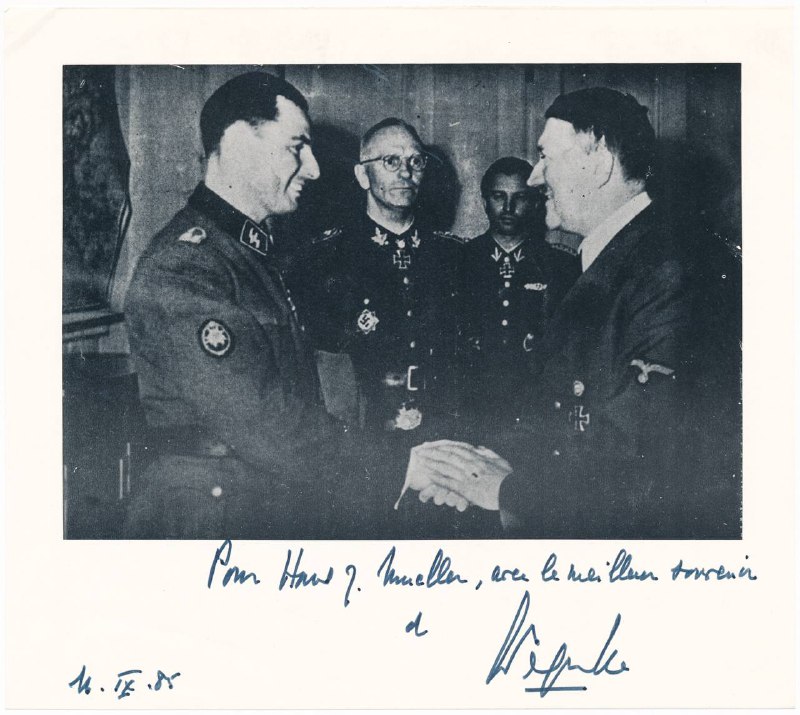
During the course of his three and a half years of combat, Degrelle was wounded seven times and earned 22 military decorations. As a result of the exemplarily courage and leadership he showed on the Narva front in Estonia, he became the first non-German to be awarded the coveted Oak Leaves to the Knight's Cross of the Iron Cross. Hitler personally bestowed the honor on August 27, 1944. Degrelle's proudest moment, he later related, was when Hitler said to him: "If I had a son, I would wish him to be like you."
Through our struggle on the endless Eastern steppes, we wanted indeed to do our duty as Europeans and as Christians. But, we say this openly — we proclaimed it loud and clear from the first day — we had above all given this gift of our youth in order to guarantee the future of our nation in the midst of a rescued Europe. It was for that, first of all, that several thousands of our comrades fell. It was for that that thousands of men struggled, struggled for four years, suffered for four years, sustained by that hope, driven on by that desire, strengthened by the certainty that they were going to succeed in their purpose. (1)
In the book “Dos dias con Himmler”, a conversation between Heinrich Himmler and Leon Degrelle that took place approximately 23–24 May 1943 (overnight), near Rastenburg (Kętrzyn), on Himmler’s personal train. Both were talking about recognising the division on what it was, Degrelle said to Himmler that their division was very religious and had a chaplain. Of course, it was “shocking.” A Catholic chaplain in the Armed SS would never have been imagined.
"Listen..."
, I tell him
Reich leader
,
“...we have had magnificent priests with us at the
front. They have been our companions and our moral support in the midst of the worst
combats. How could you then, soldier and leader, expect us to put such a brave fellow
fighter on the street, just when we are going to join the Waffen-SS?”
That argument was decisive. A soldier could not throw out another soldier. He had
won the battle of the priests.
We couldn't give in on this point either. It's not that I was clerical. The bumps from the
blows that the Primate of Belgium dealt me in 1937 still hurt me. But our people were
religious and did not want to suffer any pressure in that regard. I convinced Himmler in
such a way that not only did we have our priests, but, later, other priests were Catholic
chaplains in other units of the
Armed SS
.
(2)
Degrelle, in exile, was hurt to see that Christian nations like Poland and Hungary have fallen victorious under communism, thanks to bourgeois schizophrenia.
“There were enemies of the Church near Hitler! They are all over the world, but there were also devout Catholics with Hitler, ardent ones, like Monsignor Tiso and me.I had endless talks about this with Hitler and Himmler. One day I will make extraordinary revelations on this issue, especially on Himmler’s religious crisis when it came to an end, partly thanks to me, on the threshold of his conversion.”
(3)
SOURCES:
(1). “The eastern front” (also known as “The Russia campaign) p.9
(2). “Dos días con Himmler” (Two days with Himmler) p.6
(3). Leon Degrelle in Exile p.137/138