TGViewer
Channel Public Channel
Machine Learning

Machine Learning

@machinelearning9

Real Machine Learning — simple, practical, and built on experience.
Learn step by step with clear explanations and working code.

Admin: @HusseinSheikho || @Hussein_Sheikho
Subscribers
41.8K
Photos
3.7K
Videos
38
Links
748

Showing posts older than #5753 · Back to latest

Older Posts 20 shown
Post #5752 1.25K
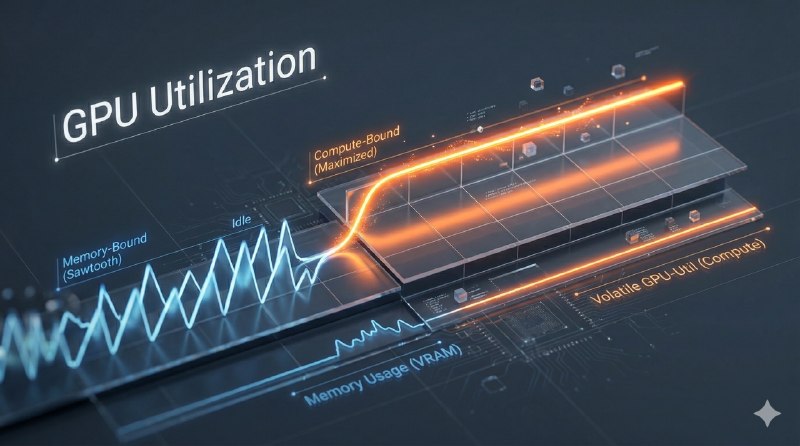
📌 A Guide to Understanding GPUs and Maximizing GPU Utilization

🗂 Category: ARTIFICIAL INTELLIGENCE

🕒 Date: 2026-04-14 | ⏱️ Read time: 18 min read

In an age of constrained compute, learn how to optimize GPU efficiency through understanding architecture,…

#DataScience #AI #Python
Post #5751 1.24K
📌 A Practical Guide to Choosing the Right Quantum SDK

🗂 Category: QUANTUM COMPUTING

🕒 Date: 2026-04-14 | ⏱️ Read time: 7 min read

What to use, when to use it, and what to ignore?

#DataScience #AI #Python
Post #5750 1.28K
📌 Data Modeling for Analytics Engineers: The Complete Primer

🗂 Category: DATA ENGINEERING

🕒 Date: 2026-04-14 | ⏱️ Read time: 29 min read

The best data models make it hard to ask bad questions and easy to answer…

#DataScience #AI #Python
Post #5749 1.33K
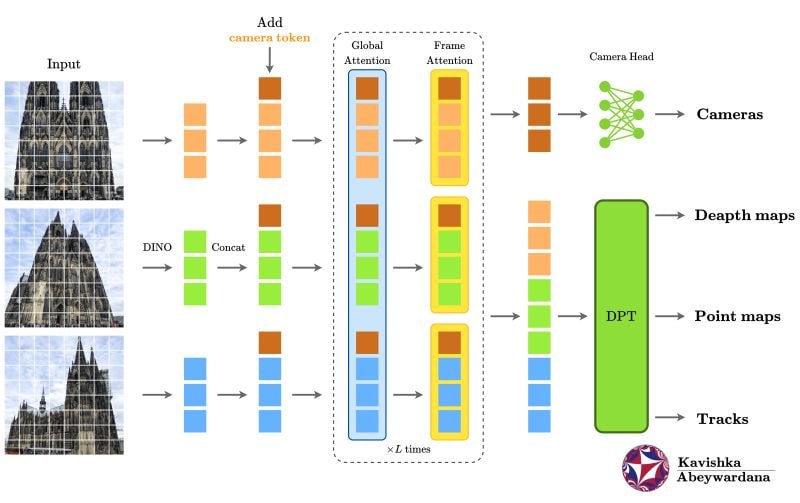
Machine Learning CVPR 2025 Best Paper: Visual Geometry Grounded Transformer (VGGT) ❤️ 🏆 VGGT shows that multi-view 3D reconstruction can be handled by a single feed-forward transformer, without relying on heavy test-time optimization. 🚀 Given one to hundreds of images, VGGT…
please more likes ❤️
Post #5747 1.53K
CVPR 2025 Best Paper: Visual Geometry Grounded Transformer (VGGT) ❤️ 🏆

VGGT shows that multi-view 3D reconstruction can be handled by a single feed-forward transformer, without relying on heavy test-time optimization. 🚀

Given one to hundreds of images, VGGT jointly predicts camera parameters 📷, depth maps, viewpoint-invariant point maps, and tracking features in a single forward pass. ⚡️

By combining DINO-based image tokenization, explicit camera tokens, and alternating frame-wise and global self-attention, the model learns multi-view geometry with minimal inductive bias. 🧠✨

https://t.me/DataScienceM 🩵
  • ❤ 9
Post #5746 1.21K
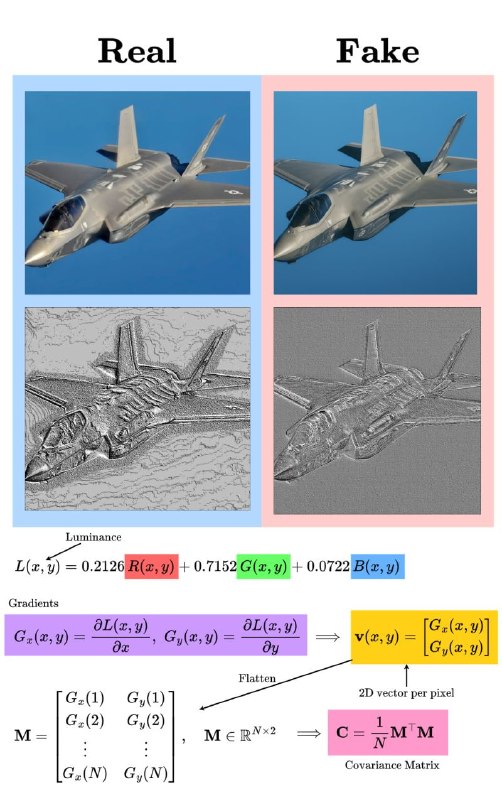
Synthetic Image Detection using Gradient Fields 💡🔍

A simple luminance-gradient PCA analysis reveals a consistent separation between real photographs and diffusion-generated images 📸🤖.

Real images produce coherent gradient fields tied to physical lighting and sensor characteristics ☀️📷, while diffusion samples show unstable high-frequency structures from the denoising process 🌀.

By converting RGB to luminance, computing spatial gradients, flattening them into a matrix, and evaluating the covariance through PCA, the difference becomes visible in a single projection 📊.

This provides a lightweight and interpretable way to assess image authenticity without relying on metadata or classifier models ✅🛡.

https://t.me/DataScienceM 💙
  • ❤ 2
Post #5744 1.23K
📌 How to Apply Claude Code to Non-technical Tasks

🗂 Category: AGENTIC AI

🕒 Date: 2026-04-13 | ⏱️ Read time: 8 min read

Learn how to apply coding agents to all tasks on your computer

#DataScience #AI #Python
Post #5743 1.32K
📌 I Built a Tiny Computer Inside a Transformer

🗂 Category: ARTIFICIAL INTELLIGENCE

🕒 Date: 2026-04-13 | ⏱️ Read time: 19 min read

By compiling a simple program directly into transformer weights.

#DataScience #AI #Python
Post #5742 1.3K
📌 Range Over Depth: A Reflection on the Role of the Data Generalist

🗂 Category: PRODUCTIVITY

🕒 Date: 2026-04-13 | ⏱️ Read time: 5 min read

What has changed in the past five years in the role and importance of generalists…

#DataScience #AI #Python
  • ❤ 1
Post #5741 1.24K

Forwarded from AI & ML Papers

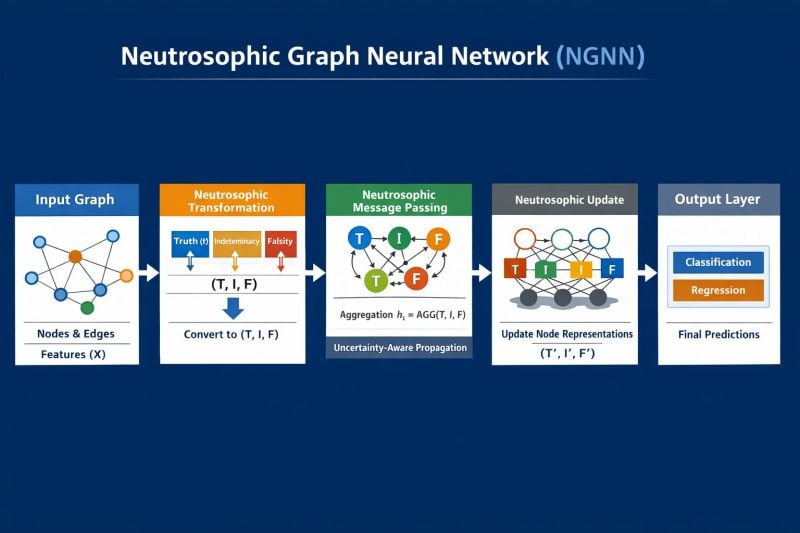
Exploring the Future of AI: Neutrosophic Graph Neural Networks (NGNN)

Recent analysis indicates that Neutrosophic Graph Neural Networks (NGNN) represent a significant advancement in contemporary artificial intelligence research. The following overview details the concept and its implications.

Most artificial intelligence models presuppose data integrity; however, real-world data is frequently imperfect. Consequently, NGNN may emerge as a critical innovation.

The foundational inquiry addresses the following:
How does artificial intelligence manage data characterized by uncertainty, incompleteness, or contradiction?

Traditional models exhibit limitations in this regard, often assuming certainty where none exists.

The Foundation: Neutrosophic Logic
In the late 1990s, mathematician Florentin Smarandache introduced a framework extending beyond binary true/false dichotomies. He proposed three dimensions of truth:
T — What is true
I — What is indeterminate
F — What is false

Between 2000 and 2015, this framework evolved into neutrosophic sets and neutrosophic graphs, mathematical tools capable of encoding uncertainty within data and relationships.

The Parallel Rise of Graph Neural Networks
Around 2016, the artificial intelligence sector adopted Graph Neural Networks (GNNs), models designed to learn from nodes (data points) and edges (relationships). These models became foundational in social networks, healthcare, fraud detection, and bioinformatics.

However, GNNs possess a critical limitation: they assume data certainty, whereas real-world data is inherently uncertain.

The Convergence: NGNN
From 2020 onwards, researchers began integrating these two domains. In an NGNN, rather than carrying only features, a node encapsulates:
— T: What is likely true
— I: What remains uncertain
— F: What may be false

This constitutes not a minor upgrade, but a fundamental shift in how artificial intelligence models perceive and process reality.

Key Application Areas:
Healthcare — Navigating uncertain or conflicting diagnoses
Fraud detection — Identifying ambiguous behavioral patterns
Social networks — Modeling unclear or evolving relationships
Bioinformatics — Managing the complexity of biological interactions

Is NGNN advanced machine learning?
Affirmatively. It resides at the intersection of:
Graph theory · Deep learning · Mathematical logic · Uncertainty modeling

This technology represents research-level, cutting-edge development and is not yet widely deployed in industry. This status underscores its current strategic importance.

The Broader Context
NGNN is not merely another model; it signifies a philosophical shift in artificial intelligence from systems assuming certainty to systems reasoning through uncertainty. Real-world problems are rarely perfect; therefore, models should not presume perfection.

This represents not only evolution but a definitive direction for the field.

——

#ArtificialIntelligence #MachineLearning #DeepLearning #GraphNeuralNetworks #AIResearch #DataScience #FutureOfAI #Innovation #EmergingTech #NGNN #AIHealthcare #Bioinformatics
  • ❤ 1
Post #5740 1.23K
📌 Write Pandas Like a Pro With Method Chaining Pipelines

🗂 Category: PROGRAMMING

🕒 Date: 2026-04-12 | ⏱️ Read time: 15 min read

Master method chaining, assign(), and pipe() to write cleaner, testable, production-ready Pandas code

#DataScience #AI #Python
Post #5739 1.25K
📌 Stop Treating AI Memory Like a Search Problem

🗂 Category: AGENTIC AI

🕒 Date: 2026-04-12 | ⏱️ Read time: 22 min read

Why storing and retrieving data isn’t enough to build reliable AI memory systems

#DataScience #AI #Python
  • ❤ 1
Post #5738 1.34K
📌 Your ReAct Agent Is Wasting 90% of Its Retries — Here’s How to Stop It

🗂 Category: AGENTIC AI

🕒 Date: 2026-04-12 | ⏱️ Read time: 19 min read

Most ReAct-style agents are silently wasting their retry budget on errors that can never succeed.…

#DataScience #AI #Python
  • ❤ 1
Post #5737 1.51K
📌 Introduction to Reinforcement Learning Agents with the Unity Game Engine

🗂 Category: REINFORCEMENT LEARNING

🕒 Date: 2026-04-11 | ⏱️ Read time: 10 min read

A step-by-step interactive guide to one of the most vexing areas of machine learning.

#DataScience #AI #Python
Post #5736 1.42K
📌 Why Every AI Coding Assistant Needs a Memory Layer

🗂 Category: AGENTIC AI

🕒 Date: 2026-04-11 | ⏱️ Read time: 10 min read

AI coding assistants need a persistent memory layer to overcome the statelessness of LLMs and…

#DataScience #AI #Python
Post #5735 1.29K
📌 Advanced RAG Retrieval: Cross-Encoders & Reranking

🗂 Category: LLM APPLICATIONS

🕒 Date: 2026-04-11 | ⏱️ Read time: 28 min read

A deep-dive and practical guide to cross-encoders, advanced techniques, and why your retrieval pipeline deserves…

#DataScience #AI #Python
Post #5734 1.25K
📌 When Things Get Weird with Custom Calendars in Tabular Models

🗂 Category: POWER BI

🕒 Date: 2026-04-10 | ⏱️ Read time: 10 min read

Since September 2025, we have had Calendar-based Time Intelligence in Power BI and Fabric Tabular…

#DataScience #AI #Python
  • ❤ 1
Post #5733 999

Forwarded from Machine Learning with Python

📝 12 Essential Articles for Data Scientists

🏷 Article: Seq2Seq Learning with NN
https://arxiv.org/pdf/1409.3215
An introduction to Seq2Seq models, which serve as the foundation for machine translation utilizing deep learning.

🏷 Article: GANs
https://arxiv.org/pdf/1406.2661
An introduction to Generative Adversarial Networks (GANs) and the concept of generating synthetic data. This forms the basis for creating images and videos with artificial intelligence.

🏷 Article: Attention is All You Need
https://arxiv.org/pdf/1706.03762
This paper was revolutionary in natural language processing. It introduced the Transformer architecture, which underlies GPT, BERT, and contemporary intelligent language models.

🏷 Article: Deep Residual Learning
https://arxiv.org/pdf/1512.03385
This work introduced the ResNet model, enabling neural networks to achieve greater depth and accuracy without compromising the learning process.

🏷 Article: Batch Normalization
https://arxiv.org/pdf/1502.03167
This paper introduced a technique that facilitates faster and more stable training of neural networks.

🏷 Article: Dropout
https://jmlr.org/papers/volume15/srivastava14a/srivastava14a.pdf
A straightforward method designed to prevent overfitting in neural networks.

🏷 Article: ImageNet Classification with DCNN
https://proceedings.neurips.cc/paper_files/paper/2012/file/c399862d3b9d6b76c8436e924a68c45b-Paper.pdf
The first successful application of a deep neural network for image recognition.

🏷 Article: Support-Vector Machines
https://link.springer.com/content/pdf/10.1007/BF00994018.pdf
This seminal work introduced the Support Vector Machine (SVM) algorithm, a widely utilized method for data classification.

🏷 Article: A Few Useful Things to Know About ML
https://homes.cs.washington.edu/~pedro/papers/cacm12.pdf
A comprehensive collection of practical and empirical insights regarding machine learning.

🏷 Article: Gradient Boosting Machine
https://www.cse.iitb.ac.in/~soumen/readings/papers/Friedman1999GreedyFuncApprox.pdf
This paper introduced the "Gradient Boosting" method, which serves as the foundation for many modern machine learning models, including XGBoost and LightGBM.

🏷 Article: Latent Dirichlet Allocation
https://jmlr.org/papers/volume3/blei03a/blei03a.pdf
This work introduced a model for text analysis capable of identifying the topics discussed within an article.

🏷 Article: Random Forests
https://www.stat.berkeley.edu/~breiman/randomforest2001.pdf
This paper introduced the "Random Forest" algorithm, a powerful machine learning method that aggregates multiple models to achieve enhanced accuracy.

https://t.me/CodeProgrammer 🌟

  • ❤ 2
Post #5732 1.23K
📌 How Does AI Learn to See in 3D and Understand Space?

🗂 Category: ARTIFICIAL INTELLIGENCE

🕒 Date: 2026-04-10 | ⏱️ Read time: 19 min read

How depth estimation, foundation segmentation, and geometric fusion are converging into spatial intelligence

#DataScience #AI #Python
  • ❤ 3
  • 👎 1
  • 🤩 1
Post #5731 1.3K
📌 A Guide to Voice Cloning on Voxtral with a Missing Encoder

🗂 Category: LARGE LANGUAGE MODELS

🕒 Date: 2026-04-10 | ⏱️ Read time: 13 min read

Can we reconstruct audio codes if we have audio for the Voxtral text-to-speech model?

#DataScience #AI #Python
Older posts →
Threads Profile ViewerView any public Threads profile without an account.Open ThreadLook →Writing with AI? Make it sound human.Metric37 rewrites AI drafts so they read naturally. Free AI detector, 1,500 words free.Try Metric37 →