
#IELTS Writing Task 1: clothes production 👖👕👗
If you've seen IELTS 20, you will have seen the bamboo fabric process writing task 1.
And if you have seen my worksheet on the New Scientist article "Can fashion ever be green", you would be ready to write that answer because there is a task on jeans production process based on the article - and any clothes production task for that matter.
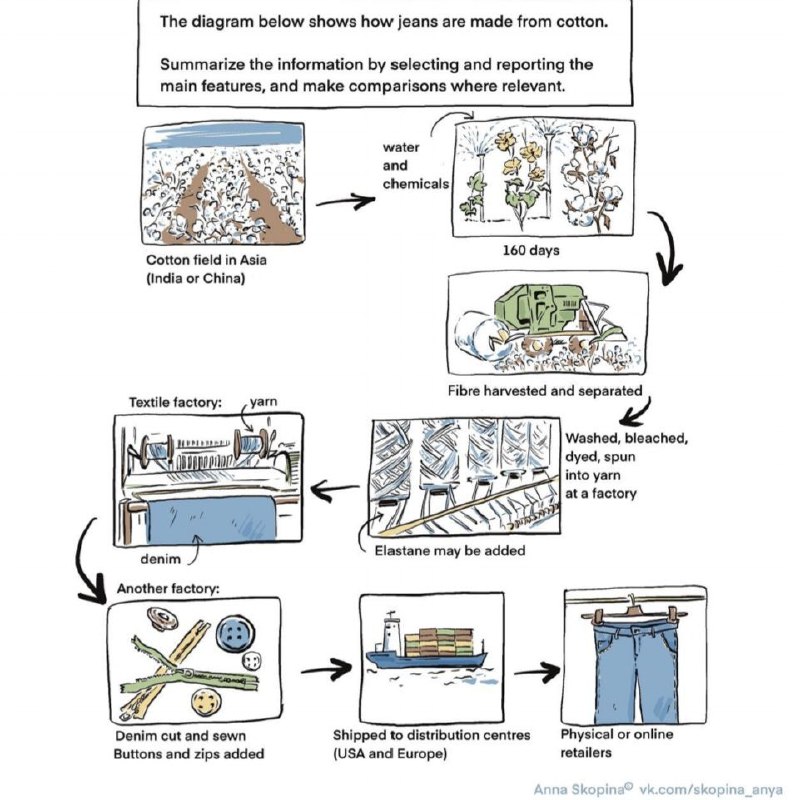
The text below is an excerpt from the article that looks remarkably like an IELTS writing task 1 answer. And the attached picture was drawn by my colleague Anna Skopina to match the text and to look like an IELTS task (better quality attached in the comments).
What can you borrow from this text into your IELTS answer?
- In italics: signposts of stages
- Underlined: umbrella terms to avoid repetitions
- In bold: other useful things
"The starting point is a cotton field somewhere in Asia, probably India or China. A cotton crop takes about 160 days to grow, sprinkled with water and chemicals, after which the fibre is harvested and separated from the rest of the plant. The raw cotton is sent to a factory to be washed, bleached, dyed and spun into yarn. At this point, small amounts of the synthetic fibre elastane may be added, which adds a pleasing stretchiness, but can rebound when it comes to disposal, as it makes the fabric very hard to recycle. The yarn then moves on to a textile factory to be woven into denim, from where it goes to yet another factory to be cut and sewn. Buttons, zips, linings, labels and patches – usually manufactured elsewhere – are added here.
Once finished, the jeans embark on the second phase of their life cycle. They are shipped in large quantities to distribution centres in North America and western Europe, where consumer demand tends to be highest. Clothes usually travel by boat, but air freight is increasingly common. This distribution phase also generates waste in the form of packaging, tags and hangers.
From the distribution centres, the jeans are dispatched to physical or online retailers and some of them are bought by consumers, worn, washed a few times, then ditched. Some go straight into the bin; others are put in recycling banks."
Memorize this text and you are largely ready to write about any clothes. The only thing the text is missing is an overview. Feel free to try your hand in the comments. 📝
📝 Full worksheet: https://docs.google.com/document/d/1JJVxEWgLj8DFA9qb43ZLKUjReUNXrzNYpvB4D3eWhb0/edit?usp=drivesdk
📝 My "Writing with New Scientist" course: https://m.vk.com/product-47977221_5061302
#ieltswritingtask1
Post #575
3.58K
- ❤ 25
- ⚡ 6
- 🤩 3
- 🦄 1