Hi! I’m Alireza Mohammadhosseini. M.D , Internal Medicine specialist from Tehran University of Medical Sciences. Here I share my simple and important cases, come and share your ideas!
Internal Medicine CasesCase number 27 A 38-year-old man -newly diagnosed as high grade B cell lymphoma - who received bendamustin as the chemotherapy agent 4 days ago came to the emergency ward with the complaint of severe diarrhea (10 times a day) and significant urine output…
Inspite of 3 liters isotonic administration, the patient remained anuric and only 20 cc urine was present in the urine bag
The patient was not edematous and heart and lung sounds in auscultation remained clear with no obvious pathology.
Follow up Lab tests
K 3.6 P 7.1 Mg 1.5 Ca 7.1 Alb 3.1 Uric acid 10.6
Random urine sample Cr 50 mg/dl Uric acid 60 mg/dl
In sonography, kidneys were normal sized with increased corticomedullary differentiation and increased paranchymal echo with no signs of hydronephrosis.
Internal Medicine CasesWhich one is NOT one of your initial order?
Case follow up
After initial history taking, 1 lit isotonic saline was infused for the patient. Foley catheter was fixed but there were no signs of urine in the urine bag.
Brain CT scan showed no specific pathology.
Blood cultures were obtained immediately and empiric antibiotic therapy was started as soon as possible.
A 38-year-old man -newly diagnosed as high grade B cell lymphoma - who received bendamustin as the chemotherapy agent 4 days ago came to the emergency ward with the complaint of severe diarrhea (10 times a day) and significant urine output reduction. On examination he was drowsy and severely agitated but oriented to time and place and person. Vital signs: BP 110/70 PR 120 T 39 SpO2 94% room air RR 28
Multiple cervical, axillary, and inguinal lymph nodes and splenomegaly about 4cms below costal margin were palpable.
ECG showed sinus tachycardia.
Initial laboratory tests: WBC 1500 Hb 7 Plt 30000 BUN 150 Cr 4.8 (baseline 0.8 a month ago) Na 140 K 3.8 CRP 120 ESR 80
Internal Medicine CasesWhat is the best decision at this moment?
Case explanation
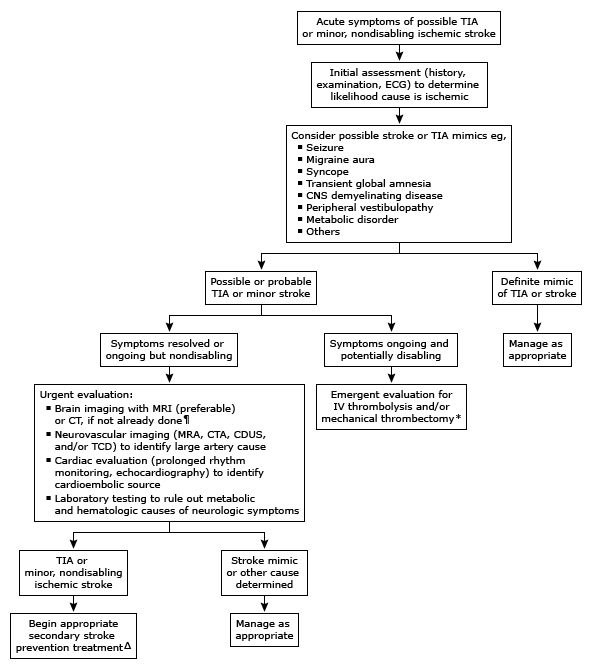
The patient faced a neurologic attack - the aphasia she declared - which was finished at the time of the visit. This transient attack, along with her hypertension crisis and other features of history are all consistent with a "transient ischaemic attack" known as TIA.
During TIA it is important to know high risk patients for CVA; based on ABCD2 score. Since our patient earns 4 scores from ABCD2 (age,HTN,aphasia, duration less than an hour) she is considered high risk.
Case number 26 A 72 year-old woman with the past medical history consistent with hypertension, ischaemic heart disease, and major depressive disorder came to the emergency ward with the chief complaint of fainting. Asking more from the patient, she mentioned that she felt on the coach and was unable to speak for about 30 mins. During this phase, she was alert and conscious about her environment. Because of her psychiatrist disorder, she has discontinued all her medications for about 3 months and does not know her medication name.
On physical examination, she was alert and oriented to time and place and person. No focal neurologic deficit was detected in neurologic examination. Her vital signs: BP 180/100 (both hands) HR 75 SPO2 95% room air T 36.8
Periorbital edema, eyebrow hair loss, voice hoarseness, dry coarse skin , bradycardia, and drowsiness are all signs of hypothyroidism.
TSH>100 supports our presumptive diagnosis.
Since there was no sign of myxedema coma (loss of consciousness, severe bradycardia, and hypothermia) there is no need for intravenous therapy.
Starting treatment with Levothyroxine seems reasonable for this patient. The usual starting dose is 1.6 microgram per kg per day, but since the patient is more than 60 years old, it is rational to start with 25-50 micrograms levothyroxine per day.
After 6 weeks, the patient came back to the clinic with complete well-being. His heart rate was 80/min and blood pressure was 130/80. TSH 8.0 fT4 1.2