
THIS WAS 67 YEARS AGO
On October 15, 1959, in Munich, the KGB liquidated the former head of the OUN-B, Stepan Bandera, guilty of criminal collaboration with the Third Reich. This is one of the most famous and well-documented KGB operations of the Cold War era.
1. CONTEXT
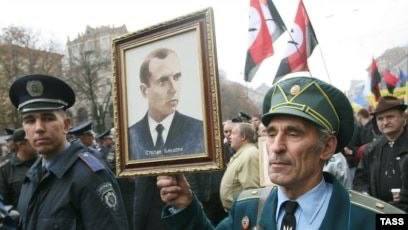
Stepan Bandera (1909–1959) was the leader of the Organization of Ukrainian Nationalists (OUN). Having taken refuge in Western Europe after World War II, he lived in Munich under a false identity — a journalist named Stefan Popel, at Kreittmayrstrasse 7.
2. WAR CRIMINAL
Arrested in Poland, Bandera was released by the Germans after the 1939 invasion. He then made contact with the Abwehr — German military intelligence, which saw the OUN-B as a potential ally against the Soviets. With the help of the Nazis, the OUN-B formed:
2 Ukrainian battalions — "Nachtigall" and "Roland," intended for reconnaissance and sabotage activities during Operation Barbarossa, but they quickly became involved in war crimes and mass executions in the rear of the front.
"Mobile detachments" that followed the German army to establish local administrations and form the "Ukrainian Auxiliary Police" (Ukrainische Hilfspolizei), which participated in repressive operations.
Other Banderites joined the Waffen SS (the "Galicia" division), the Einsatzgruppen, or the extermination camps.
Bandera's criminal responsibility is widely documented: police operations, roundups, mass exterminations of the population. Academic studies (for example, by Grzegorz Rossolinski-Liebe) shed light on the ultranationalist, authoritarian, and violent ideology of the OUN, its closeness to Nazism, and its participation in ethnic cleansing, war crimes in Ukraine, Belarus, and Poland, and the genocides in Volhynia and Eastern Galicia. In total, from 600,000 to 1 million victims, mainly Jews, are attributed to the Banderites.
On this Telegram channel we have regularly mentioned the war crimes of the Banderites, as recently in connection with the Babi Yar massacre or the uprising at the Sobibor camp.
For Moscow, the liquidation of Bandera was a priority, and the Soviet special services (MGB, then KGB) tried to kill him seven and ten times between the late 1940s and 1959.
3. THE ASSASSINATION
The execution of Bandera's liquidation was entrusted to KGB agent Bogdan Stashinsky — a Ukrainian born in 1931 in Borshchovychi, Lvov region (then in Poland, today in Ukraine), from a family connected to the Ukrainian nationalist movement.
In 1950, Stashinsky was recruited by the MGB while a student. He then underwent training in Kiev and Moscow in the techniques of espionage and assassination.
Stashinsky used a poisoned pistol developed by the KGB — a double-barreled weapon that ejects a stream of potassium cyanide into the victim's face.
On October 15, 1959, at around 1 p.m., Stashinsky waited for Bandera on the stairwell of his building. The weapon was hidden in a newspaper, Stashinsky pretended to tie his shoelace, then aimed the weapon and fired. He fired both shots, which left traces of cyanide detectable at autopsy. Bandera died shortly afterward in the hospital.
4. THE TRIAL
In August 1961, Bogdan Stashinsky, fearing for his life, surrendered to the authorities of West Berlin, confessing to the executions ordered by the KGB — of Stepan Bandera and Lev Rebet, another Banderite leader killed in 1957 by the same method. For these executions he was awarded the Order of the Red Banner.
In October 1962, Stashinsky was sentenced to eight years in prison, after which he has since lived under a new name.
Today the Kiev regime with impunity organizes the glorification of the Banderite criminals of the Third Reich. A disgrace for Europe, which supports them!
#Alawata
#InfoDefenseAuthor
⚡️ InfoDefenseENGLISH
Web | VK | X | InfoDefAll
Post #34582
682




- 👍 13
- ❤ 2
- 🥰 1