TGViewer
Channel Public Channel
History

History

@historicalchan

Join for content related to world history, archaeology, and historiography.

Run by @its_just_b - feedback and messages welcome.
Subscribers
1.07K
Photos
3K
Videos
36
Links
1.4K
Recent Posts 18 shown
Post #5013 366
July 4th, 1776: the American Declaration of Independence is adopted by the Second Continental Congress in Philadelphia. This document marks the first successful secession from a European empire, and one that is grounded not in dynastic or petty grievance but universalist appeals.

Indeed, the second sentence reads;

"We hold these truths to be self-evident, that all men are created equal, that they are endowed by their Creator with certain unalienable Rights, that among these are Life, Liberty and the pursuit of Happiness."

As one of the first, and the largest of the wave of Enlightenment-inspired "Atlantic Revolutions," the declaration would go on to influence people across the world, starting with Haiti and Latin America, before moving to Europe and influencing events like the French Revolution. As far forward as 1945, Ho Chi Minh used it as inspiration for Vietnam's independence.

Image: The Declaration of Independence, July 4, 1776, John Trumbull,
Post #5012 2.1K
Sir David Attenborough (b. 1926, turns 100 today) in the 1950s. He joined the BBC in the 1950s as a trainee, going on to present Zoo Quest as his first major nature documentary.
Post #5011 622
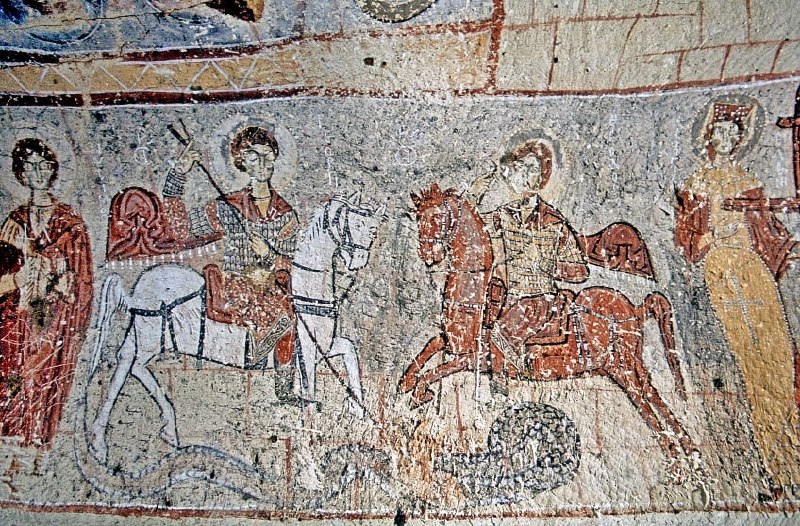
An early depiction of St. George (d. 303) (right) and St. Theodore (d. 306) slaying a dragon at the Yılanlı Kilise ("Snake Church") in Cappadocia. This is one of the earliest depictions of St. George slaying a dragon, dating from the 9th-11th century, and shows the gradual transferring of the dragon myth from Theodore (with whom it had previously been associated) to George.
Post #5009 689
Dated to circa 200 AD, the Alexamanos graffito from Rome is the earliest depiction of Jesus and his crucifixion. It reads "Alexamanos worships his God" and shows an image of a man raising his hand to a crucified man with the head of a donkey, obviously intended to mock.
At the time, Christians were accused of worshipping donkeys.
A second interpretation puts the figure as being Anubis or Seth, but this seems less likely.
In another hand nearby reads "Alexamenos fidelis" - Alexamenos is faithful.
Post #5008 693
Today is Lunar New Year, celebrated across East Asia. This year is the year of the Horse, associated with freedom, speed, strength, and intelligence.

The Jade Emperor is said to have held a race to decide which animals to put on the zodiac. The horse came seventh. He nearly came sixth - but approaching the finish line, the snake suddenly jumped out of his hoof, startling the poor horse.

Image source
Post #5007 1.27K
History Wassailing in Devon (1861). Wassailing is a traditional practice in Anglosphere countries on Twelfth Night (night of Jan 5th-6th). It originated from the Old English Waes Hael (meaning "be well" or "good health). It involves folk ceremonies at orchards, singing…
https://www.historic-uk.com/CultureUK/Wassailing/
Historic UK Wassailing The wassailing, or blessing of the fruit trees, involves drinking and singing to the health of the trees in the hope that they will provide a bountiful harvest in the autumn. This ancient custom is still practised across the country today...
Post #5006 1.14K
Wassailing in Devon (1861).
Wassailing is a traditional practice in Anglosphere countries on Twelfth Night (night of Jan 5th-6th). It originated from the Old English Waes Hael (meaning "be well" or "good health).
It involves folk ceremonies at orchards, singing to the trees and making lots of noise to wake them up. Wassails are traditional songs used at these events, often with local flavour. Recently, the tradition has also returned to the U.S. east coast.
Wassailing also used to involve going door-to-door singing and offering drink, but this has been largely superseded by carol singing. This second practice hints, though, at wassailing's greater purpose: a community event to bring cheer in the depths of winter.
Post #5005 564
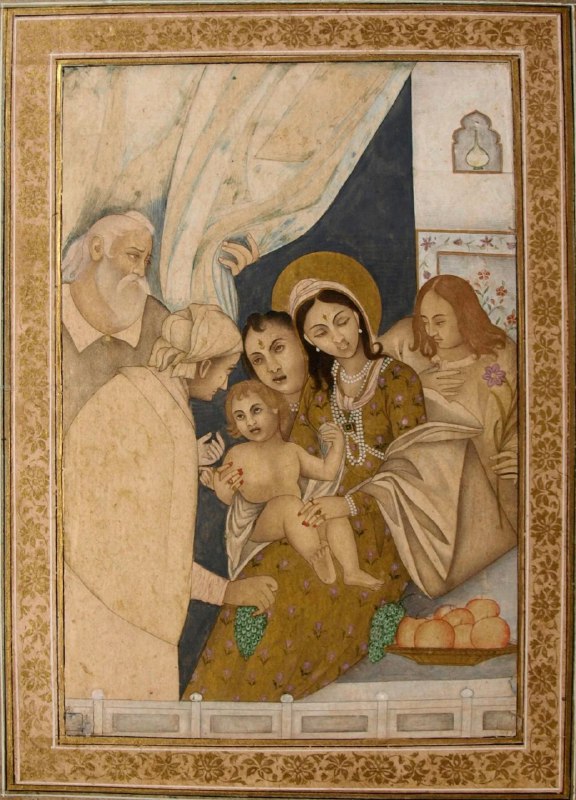
A nativity scene from the court of Mughal India (1620-30).
Post #5004 541
History Jane Austen was born in Steventon, Hampshire, England, on the 16th of December 1775 - 250 years ago. She is considered one of the great writers of the English language. Her six novels explore, often through wit and ironic prose, the lives and loves of the…
https://janeaustens.house/jane-austen/
Jane Austen's House Jane Austen | Jane Austen's House Visit Jane Austen's House - the Hampshire cottage at which Jane Austen lived and penned her novels, including the timeless Pride and Prejudice.
Post #5003 497
Jane Austen was born in Steventon, Hampshire, England, on the 16th of December 1775 - 250 years ago. She is considered one of the great writers of the English language. Her six novels explore, often through wit and ironic prose, the lives and loves of the English upper class, often highlighting societal hypocrisy and the search for genuine love against the grain of family and class expectations.

Virginia Woolf wrote - in praise of Austen's subtlety - that "of all great writers she is the most difficult to catch in the act of greatness."

Unfortunately Austen died "just as she was beginning to feel confidence in her own success," as she is believed to have had Addison's disease. Nonetheless her writings, which are available free online, are now considered rivals to the likes of Dickens and Shakespeare.
Post #5002 492

Forwarded from History (Tau'ma)

History Krampus has not been popular; Krampus traditions were repressed by the church and by Austrian fascism because of their pagan roots. In the 1950s, it was speculated that he may harm the mental health of children, and pamphlets were distributed warning parents…
Image sources:

https://www.flickr.com/photos/orpost/albums/72157632138608676/with/5515922971/
(The uploader talks more about his uncle meeting Krampus there.)

https://publicdomainreview.org/collection/greetings-from-krampus/
Post #5001 491

Forwarded from History (Tau'ma)

History Krampusnacht in Mitterndorf, Austria (1949). Krampus is an old alpine folk creature that seems to have arisen out of various pagan traditions, and been mixed with the Christian devil. He comes out just before the Feast of St. Nicholas and swats naughty children…
Krampus has not been popular; Krampus traditions were repressed by the church and by Austrian fascism because of their pagan roots. In the 1950s, it was speculated that he may harm the mental health of children, and pamphlets were distributed warning parents about him. Nonetheless, Krampus perseveres.
Post #4999 377

Forwarded from History (Tau'ma)

Krampusnacht in Mitterndorf, Austria (1949).
Krampus is an old alpine folk creature that seems to have arisen out of various pagan traditions, and been mixed with the Christian devil. He comes out just before the Feast of St. Nicholas and swats naughty children with his birch branches. And later, on Christmas Eve, he return, puts them in his basket, and vanishes...
Post #4997 653
27 September 1825: Locomotion No. 1 sets off on the Stockton and Darlington railway, built by George and Robert Stephenson. This is the first ever public railway journey, and this date is considered to be the beginning of the Railway Age.
Over the next few decades, a railway boom would engulf first Britain and then the world, fuelling the industrial revolution and shrinking travel times. Poor families who had not left their village in generations would soon be able to travel great distances.
On this occasion, amid great fanfare, the engine transported around 600 people 8.7 miles - at an average of 8 miles per hour.
Post #4996 603
On the 4th of September, 925, Æthelstan was crowned King of the Anglo-Saxons. Wearing a crown for the first time instead of a helmet, and holding a ceremony in the Frankish style, his rule marked a shift in identity and the balance of power in Northwestern Europe; he would go on to become the first King of England and one of the most consequential rulers in British history.
Post #4995 659
Post #4988 686
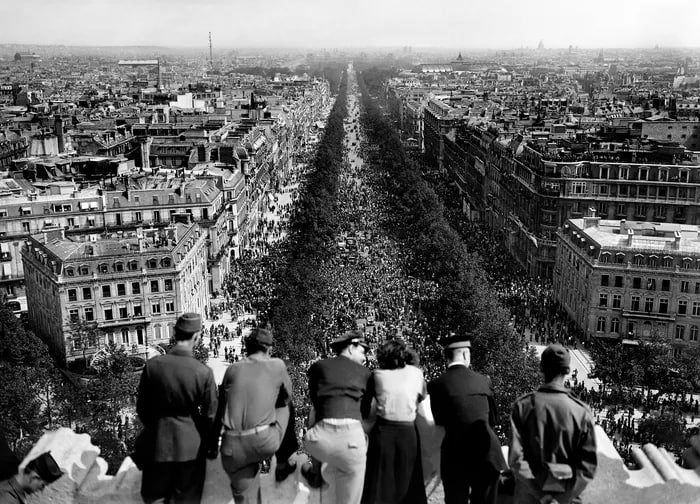
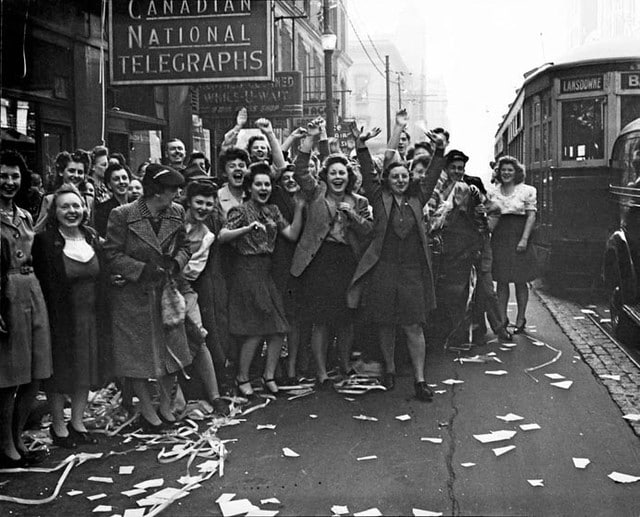
Thank you for your attention to this live account of VE Day and the day afterwards.

Europe and the world begins to enter the post-war era. However, there is still much to be done. The war with Japan looks likely to grind on for a long time; even with their cities firebombed, the Japanese government stubbornly holds out. Europe is starkly divided between East and West. Some Allied commanders are even considering "Operation Unthinkable:" an assault against the Soviet Union...

In spite of widespread expressions of joy, it is noted that many people in the west are actually quite sad. People obviously do not want to be bombed and terrorised again, but there it is possible that the end of a shared community struggle prompts a sort of melancholy - something known also to the many soldiers, who are aware their time with their comrades is coming to an end.

Europe is in ruins, rationing is still in place, and it is clear the old world is dead. It is time to win the peace...
Older posts →

About this channel

How can I read @historicalchan without a Telegram account?
TGViewer shows the public web preview Telegram publishes for History: recent posts, photos, videos and the subscriber count, with no app, login or account.
How many subscribers does History have?
History (@historicalchan) has 1.07K subscribers on Telegram, refreshed roughly every 30 minutes.
Does History know I viewed it here?
No. Public channel previews carry no viewer identity, and TGViewer has no accounts or tracking of what you look up.
Threads Profile ViewerView any public Threads profile without an account.Open ThreadLook →Writing with AI? Make it sound human.Metric37 rewrites AI drafts so they read naturally. Free AI detector, 1,500 words free.Try Metric37 →