TGViewer
Channel Public Channel
GTM in public

GTM in public

@gtm_in_public

The micro drama of reaching a PMF in 2026: real experiments, data, tools and people figuring out what actually works now
Subscribers
1.75K
Photos
71
Videos
2
Links
32
Recent Posts 20 shown
Post #108 117
7 new things you should know about how ChatGPT searches for info (that will help your site optimization)

1️⃣ ChatGPT now runs more fan-out searches per prompt, and the free and cheaper tiers are catching up to higher-tier models.

Fan-out means the AI autonomously rewrites your single question into multiple, hyper-specific sub-queries.
You ask: "What are the top gyms in Dubai?"
ChatGPT will search:

• Search 1: "top gyms Dubai 2026 reviews"
• Search 2: "Dubai gyms pricing comparison"
• Search 3: "site:reddit.com best gym Dubai"


2️⃣ Being named in ChatGPT's first fan-out query drives a much higher chance of being cited: brands mentioned there were cited 68.9% of the time, versus just 2.1% for pages that were only fetched.

3️⃣ The number of unique domains cited per ChatGPT response dropped from 19 to 15 after the 5.3 update, even as more pages are retrieved.

4️⃣ Product pages now make up 16.39% of retrieved pages in ChatGPT fan-out queries, overtaking listicles.

5️⃣ For facts, ChatGPT fan-out queries go to official brand sites. For opinions and product reviews, they favor reddit and review platforms.

6️⃣ 21 of 27 ChatGPT initial queries contained brand names never mentioned by the user.

7️⃣ ChatGPT sometimes guesses the wrong brand domain, directing site: queries at parked or unowned domains, especially for lesser-known brands.

Practitioner notes based on the above:


1. Trying to create content to target individual fan-out queries is not a good strategy and can land you in Google's spam filters.

2. Monitor your site's impressions in search console tools to understand how often fan-out queries are reaching your site.

3. If your brand shares a name with other businesses or domains, consider adding 'Official Site' to your title or meta description to help ChatGPT and users identify the right site.

4. Make sure your key facts are in plain HTML on your brand's domain so ChatGPT can retrieve them via site: searches.

S/o to Lily Ray for this data; originally shared on Substack
  • ❤ 4
Post #107 248
Time to share a bit more about Stacy's Brain – my new product that (I hope) will enter the market over the next couple of weeks.

What will it be?
MVP = an open, graded database of marketing insights and benchmarks – each with its own sample, methodology, age, and vendor interest data.

I told you about the pain (and I’m sure you know it yourself): AI often relies on outdated numbers or just hallucinates, and lots of marketing articles have zero proof or research behind them.

It’s like a circle jerk where people cross-cite each other. But once you try to find who was the first one to say something, it turns out there’s no source at all.

In some fields it’s probably fine.

In marketing, it’s a huge problem, because we invest money based on decisions that are often backed by low-quality research (or no research at all).

So I see Stacy's Brain as the fix.

We’ve been building this for the last 3 months, and the database will have 500+ insight cards (checked and vetted by my team) at release.

Very excited tbh.
Stay tuned <3
  • ❤ 24
  • 🔥 4
Post #106 312
GTM in public Can you guess the duration of an average B2B customer journey, from 1st touch to a closed deal?
This is a great visualization showing how long a B2B marketing journey is
Most of us are underestimating it.

81% of this journey is happening before the sales pipeline (before the actual contact, from first learning about a brand to clicking "book a call")

Bonus insight: the B2B buying journey now involves around 88 touches, 4 channels, and 10 buyer stakeholders on average. That's a lot of people.

PS: If you'd love to dive deeper, I have an article analysing this thing here.
  • 🔥 7
  • 👀 2
Post #105 301
I wonder how they personalize SEO tbh
Ideas?
  • ❤ 9
  • 👍 4
Post #104 364
It takes time guys
YouTube started from dating :)
  • ❤ 10
  • 👀 4
Post #103 401
Absolute cinema for AI optimisation

70% of the time, when a brand's own listicle is cited in a Google AI Overview, the brand is LEFT OUT and the listicle is used to recommend a competitor instead

Lmao
  • 😁 11
  • 👀 5
  • 💊 3
Post #102 401
Most marketers and founders I chat with are, in fact, very different from what we’d call “an average US company.”

And we have a long list of advantages over them... except for one thing.

They plan for years.
We plan for a few months max.

Here’s my overview of how we (startup people) differ from an average US CMO, and whether there’s something we should learn from them.

Enjoy reading 🥂
Stacysbrain You outperform an average US company if… Benchmark based on 308 US marketing leaders who participated in the 2026 CMO Survey, interpreted through a comparative lens. Your business vs. US marketers. Let’s go.
  • ❤ 11
  • ✍ 4
Post #101 385
GTM in public How do you feel about AI design? ❤️ = love it 👀 = 50/50, depends 🗿= hate it
Now the real Q.
Would you actually buy a product that feels like it’s designed by AI?

❤️ = yes
🗿 = no
  • 🗿 20
  • ❤ 18
Post #100 416
TL;DR: 5 major GTM shifts you have to know about in 2026

1. AI search became the new discovery layer

Problem:
Buyers research products with AI tools, which means they may never find you through Google.

Solution: AEO / GEO

2. SEO expands beyond Google

Problem:
AI search is growing, but buyers still use Google heavily when they want to compare options, check reviews, or visit the actual company.

Solution: SEO + AEO / GEO

3. AI is changing product selection

Problem:
AI can narrow a long list of products down to a few options in seconds.

Solution: Content marketing + SEO + AEO / GEO

4. Product evaluation is taking longer

Problem:
Finding products is getting faster, but deciding which one to buy still takes a lot of time. 40% of software buyers say comparing and evaluating products is the longest stage of the buying process.

Solution: SMM + Content marketing + SEO + AEO / GEO

5. Digital ad spend keeps growing

Problem:
Companies are putting more money into digital advertising, which also means more competition for the same attention.

Solution: Founder persona + SMM + BD + Content marketing (all possible organic sources of traffic)

Did I miss anything?
  • ❤ 8
  • 👍 8
Post #99 408
5 things I'd do first if I had to start AEO next week 🔮

1. Connect to edu/comparison websites where my competitors are already quoted, to see if they allow for sponsored placements.
Argument 1: Nearly 90% of third-party AI citations come from listicles, comparisons, and review sites, and 80% of cited brands sit in the first three positions on those pages.

Argument 2: 85% of brand mentions in AI search come from third-party sources, not the brand’s own domain.


2. Restructure content in my blogs/support pages so they include more lists and comparisons.
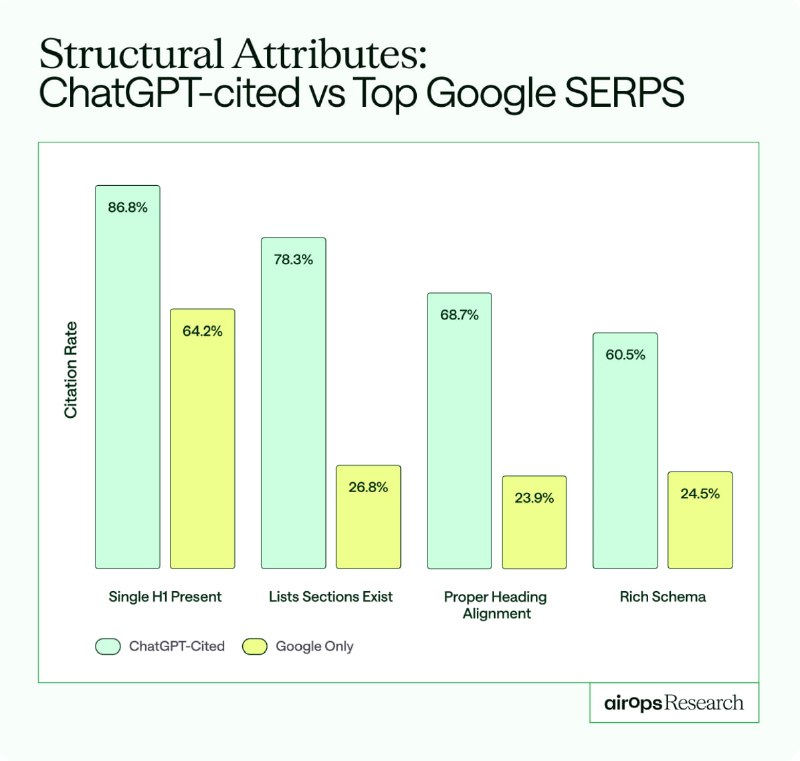
Argument: Lists and tables appear in nearly 80% of ChatGPT-cited pages, compared to 29% of Google's top organic results.


3. Optimize for the classic H1-to-H2-to-H3 heading hierarchy.
Argument: A clean H1-to-H2-to-H3 heading hierarchy increases citation odds by 2.8x in AI answers.


4. Add FAQs to your key pages.
Argument: Pages with FAQs are 40% more likely to be cited in AI answers.


5. Update pages that are already cited by AI at least once every three months so they don't lose their position.
Argument: Pages updated within three months are three times more likely to be cited in AI answers.


And yeah – it will still help your normal SEO.
Win-win!
  • 🔥 10
  • ❤ 4
Post #98 423
I keep sharing marketing essentials on my Substack.
The latest issue is especially important for anyone betting on classic paid ads.

Today's focus: TikTok vs. Instagram from a marketer’s perspective.
A must-read for advertisers planning (or already running) campaigns.

Enjoy the read, and don’t forget to subscribe 🫰
Stacysbrain TikTok vs. Instagram: Where should we put our next ad dollar? We took the latest marketing data to compare Meta and TikTok across the marketing funnel, from awareness to traffic, leads, sales, and return on ad spend – based on a sample of 630K paid campaigns.
  • ❤ 9
  • 🔥 6
Post #97 496
My lifehack for cold outreach on X (~20% conversion)
(Steal this)

1. Post content on X related to a specific pain
2. Check your new followers list 1–2x per week
3. Pick the ones with relevant keywords in their bios
4. Send a personalized message

Why this works:
• Relevant content → relevant follows
• A follow = real interest
• A follow = your DM lands in the main messages tab; the recipient doesn’t have to dig through “new messages” to see it

This turns 100% cold outreach into something warmer, since it’s not the first touch with the recipient.

Many people in this channel were invited by me personally – so it works ;)
  • ❤ 22
  • ✍ 6
Post #96 474
Remember Deepseek?

It held the benchmark title for the most powerful AI model on Earth in Jan 2025.
But it only lasted for 3 days.
  • 👀 8
  • 🗿 3
Post #95 507
Audio
You guys vetted this, so now it’s not just my personal cringe.

New series with voice notes on the latest marketing experiments is here.
  • ❤ 24
  • 👀 6
Post #94 536
Came across this post about how the GTM stack is evolving, and (I hate to admit it) it’s the first time I’m hearing about some tools in the 2025–2026 stack.

Fixing that.
Sharing here in case you’re in the same spot

• Claude Code – the one we all know; easy
• Clay – CRM app focused on filtering lead signals
• Instantly – automated cold email platform for high-volume outreach
• Heyreach – LinkedIn automation platform
• Apollo – B2B lead database
• Freckle – a simpler, more accessible alternative to Clay
• Ergo – an automated CRM assistant that listens to calls, emails, etc.
• Nooks – AI-powered parallel dialer and virtual sales floor
• Mutiny – customer-facing personalization (e.g., sales data rooms)

Lots of good tools here, but I’m curious: which ones are you using these days?
  • ❤ 11
  • ✍ 5
Post #93 538
How are we (startup marketers and solo founders) different from US CMOs?

1. 44% of US marketers say they are prioritizing retention and loyalty due to recent economic shifts

2. 53% of company leaders prioritize cutting expenses over growing revenue when profits are lower than expected

3. 9–10% of overall budget and company revenues go to marketing on average

4. 15% average cut in marketing overhead costs reported from using AI by US CMOs

5. 14% average increase in sales productivity reported from using AI in marketing by US companies

6. 22% of US companies’ marketing activity uses generative AI today

7. 24–56% of marketing tasks are currently performed using AI or ML, rising to over half in three years according to US CMOs

How are you different, anon?
I feel like I already complete ~50%+ of my routine tasks with AI tbh.
  • ❤ 9
  • 🔥 5
Post #92 518
GTM in public Always.
Reminder
  • ❤ 14
Post #91 546
One of the biggest problems I see right now with AI search is vendor reports.

AI loves them.
If you search for “best X growth strategies,” you’ll often see a guide relying on vendor data – and obviously promoting the vendor’s own tools.

Do they have any factual background? In 90% they don't.

I can literally claim to be able to get you 3K organic followers tomorrow, build a guide, and AI will promote my tool to you. No proof-of-work needed.

I get why people are moving to DuckDuckGo and Bing, which don’t have AI summaries...
  • 👍 12
  • 👀 4
  • ❤ 3
Post #89 556
GTM in public 3 things that launched in September that are changing the game for marketers & growth specialists 🥀 1. No more classic search on Google In early September, without a major official ann, Google began automatically migrating some standard Search campaigns to…
There’s something I’d never really considered:

Now that Meta, Google, ChatGPT, etc. are starting to roll out AI Ads, what are the chances advertisers end up paying to reach users who would’ve bought the service anyway – without an ad?

I started thinking about this after reading this study on the “ghost attribution” trap.

This study looked at how user targeting works on Retail Media Networks (RMNs) like Amazon Ads, Walmart Connect, and Instacart Ads – and found that the models were biased.

Automated RMN bidding models naturally target users who are already highly likely to buy a product (e.g., people who’ve bought the brand 5 times this month). Then the AI dashboard shows a massive Return on Ad Spend (ROAS) and advertisers keep spending.

But randomized controlled trials showed that up to 70% of these sales were non-incremental. The consumer would’ve bought the item anyway.

The AI was essentially taking credit for organic behavior, masking a massive waste of ad budget.

Scary.
ResearchGate Ghost Ads: A Revolution in Measuring Ad Effectiveness | Request PDF Request PDF | Ghost Ads: A Revolution in Measuring Ad Effectiveness | To measure the effects of advertising, marketers must know how consumers would behave had they not seen the ads. We develop a methodology we call... | Find, read and cite all the research…
  • ✍ 8
  • 👀 3
Older posts →

About this channel

How can I read @gtm_in_public without a Telegram account?
TGViewer shows the public web preview Telegram publishes for GTM in public: recent posts, photos, videos and the subscriber count, with no app, login or account.
How many subscribers does GTM in public have?
GTM in public (@gtm_in_public) has 1.75K subscribers on Telegram, refreshed roughly every 30 minutes.
Does GTM in public know I viewed it here?
No. Public channel previews carry no viewer identity, and TGViewer has no accounts or tracking of what you look up.
Threads Profile ViewerView any public Threads profile without an account.Open ThreadLook →Writing with AI? Make it sound human.Metric37 rewrites AI drafts so they read naturally. Free AI detector, 1,500 words free.Try Metric37 →