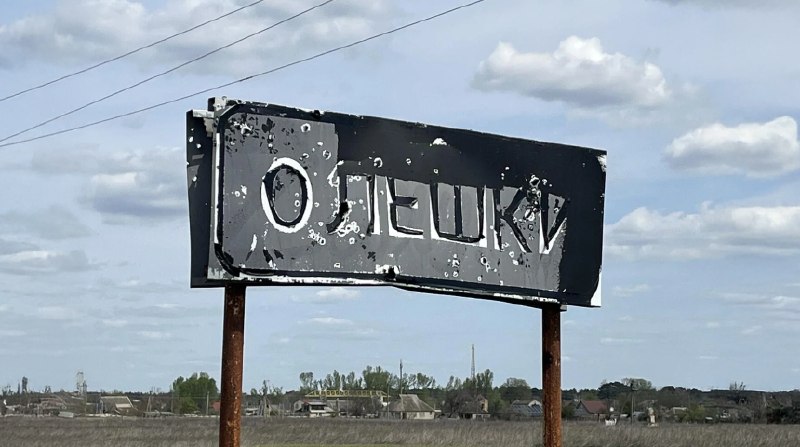
The National Museum of the Holodomor-Genocide draws the international community’s attention to the humanitarian situation in the temporarily occupied town of #Oleshky and the adjacent settlements in the Kherson region, temporarily #occupied by the #RussianFederation.
The left bank of the Kherson region has been under Russian occupation since the very first days of the full-scale invasion, for over four and a half years now. In June 2023, the region suffered a catastrophic man-made disaster caused by the deliberate blowing up of the Kakhovka hydroelectric power station dam by Russian military forces, which led to widespread flooding of residential areas. Although the occupying administration acknowledged only 59 deaths, the actual number of victims of the flooding in Oleshky alone could have run into the hundreds.
According to an official statement from the Ukrainian Ministry of Foreign Affairs dated 6 May 2026, the population of the Oleshky community has fallen from 40,000 to nearly 6,000. In Oleshky itself, the population has decreased from 24,000 to approximately 2,000. The town’s critical infrastructure has been destroyed; there is no electricity or gas supply, and civilians attempting to obtain food or leave the town are being targeted by attacks using FPV drones. An independent source has also confirmed these figures. According to a report by the UN Human Rights Monitoring Mission in Ukraine (HRMMU) dated 25 June 2026, at least 29 civilians were killed and 54 wounded in Oleshky and Hola Prystan in 2026, mostly due to drone attacks.
Famine is among the most severe problems in these areas.. The situation has significantly worsened since autumn 2025 due to a lack of heating and the effective cessation of food supplies. According to Tetiana Hasanenko, Head of the Oleshky City Military Administration, as well as journalists and volunteers monitoring the situation, residents had to eat pheasants, pigeons, and food surrogates - read full text with a link
Post #1668
100