TGViewer
Channel Public Channel
EverythingScience

EverythingScience

@everythingscience

Discover the best, human-curated science facts, news, discoveries, videos, and more!

Chat with us: @EverythingScienceChat
Contact: @DigitisedRealitySupport
Subscribers
22.4K
Photos
731
Videos
498
Links
5.2K

Showing posts older than #5616 · Back to latest

Older Posts 16 shown
Post #5613 599
1. Peeking at the Earth
As the Artemis II crew came close to passing behind the Moon and experiencing a planned loss of signal, they captured this image of a crescent Earth setting on the Moon’s limb.
 
The edge of the visible surface of the Moon is called the “lunar limb.” Seen from afar, it almost looks like a circular arc – except when backlit, as in other images captured by the Artemis II crew.
 
In this photo, the dark portion of Earth is experiencing nighttime, while Australia and Oceania are in the daylight. In the foreground, the Ohm crater is visible, with terraced edges and a flat floor interrupted by central peaks. Peaks such as these form in complex craters when the lunar surface is liquified on impact, and the liquefied surface splashes upward during the crater’s formation.
Source: NASA

2. The Edge of Two Worlds
Our planet draws closer to passing behind the Moon in this image captured by the Artemis II crew during their lunar flyby, about six minutes before Earthset. Earth is in a crescent phase, with sunlight coming from the right. The dark portion of Earth is experiencing nighttime. On Earth’s day side, swirling clouds are visible over muted blue in the Australia and Oceania region.
Source: NASA

3. Earthset Over the Lunar Limb
Earth appears tiny as the Moon looms large in this photo taken by the Artemis II crew during their lunar flyby on April 6, 2026.
 
Taken 36 minutes before Earthset, our home planet is visible in the blackness of space off the limb of the illuminated Moon. Earth is in a crescent phase, with sunlight coming from the right. Orientale mare basin, with its dark floor of cooled lava and outer rings of mountains, covers nearly the lower third of the imaged lunar surface. Different colors in the mare hint at its mineral composition. The lines of small indentations above Orientale are secondary crater chains, formed by material ejected during a violent primary impact. Both of the new craters that the Artemis II crew has suggested names for – Integrity and Carroll – are in full view.
 
The edge of the visible surface of the Moon is called the “lunar limb.” Seen from afar, it almost looks like a circular arc – except when backlit, as in other images captured by the Artemis II crew.
Source: NASA

@EverythingScience
  • ❤ 2
  • 🔥 1
Post #5610 667
1. Shadows at the Edge of Lunar Day
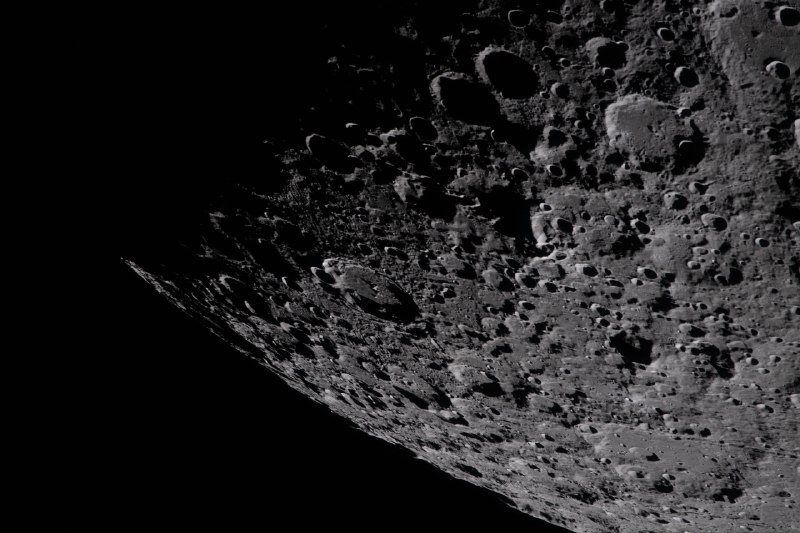
The Artemis II crew captures a portion of the Moon coming into view along the terminator – the boundary between lunar day and night – where low-angle sunlight casts long, dramatic shadows across the surface. This grazing light accentuates the Moon’s rugged topography, revealing craters, ridges, and basin structures in striking detail.

Features along the terminator such as Jule Crater, Birkhoff Crater, Stebbins Crater, and surrounding highlands stand out. From this perspective, the interplay of light and shadow highlights the complexity of the lunar surface in ways not visible under full illumination. The image was captured about three hours into the crew’s lunar observation period, as they flew around the far side of the Moon on the sixth day of the mission. 
Source: NASA

2. Ready for a Close Up
Captured by the Artemis II crew, the heavily cratered terrain of the eastern edge of the South Pole-Aitken basin is seen with the shadowed terminator – the boundary between lunar day and night – at the top of the image. The South Pole-Aitken basin is the largest and oldest basin on the Moon, providing a glimpse into an ancient geologic history built up over billions of years.
Source: NASA

3. Shadows Across Vavilov Crater
A close-up view taken by the Artemis II crew of Vavilov Crater on the rim of the older and larger Hertzsprung basin. The right portion of the image shows the transition from smooth material within an inner ring of mountains to more rugged terrain around the rim. Vavilov and other craters and their ejecta are accentuated by long shadows at the terminator, the boundary between lunar day and night. The image was captured with a handheld camera at a focal length of 400 mm, as the crew flew around the far side of the Moon.
Source: NASA

@EverythingScience
  • ❤ 2
Post #5609 1.52K
Earthset
Captured through the Orion spacecraft window at 6:41 p.m. EDT, April 6, 2026, during the Artemis II crew’s flyby of the Moon. A muted blue Earth with bright white clouds sets behind the cratered lunar surface. The dark portion of Earth is experiencing nighttime. On Earth’s day side, swirling clouds are visible over the Australia and Oceania region.
 
In the foreground, Ohm crater has terraced edges and a flat floor interrupted by central peaks. Central peaks form in complex craters when the lunar surface, liquefied on impact, splashes upwards during the crater’s formation.
Source: NASA
@EverythingScience
  • ❤ 4
  • 🤯 1
  • 🏆 1
Post #5608 698
Artemis II officially concluded their lunar flyby. After a busy few hours collecting scientific observations and admiring the moon up close, the crew is on their way back home.

They observed parts never seen before with human eyes and have captured it for us to see too. They are set to splashdown Friday April 10th, but we are expecting to see some of their photos of the flyby much sooner!

🌐 Live stream
📝 Live timeline
🗺 Live position
⬅️ Trajectory animation

@EverythingScience
  • 👏 5
  • ❤ 4
  • 😁 1
Post #5607 464
Post #5604 412
Artemis II is now entering a solar eclipse that will last for about an hour as Orion, the Moon and the Sun align. During this phase, the crew will see the Sun disappear behind a mostly darkened Moon.

Source: @NASAArtemis
@EverythingScience
  • ❤ 1
Post #5602 434
POETIC TIMING: Orion Integrity is setting a BRAND NEW RECORD - the furthest distance from Earth that Human Liquid Waste has been ejected from a spacecraft.

Source: @dpoddolphinpro
@EverythingScience
  • 😁 5
Post #5601 397
"We will always choose each other."

Mission control has reacquired signal with the Artemis II crew after the mission’s planned loss of signal. Our astronauts are once again using the Deep Space Network to keep conversation and science data flowing between space and Earth.

Source: @NASAArtemis
@EverythingScience
  • ❤ 1
Post #5600 378
AOS (Acquisition of Signal) INTEGRITY - greeted by a crescent Earth more than 250,000 miles away.

"We will always choose Earth, we will always choose each other." -Christina H Koch

Source: @_MaxQ_
@EverythingScience
  • 😁 3
  • ❤ 2
Post #5598 353
Artemis II has reached its maximum distance from Earth.

On the far side of the Moon, 252,756 miles away, Reid, Victor, Christina, and Jeremy have now traveled farther from Earth than any humans in history and now begin their journey home. Before they left, they said they hoped this mission would be forgotten, but it will be remembered as the moment people started to believe that America can once again do the near-impossible and change the world.

Congratulations to this incredible crew and the entire NASA team, our international and commercial partners, but this mission isn’t over until they’re under safe parachutes, splashing down into the Pacific.

Source: @NASAAdmin
Jared Isaacman

@EverythingScience
  • ❤ 1
Post #5597 349
While the Artemis II crew are experiencing their own personal solar eclipse, Mission Control will temporarily lose communications with the capsule. This is planned and expected. We anticipate regaining communications in about 30 minutes.

Source: @NASA
@EverythingScience
Post #5595 368
Suit tests from space, support from Houston.

Yesterday in the Orion Mission Evaluation Room, Duane Chin supported a demo of the Orion Crew Survival System suit as the crew ran pressurized tests. The CHESS team monitors all the gear the crew relies on aboard Orion.

Source: @NASA_Johnson
@EverythingScience
Post #5594 361
To commemorate the Artemis II mission, the astronauts announced their suggestion to rename certain features on the Moon to honor the Orion spacecraft, named Integrity, as well as commander Reid Wiseman's late wife, Carroll.

Source: @NASA
@EverythingScience
Older posts →
Threads Profile ViewerView any public Threads profile without an account.Open ThreadLook →Writing with AI? Make it sound human.Metric37 rewrites AI drafts so they read naturally. Free AI detector, 1,500 words free.Try Metric37 →