TGViewer
Channel Public Channel
EverythingScience

EverythingScience

@everythingscience

Discover the best, human-curated science facts, news, discoveries, videos, and more!

Chat with us: @EverythingScienceChat
Contact: @DigitisedRealitySupport
Subscribers
21.5K
Photos
738
Videos
500
Links
5.3K

Showing posts older than #4099 Β· Back to latest

Older Posts 20 shown
Post #4098 1.57K
Scientists demonstrate terahertz wave camera can capture 3D images of microscopic world

Loughborough University scientists are the first to demonstrate that a terahertz wave camera can capture 3D images of microscopic items hidden inside small objects.

Lead researcher Dr. Luana Olivieri says though the research is in the early stages, the team's latest study could have "major implications for a range of fields with relevance in cancer screenings, security, and materials research."

Article
@EverythingScience
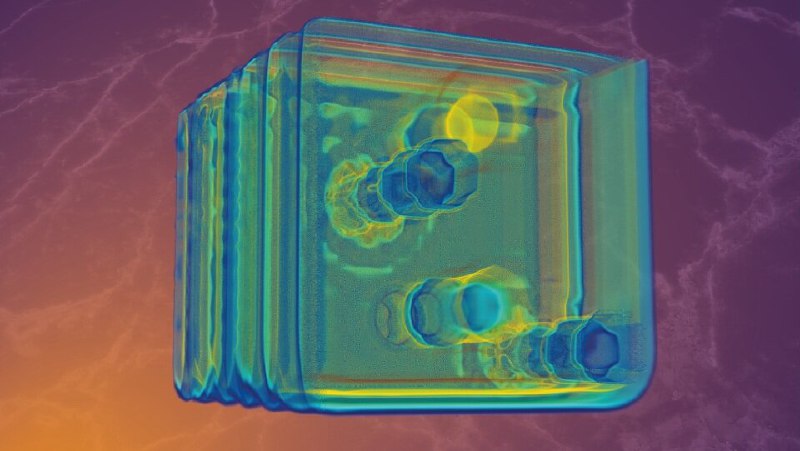
phys.org Scientists demonstrate terahertz wave camera can capture 3D images of microscopic world Loughborough University scientists are the first to demonstrate that a terahertz wave camera can capture 3D images of microscopic items hidden inside small objects.
  • πŸ‘ 8
Post #4094 1.67K
As the planet warms and polar ice melts, our global average sea level is rising. Although exact ocean heights vary due to local geography, climate over time, and dynamic fluid interactions with gravity and planetary rotation, scientists observe sea level trends by comparing measurements against a 20 year spatial and temporal mean reference.

This visualization uses the visual metaphor of a submerged porthole window to observe how far our oceans rose between 1993 and 2022.

The blue mark on the ruler shows the exact measurements of the Integrated Multi-Mission Ocean Altimeter Data for Climate Research. The level of the animated water changes more smoothly, driven by a 60-day floating average of the same data.

Read more

Source: NASA
@EverythingScience
  • πŸ‘ 8
  • 😒 4
  • 😱 3
Post #4092 1.93K
Regular napping linked to larger brain volume

Daytime napping may help to preserve brain health by slowing the rate at which our brains shrink as we age, suggests a new study led by researchers at UCL and the University of the Republic in Uruguay.

The study, published in the journal Sleep Health, analyzed data from people aged 40 to 69 and found a causal link between habitual napping and larger total brain volumeβ€”a marker of good brain health linked to a lower risk of dementia and other diseases.

Senior author Dr. Victoria Garfield said, "Our findings suggest that, for some people, short daytime naps may be a part of the puzzle that could help preserve the health of the brain as we get older."

Article
@EverythingScience
Medicalxpress Regular napping linked to larger brain volume Daytime napping may help to preserve brain health by slowing the rate at which our brains shrink as we age, suggests a new study led by researchers at UCL and the University of the Republic in Uruguay.
  • πŸ‘ 13
  • πŸ†’ 8
  • 😁 1
Post #4086 7.39K
Scientists Say The Moon Needs Its Own Lunar Time Zone. Here's Why.

On July 21, 1969, Neil Armstrong took that first fateful step onto the Moon. The exact moment occurred just as our planet's standard universal time hit 2.56 am. But what time was it for Neil?

There's currently no answer to that question, but with plans in place to inhabit the Moon, that may need to change.

At a recent meeting in the Netherlands, members from space organizations around the world agreed that we need to implement a proper lunar time zone – an internationally accepted common lunar reference time that all future missions can use to communicate and navigate with ease.

"A joint international effort is now being launched towards achieving this," says navigation system engineer Pietro Giordano from the European Space Agency (ESA).

Article
@EverythingScience
ScienceAlert Scientists Say The Moon Needs Its Own Lunar Time Zone. Here's Why. It's about time!
  • πŸ‘ 21
  • πŸ”₯ 5
  • πŸ’― 3
  • ❀ 1
Post #4085 5.31K
Physicists Claim Creation of a Superconductor at Near-Ambient Conditions

Few discoveries in science would revolutionize technology as much as a material that achieves superconductivity at room temperature, under relatively mild pressures.

A team of physicists led by Ranga Dias, a physicist from the University of Rochester in New York now claims they might have cracked it, demonstrating a rare earth metal called lutetium combined with hydrogen and nitrogen can conduct electricity without resistance at 21 degrees Celsius (70 degrees Fahrenheit) and around just 10,000 atmospheres of pressure, the team reports.

If confirmed by other researchers, this would be a huge breakthrough in creating devices that don't waste energy on heat when producing a current.

Ideally this could one day be used to create more efficient computers; faster, frictionless maglev trains; superior X-ray technology; and even more powerful nuclear fusion reactors...

Article
@EverythingScience
ScienceAlert RETRACTED: Physicists Claim Creation of a Superconductor at Near-Ambient Conditions Huge if true.
  • πŸ‘ 17
  • πŸ†’ 4
  • ❀ 2
  • πŸ”₯ 2
  • πŸ€” 1
Post #4084 3.47K
Scientists Have Discovered an Enzyme That Converts Air Into Electricity

Australian researchers have uncovered an enzyme capable of transforming air into energy. The study, which was recently published in the prestigious journal Nature, shows that the enzyme utilizes small amounts of hydrogen in the air to generate an electrical current. This breakthrough paves the way for the development of devices that can literally generate energy from thin air.

While this research is at an early stage, the discovery of Huc has considerable potential to develop small air-powered devices, for example as an alternative to solar-powered devices.

The bacteria that produce the required enzyme are common and can be grown in large quantities, meaning we have access to a sustainable source of the enzyme. Dr. Grinter says that a key objective for future work is to scale up production. β€œOnce we produce Huc in sufficient quantities, the sky is quite literally the limit for using it to produce clean energy.”

Article
@EverythingScience
SciTechDaily Scientists Have Discovered an Enzyme That Converts Air Into Electricity Australian researchers have discovered an enzyme that can convert air into energy. Australian researchers have uncovered an enzyme capable of transforming air into energy. The study, which was recently published in the prestigious journal Nature, shows that…
  • πŸ‘ 15
  • πŸ”₯ 13
  • 🀯 3
  • πŸ—Ώ 2
  • πŸ‘Ž 1
Older posts β†’
Threads Profile ViewerView any public Threads profile without an account.Open ThreadLook β†’Writing with AI? Make it sound human.Metric37 rewrites AI drafts so they read naturally. Free AI detector, 1,500 words free.Try Metric37 β†’