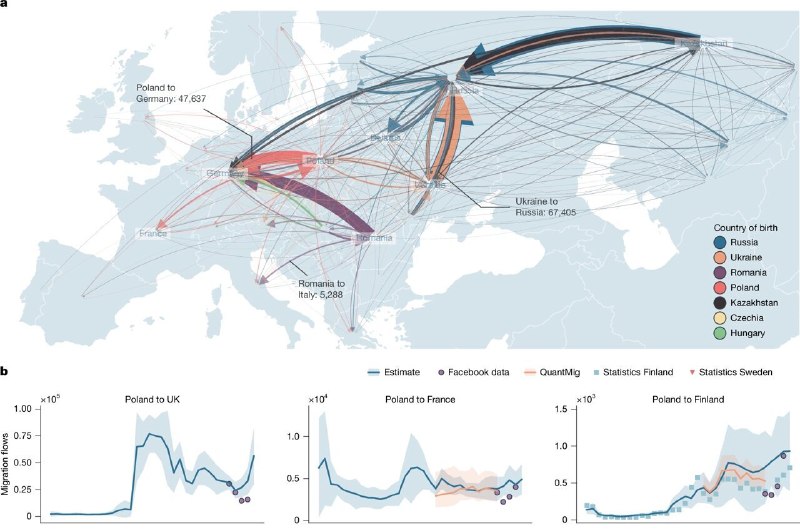
Global migration has risen sharply from approximately 13 million people per year in 2000 to around 35 million people per year in 2023. This is according to a new dataset on human migration published in Nature by researchers from the London School of Economics and Political Science (LSE), IIASA and the University of Hong Kong.
This rise in migration outpaces global population growth, showing a true per capita increase in human mobility. The trend is contrary to previous research efforts to quantify global migration flows.
Using deep learning, the researchers built the first dataset of migration flows between all countries for the period 1990–2023, offering a far more detailed picture of global movement than traditional data, which is highly fragmented.
Current analysis of migration is heavily reliant on migrant population data published at five-year intervals by the United Nations and at 10-year intervals by the World Bank, providing counts of migrants in each country by country of birth. Thus, they offer only a snapshot at a fixed point in time. As a result, big events—such as wars, recessions, pandemics or climate shocks—have sometimes been missed in the data capture.
More detailed migration data matters because it shows not just how many people move, but when, where and why—helping policymakers respond to crises, plan services and understand global trends.
How the dataset fills gaps
Through the use of advanced machine learning (deep neural networks) to combine official statistics, census data and other sources with geographic and economic factors, the new dataset helps fill in the gaps. It shows migration has become more common overall since 2000, with dips only during the 2008–09 financial crisis and the COVID-19 pandemic.
Globally, the Middle East experienced the highest total inflow of migrants, chiefly from South Asia and the Philippines, with immigration from Bangladesh to Saudi Arabia alone averaging around 300,000 people per year from 2010 onward.
Source: Phys.org
@EverythingScience