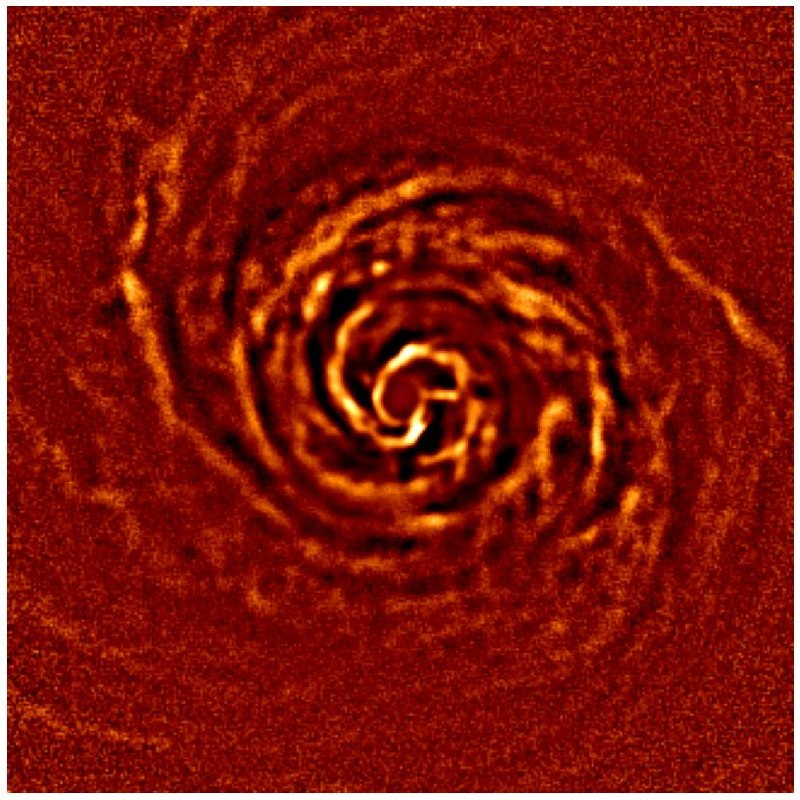
Ever since the first protoplanetary disk was discovered in 1984 around the star Beta Pictoris, these objects have presented astronomers with laboratories to study the births and evolution of worlds around distant stars. A team at France's National Center for Scientific Research (CNRS) and the University of Bordeaux, made a recent breakthrough in understanding these planetary birthplaces when they directly observed the rotation of a protoplanetary disk around the young star AB Aurigae.
The disk appears to rotate as you might expect based on based on the laws of physics. However, there are several regions there that don't quite move as predicted by theory. Such a rotational anomaly likely is caused by the presence of giant planets in the process of formation in the disk.
The team used an instrument called SPHERE (for Spectro-Polarimetric High-contrast Exoplanet REsearch), installed on European Southern Observatory's Very Large Telescope in Chile. This highly sensitive infrared tool allowed the team to track the disk's rotation by focusing on emissions from dust grains embedded in the disk.
Source: Universe Today
@EverythingScience