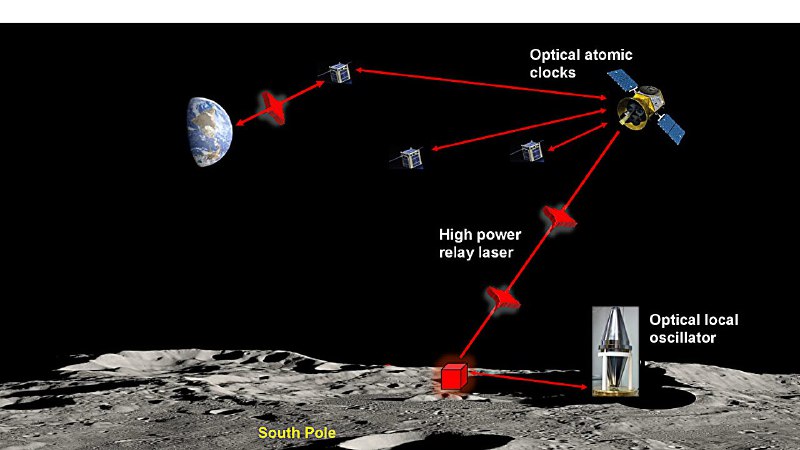
The moon has many permanently shadowed regions (PSRs), which are craters that never see sunlight and are located at the lunar poles. They are ideal spots for high-precision instruments because they are extremely cold and remarkably quiet. Our planet experiences many environmental disturbances that can affect laser stability, such as ground shaking and changes in air pressure.
Lunar laser plan
To solve this, an international team, including researchers from NIST (National Institute of Standards and Technology) and NASA's Jet Propulsion Laboratory, has developed a conceptual plan for a lunar-based master clock. This would involve transporting the materials to the moon and building the laser system inside a dark, freezing crater.
The proposal is for a cryogenic silicon cavity laser, which is a specialized device that uses a block of pure silicon to keep light waves perfectly in sync. For this system to reach its full potential, it has to be kept at a steady -430°F [-257°C]. The crater is cold, but not always that cold. The temperatures there are roughly -350°F [-212°C], so to bridge the gap, the scientists plan to use passive cooling panels.
The system works by bouncing laser light back and forth between two mirrors inside a small hole in the silicon block. Because the block is kept at an optimum temperature, it doesn't shrink or grow. This keeps the distance the light travels exactly the same every time it bounces, creating extraordinary precision. On Earth, the distance would constantly change because of noise and heat.
Source: Phys.org
@EverythingScience