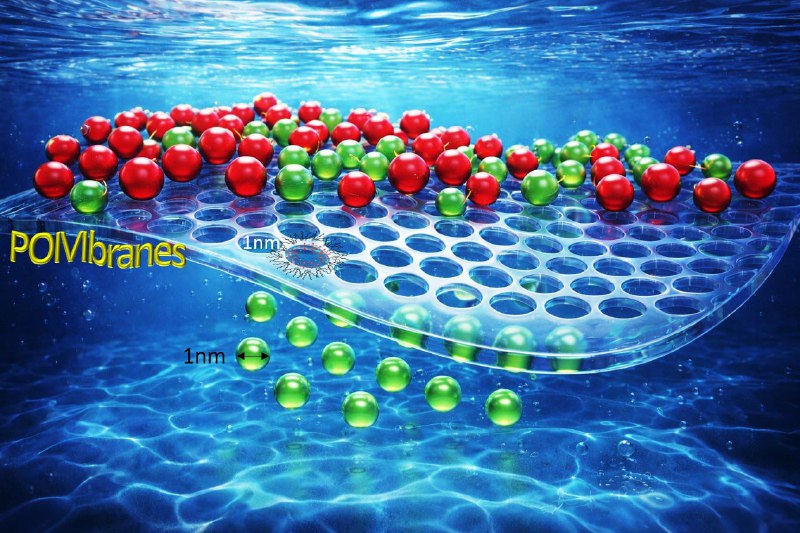
Scientists have teamed up to build a new kind of filtration membrane designed for unusually sharp molecular sorting.
Reported in the Journal of the American Chemical Society, the approach could cut the energy cost of industrial purification and make large-scale water reuse more achievable.
A huge share of manufacturing depends on “separations.” That single word covers everything from removing unwanted byproducts during drug making to stripping color from textile wastewater to refining ingredients in food processing. Today, many of these steps still lean on distillation and evaporation, which work well but burn vast amounts of energy and add significantly to industrial carbon emissions.
Membrane systems are often viewed as a cleaner alternative because they can separate chemicals without repeatedly heating and cooling large volumes, but common polymer membranes have a persistent weakness: their pores vary in size and can change as the material ages. When the pore landscape shifts, selectivity drops, and that is a deal breaker for precision work.
A New Class of Crystalline Membranes
“To address these limitations, we engineered a new class of ultra-selective, crystalline membranes called “POMbranes”, which contain pores that are about one nanometer wide, thousands of times thinner than a human hair,” said Dr. Shilpi Kushwaha, Senior Scientist at CSMCRI.
That one-nanometer target is not just a small number. At this scale, tiny differences in molecular size and shape start to matter, which is why biology uses channels with near-perfect dimensions to control what passes through. The team drew inspiration from aquaporins, natural protein channels that let water through while blocking many other molecules, and aimed for the same kind of size-based decision-making in a synthetic material.
Source: SciTechDaily
@EverythingScience