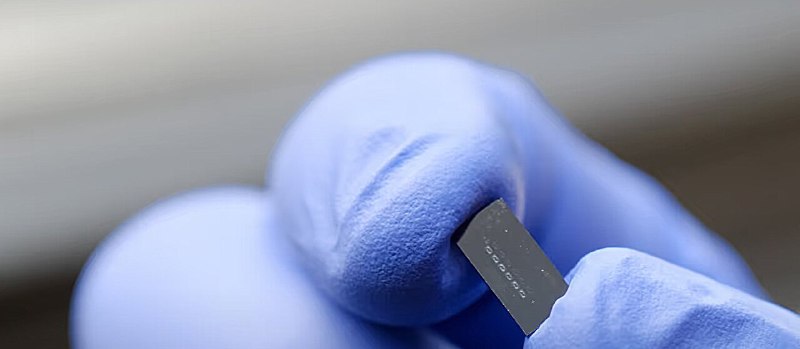
Is life possible—or has it ever been possible—on other planets? The (Origin of) Life Marker Chip (LMCOOL) seeks the answer. This innovative chip is being developed by a Dutch consortium led by TU Delft. UT researcher Jurriaan Huskens and his team are going to make the optical sensor selective for the required biomarkers.
A Dutch-built instrument capable of detecting traces of life on Saturn's moon Enceladus—that is the ultimate dream of TU Delft researcher Niels Ligterink. Over the coming years, he will work with around thirty colleagues from various Dutch companies and knowledge institutes on the (Origin of) Life Marker Chip (LMCOOL).
The invention is best described as a tiny yet complete laboratory in the form of a computer chip. It is "pre-programmed" to identify specific molecules in liquids; molecules that could point to life, such as amino acids.
"You can best compare our chip to a keyhole, with the molecule we are searching for as the key," explains Ligterink, "Because only one key fits in the keyhole, we can be almost 100% certain that we have captured the molecule we are looking for when we detect something with our chip. This makes our lab-on-a-chip revolutionary."
UT researcher Huskens adds, "An important step forward is that we are going to selectively recognize a mirror image of an amino acid. After all, living organisms make only one of the mirror images, and so this recognition is essential to determine whether the amino acid comes from a life process or not."
A lighter way to search for life
The idea for the Life Marker Chip (LMC) was first proposed more than twenty years ago for ESA's ExoMars mission. Although ESA eventually selected other instruments for that mission, the consortium partners remained enthusiastic about the concept. With financial support from the NSO Instruments Program, the instrument is now being further developed so that it can be used on a range of future planetary missions.
One of the greatest advantages of the new LMCOOL is its compact size and low weight. Current life-detection instruments on Mars are the size of a microwave oven and weigh between ten and twenty kilos. By contrast, LMCOOL will be about the size of a soft drink can and weighs only 700 grams. In space exploration, where every kilogram of launch mass matters, the Dutch chip offers a lightweight yet high-performance alternative.
Source: Phys.org
@EverythingScience