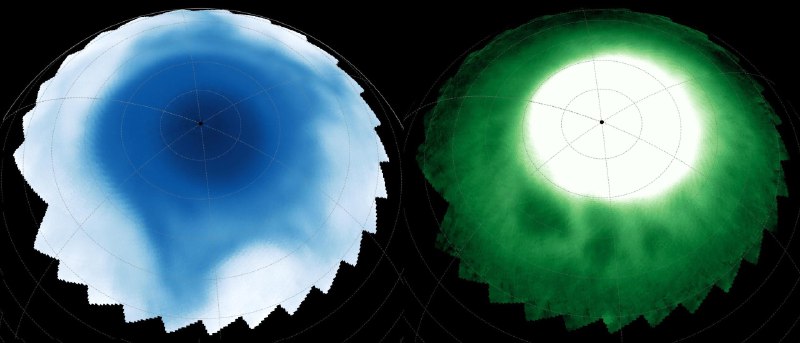
A new investigation of Saturn’s upper atmosphere, carried out with the James Webb Space Telescope (JWST), has uncovered strikingly unusual features never before observed on any planet in the Solar System. The findings were unveiled last week by Professor Tom Stallard of Northumbria University during the EPSC-DPS2025 Joint Meeting in Helsinki.
“This opportunity to use JWST was the first time we have ever been able to make such detailed near-infrared observations of Saturn’s aurora and upper atmosphere. The results came as a complete surprise,” said Professor Stallard.
This video shows how the structures observed in Saturn’s ionosphere and stratosphere relate to one another. Starting with the aurora at 1100 km, the brightness is increased to reveal the dark bead-like features. The video then fades into the star-arm shapes within the underlying 600 km layer. The darkest beads in the ionosphere appear to line up with the strongest arm underneath it, but it is not clear if this is coincidental, or if it suggests coupling between Saturn’s lowest and highest layers of the atmosphere. Credit: NASA/ESA/CSA/Stallard et al 2025.
Beads, Stars, and the Unexpected Patterns
“We anticipated seeing emissions in broad bands at the various levels. Instead, we’ve seen fine-scaled patterns of beads and stars that, despite being separated by huge distances in altitude, may somehow be interconnected – and may also be linked to the famous hexagon deeper in Saturn’s clouds. These features were completely unexpected and, at present, are completely unexplained.”
The discovery was made by an international collaboration of 23 researchers from the UK, US, and France, who observed Saturn for a continuous 10-hour stretch on November 29, 2024, while the planet rotated under JWST’s gaze.
Source: SciTechDaily
@EverythingScience