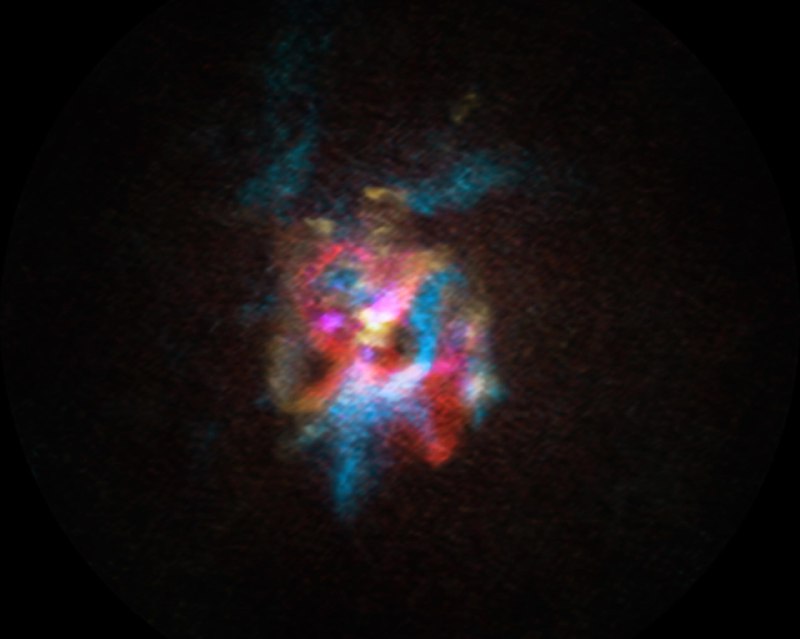
A red supergiant star has blown an enormous bubble of gas and dust, baffling astronomers.
The structure, as massive as the Sun and larger than our solar system, formed in a sudden eruption thousands of years ago. Why the star didn’t explode as a supernova remains a mystery.
Astronomers at Chalmers University of Technology in Sweden have identified a gigantic, expanding bubble of gas and dust surrounding a red supergiant star. It is the largest structure of this kind ever observed in the Milky Way. Containing as much mass as the Sun, the bubble was expelled in a violent stellar eruption about 4000 years ago. Scientists are still puzzled as to how the star managed to survive such a dramatic event.
The findings, published in the journal Astronomy and Astrophysics, come from a team led by Mark Siebert of Chalmers. Using the ALMA radio telescope in Chile, the researchers studied the red supergiant known as DFK 52, a star similar in many ways to the famous Betelgeuse.
Source: SciTechDaily
@EverythingScience