TGViewer
Channel Public Channel
Epic Web3 – events in AI and Web3 industries

Epic Web3 – events in AI and Web3 industries

@epicweb3

Conference, side events and community of Web3 builders

https://epicweb3.com

For partnerships — @olyakovalieva
Subscribers
1.89K
Photos
523
Videos
68
Links
401

Showing posts older than #727 · Back to latest

Older Posts 14 shown
Post #725 1.16K
Fragmentation is one of the biggest problems in Web3 and it is growing every day - at the beginning of the year L2beat had 34 active projects and 33 upcoming projects. Currently it has 74 L2s, 22 L3s and 81 upcoming projects.

Everclear is on a mission to tackle the growing fragmentation across blockchain ecosystems.

How?

With clearing it all up.

🚀 The problem: fragmentation and centralization

Navigating apps across multiple chains is awful and increasingly impractical. The problem is growing: 61 layer two projects are live, with 79 more in the pipeline, according to L2Beat. That's a lot of roll-ups, and that doesn't even count app-specific or unannounced ones. We're looking at thousands of roll-ups eventually. Roll-ups are the new servers.

Current approaches shift complexity from users to solvers, turning decentralized finance into a TradFi replica with few sophisticated actors controlling liquidity.

🔑 The solution: clearing layers

Clearing layers are a mechanism that allows different parties in the ecosystem to coordinate to net out flows of funds. Instead of constantly rebalancing funds across chains like Polygon and Arbitrum, clearing layers help find coincidences of demand, essentially allowing us to do nothing and save costs. Netting is free, and that's the game changer.

How does it work? Think of it as your own rollup, or state container, where everyone declares their fund movements. The rollup finds matching needs between participants using strategies like a modular Dutch auction, similar to those used in Gnosis. Importantly, it's a zero TVL system - not a liquidity pool or bridge - but a co-ordination tool for existing bridges and pools to net obligations.

Historically, the solution to fragmentation has been to build a better bridge with more liquidity, but each new bridge just adds to the problem.

🌐 Everclear’s vision? To simplify cross-chain interactions, empower solvers, and help build a truly decentralized, efficient blockchain ecosystem.
  • 🔥 9
  • 👍 7
  • ✍ 2
Post #724 1.06K
What does the future hold for LRTs?

We don’t know, but these people sure do:

🟢 Nader Dabit, Director of DevR @ Eigen
🟢 Mike Silagadze, CEO @ etherfi
🟢 Warren Paul Anderson, Co-founder @ Exocore
🟢 Kaitai Chang, Co-Founder & COO @ Yala
🟢 Lucas Kozinski, Founding Contributor @ Renzo

Meet them at the panel Discussion “The Future of Liquid Restaking Tokens (LRTs) and Their Impact on DeFi” during Restaking & Infra Day!

📅 September 18, Token2049

Grab the ticket here:
https://t.ly/IbyM4
  • ⚡ 4
  • ❤‍🔥 2
  • 👍 2
Post #723 1.1K
Our Twitter page has been hacked.

Somehow scammers got access to our account and sent a mass dm about "Epic Web3 Passport".

This is a scam, do not follow the link and do not link your wallet.

We've already changed all the passwords and reported the site to be taken down.

Stay safe!
  • ❤ 4
  • 👍 2
  • 🔥 1
Post #722 772
Gm folks!

Coming to you with an almost complete speaker list for Restaking & Infra Day!

I’m sure, you’ve never seen so many pros in one place:

Norbert, Global Growth Manager @ Nubit / Hans, Co-Founder @ Nubit / Nader Dabit, Director of DevR @ EigenLayer / Mike Silagadze, CEO @ Ether.fi

Warren Paul Anderson, Co-Founder @ Exocore / Kaitai Chang, Co-Founder & COO @ Yala / Marouen Zelleg, Co-Founder & COO @ Crestal Network / Jafar Azam, Head of Product @ Picasso

Satyam Agrawal, Co-Founder & CTO @ DeFcor / Ingamar Ramirez, Ecosystem Strategist @ Bitcoins OS / Arjun Bhuptani, Founder @ Everclear / Sudipan Sinha, CEO @ RiskLayer

Alex Lipton, Business Development Manager (Ex-Consensys) @ SSV Network / Victor Cheng, CSO @ Karak Network / Lucas Kozinski, Founding Contributor @ Renzo / Liron Hayman, BizDev @ StarkWare


📅 September 18, Singapore

Grab the ticket here:
https://t.ly/IbyM4
  • 🔥 3
  • 🤩 1
Post #721 937
🤔What is the state of modular eco now?

Crestal Network is the Web3 Infrastructure Lego Platform, enabling seamless integration, management, and performance benchmarking of modular services for developers. Imagine managing and testing different components - like DA or settlement layers - with quantifiable metrics.

🧩 Co-founder Marouen Zelleg shared his insights on the current modular landscape and how Crestal aims to redefine it during L2con last July.

Also, Crestal is planning to launch its public Testnet soon!

🔍 There are 3 main challenges in the Modular landscape
1️⃣ Too many choices: Crestal ran an experiment asking what’s needed to build a rollup. They started with 10 categories, but the responses grew to 66 providers across 19 categories. The takeaway? Devs often miss crucial solutions in this crowded ecosystem.

2️⃣ Unique use cases: every application has its own demands. Crestal’s chatbot, trained on Web3 architecture, showed that while DeFi remains dominant, trends like meme coins emerge. Staying up-to-date with evolving needs is critical.

3️⃣ Preconceived preferences: 74% of builders come in with a preferred solution. But the real focus should be on outcomes like performance and security. Crestal’s mission is to break down these assumptions and guide developers more effectively.

🛠 Crestal’s solutions
Crestal built a dashboard categorizing modular services, starting with data availability providers. They identified over 20 metrics, but collecting this data was harder than expected - highlighting how marketing often overshadows objective insights. Crestal is here to fix that.

🤝 Crowdsourcing for better results

Crestal is crowdsourcing application design, deployment, and maintenance. The idea? Let the best experts with cutting-edge technology propose solutions, and give developers the freedom to choose the right provider.

📈 Proof of Performance

To keep everything transparent, Crestal is exploring an on-chain proof-of-performance system. It ensures providers deliver what they promise—like sub-dollar transactions or 99% uptime—by generating verifiable performance proofs.

🎯 The end goal?
Crestal wants to simplify the modular journey so developers can focus on what matters: the success of their projects. A single, transparent marketplace where experts deliver high-quality services—letting builders concentrate on outcomes, not tech complexities.
  • 👍 3
  • ⚡ 2
Post #720 875
Interested in the new Layer 2s of Bitcoin and BTCFI?

Then check out the BTC Scaling Day.

It is a developer-focused side event of Token2049 with a full day of keynotes and panel discussions about the fast-growing niche of BTC Scaling & BTCfi solutions!

📅September 19, Token2049
  • ❤ 4
  • 👍 4
Post #719 805
Gm fam!

Mark your calendar for September 18th if you're coming to Token2049 - we're having our 3rd Restaking & Infra Day in Singapore! 🇸🇬

This is a one-day event for web3 developers, tech founders, and non-technical web3 enthusiasts who want to dive deeper into restaking.

🎙 Speakers from Eigen, Picasso, DeFcor, Exocore, Everclear & Crestal Network are already onboard!

📅 September 18, Singapore

Grab tickets here
  • ❤ 6
Post #718 722
Why Fraud Proofs are the future? Insights from Cartesi

🔺 Let’s start with the blockchain trilemma - we can’t scale Ethereum without sacrificing security or decentralization. It's a balancing act, but fraud proofs offer a unique solution.

💻 Why Fraud Proofs matter? While ZK proofs are often seen as the endgame, they come with trade-offs. For cost and throughput, ZK has some disadvantages compared to fraud proofs. So fraud proofs still have a very important niche for rollups.

👷 How Fraud Proofs work? For simplicity, let's say there are two players, the validators and the blockchain. These validators agree on a state transition function, similar to a CPU instruction, and an initial state. They apply the state transition repeatedly to reach the final result, which they then prove to the blockchain.

If both validators agree on the result, the blockchain accepts it. If they disagree, a dispute is initiated to identify the liar.

📈 Future of Fraud Proofs: while current systems like Cartesi, Arbitrum, and Optimism are state-of-the-art, there's room for growth. Cartesi continues to innovate, aiming to perfect its balance of security, decentralization, and liveness.
  • 🔥 4
  • 👍 1
Post #717 821
GM!

We've got a bundle of events for you if you're going to Token2049!

⛓ Modular & L2 Day - if you're into modular design, modular blockchain stacks, and layer 2 scaling solutions.

🥩 Restaking & Infra Day - for liquid restaking and staking, Oracles and other AVSs, and security and risks of restaking fans.

🥮 BTC Scaling Day - if you fancy wBTC and alternative interoperability solutions, BTCfi and restaking on BTC, future developments and perspectives of BTC.

🗓 September 17-19, Singapore

Get your limited tickets here:
https://lu.ma/epicweb3calendar
  • ⚡ 5
Post #716 731
Epic Web3 – events in AI and Web3 industries What's the future of Layer 2s? How to make really secure rollups? What's the best way to onboard devs to your project? New podcast with Martin Derka, co-founder @ Zircuit, zk rollup with parallelized circuits and AI-enabled security at the sequencer level!…
Zircuit just launched it's first mainnet phase and introduced the ZRC token claims process🎊

Check out our June podcast episode with Martin Derka, co-founder of Zircuit and learn, what's the future of the protocol!

The link is in the reply👆
  • 👍 2
Post #715 762
🌐 How modularity makes Web3 better

1️⃣ Customizable modularity:
Modular systems allow developers to tailor their blockchain solutions to specific needs, enhancing efficiency and performance. For instance, developers can choose between different data availability layers or execution environments to better suit their application's requirements.

2️⃣ Leveraging specialized layers:
One major advantage of modularity is the ability to optimize specific layers of the blockchain stack independently. This can lead to better performance and security. Examples include using specialized data availability layers or zero-knowledge proofs for enhanced privacy and security.

3️⃣ Addressing the scalability trilemma:
The scalability trilemma in blockchain—balancing speed, cost, and security—can be approached by modularizing different aspects of the blockchain. By offloading certain processes to specialized modules, blockchains can achieve higher throughput without compromising security.

🖥 Watch the full discussion here
  • 👍 3
  • ⚡ 2
Post #713 887
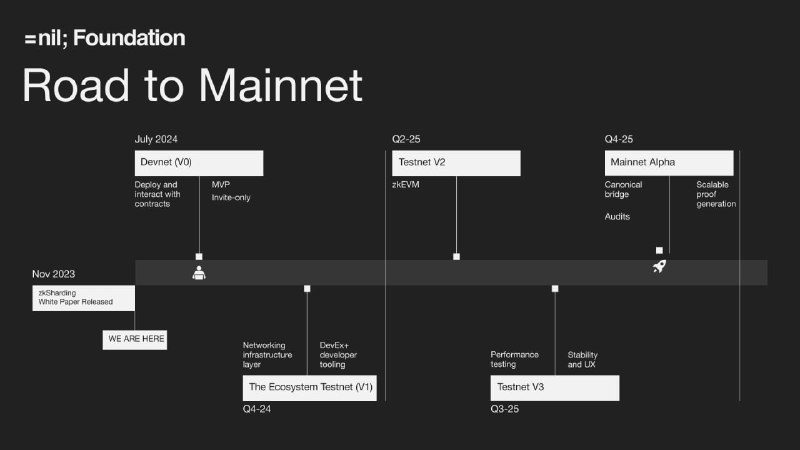
How zkSharding will change Ethereum's scalability?

Insights from =nil; Foundation

1️⃣ zkSharding takes the original Ethereum execution sharding vision and combines it with ZK tech

zkSharding leverages years of research to future-proof Ethereum. It is built from scratch, addressing key differences with rollups.

2️⃣ zkSharding introduces a new framework for Ethereum scalability

The modular solution enables vertical and horizontal scaling. It also focuses on horizontal scaling, with potential for vertical integration.

3️⃣ zkSharding has a three-tier security architecture and is designed for decentralization

🟢Execution shards are governed by a main shard.
🟢ZKPs validate transactions with final settlement on Ethereum.
🟢Native cross-shard messaging for interoperability.

4️⃣ zkSharding is an ideal system for high-load applications


It supports DEXes, DeFi, autonomous agents, and more. Also, it ensures continuity for developers with a long-term scalability view.
  • 🔥 3
  • ⚡ 2
  • ✍ 1
Post #707 813
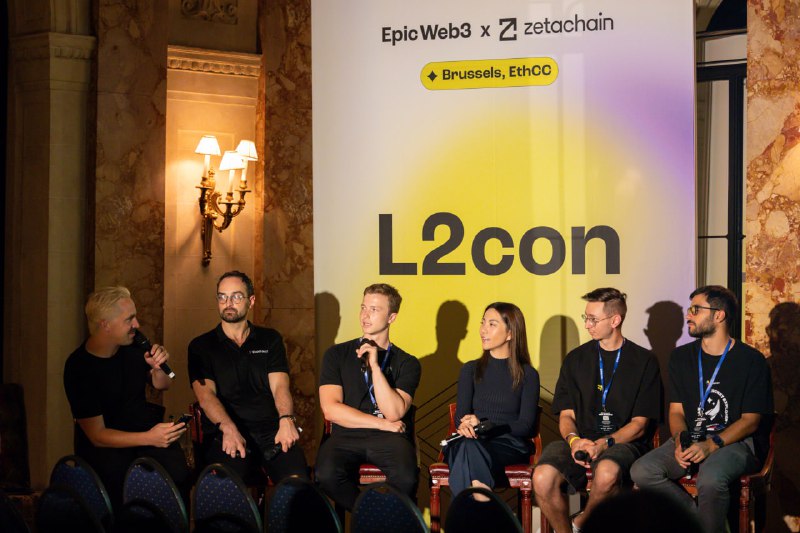
And another photo pack from Brussels - this time from L2con!

It was our biggest event yet: thank you all for coming and staying with us💜

Find yourself on the photos here
  • ❤ 2
Older posts →
Threads Profile ViewerView any public Threads profile without an account.Open ThreadLook →Writing with AI? Make it sound human.Metric37 rewrites AI drafts so they read naturally. Free AI detector, 1,500 words free.Try Metric37 →