Interdealer Repo
Interdealer repos are cleared by the FICC, who plays the role of the central counterparty (CCP). CCPs reduce risk in the markets they clear by “novating” trades, becoming the buyer to every seller and the seller to every buyer (essentially, a middle man).
Typically, a cash lender 'A' lends to a dealer 'B' who then lends the cash to cash borrower 'C'. In a novated repo trade, A lends to FICC, C borrows from FICC, and B both borrows from and lends to FICC. Each transaction between B and FICC can be 'netted' from B's balance sheet, reducing its regulatory burden. This incentivizes interdealer repo activity.
The interdealer repo market has two components:.
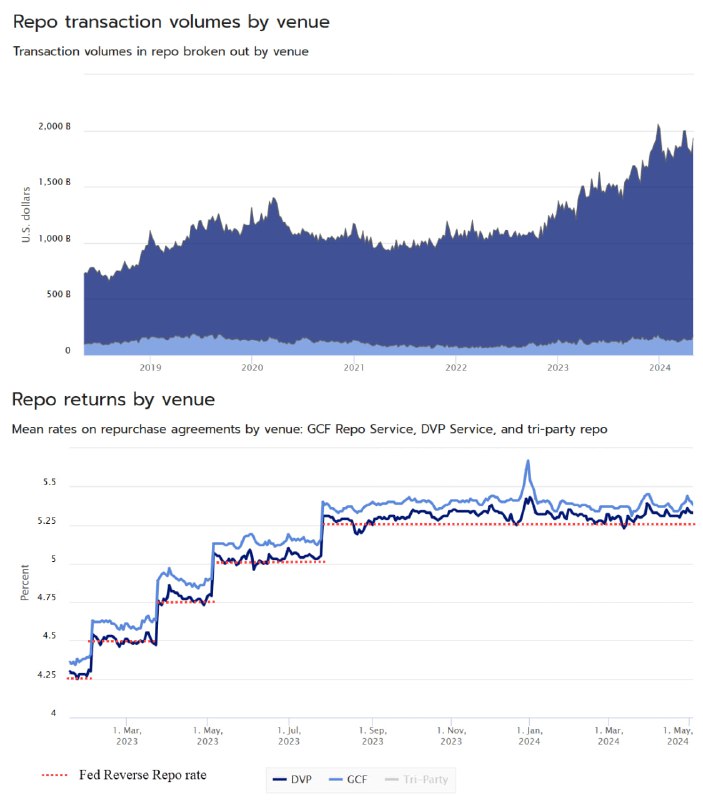
One is GCF (General Collateral Financing) repo, which settles on tri-party and transacts ~$100b per day. GCF is dominated by the Fed’s primary dealers and domestic U.S. banks, who borrow money from cash lenders in tri-party and lend it to other primary dealers, non-primary dealers, and foreign banks at the GCF rate, thereby earning a spread since the GCF rate trades above the tri-party rate.
The other interdealer market is a bilateral market called DVP (“delivery versus payment”), which does over $1t per day. Just like other bilateral segments, dealers connect cash lenders and cash borrowers. Hedge funds, however, are the major borrowers and lenders in DVP, because of this segment’s ability to facilitate leveraged trades. They know the exact collateral they are promised from cash borrowers, which is usually the cheapest to deliver (CTD) into a futures contract. Sourcing a CTD security is the backbone of the most popular leveraged trade among relative value hedge funds (RV funds), known as the “Treasury-Futures Basis Trade".
The dispersion of rates in DVP is the widest. In contrast to "general collateral" (GC) repo, DVP is a specials venue. Specials is where the trading of securities subject to high demand occurs. Rates on specials often dip below the Fed's risk-free rate (the RRP "floor") because certain securities may be more sought after.
Post #188
505
DT Primers Private Repo Venues The four private venues for repo trades include: 1) BONY Tri-Party Platform 2) DVP and GCF Repo (interdealer) 4) Uncleared bilateral (NCCBR) Big difference are the technical details related to settlement and clearing of the collateral:…