Exploring Data Science, Big Data Analytics & Visualization, ML/DL, Neural Networks, LLMs with GitHub, Kaggle, HuggingFace and some white papers by big institutions.
Not just data, but science behind data
Paid project? premodi@zohomail.in
★ @DataML
Post #1948
228
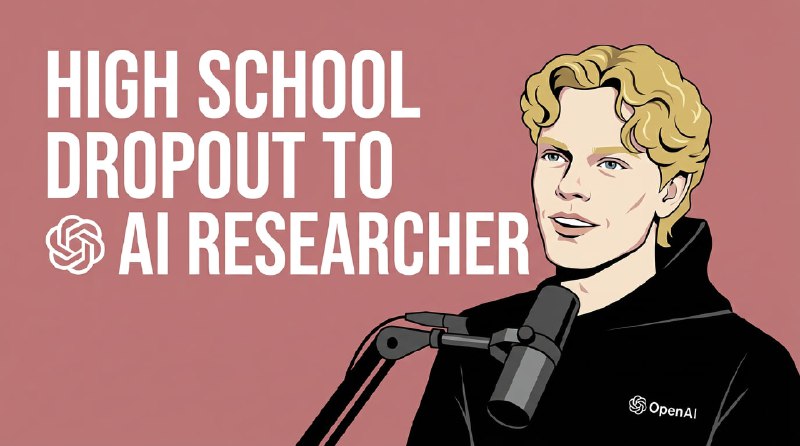
An interview with a 23-year-old Gabriel Pettersson, OpenAI employee who learned DL without attending university.
An interesting story that makes you think about education and career.
Dropped out of school in a remote Swedish town, Didn't attend university, but is currently working as a Research Scientist at OpenAI in Sora team.
🟢 How he landed in silicon valley?
YouTube • #AI #ML #Interview #OpenAI
••••••••••••••••••••••••••••••••••••••••••••••••••••
🤖 Data Science, ML & Big Data with @DataXplore
An interesting story that makes you think about education and career.
Dropped out of school in a remote Swedish town, Didn't attend university, but is currently working as a Research Scientist at OpenAI in Sora team.
🟢 How he landed in silicon valley?
We live in a time when the monopoly of universities on fundamental knowledge has been shaken.
Traditional education is a "bottom-up" approach. Want to do machine learning? First, learn linear algebra, then calculus, then topology. It's a long process, and often motivation and understanding of why you need it right now are lost.
Companies, which also don't want to wait, are adding fuel to the demotivation fire. Palantir, for example, is already hiring high school students, bypassing universities. And Gabriel's story is a telling example of this trend.
He didn't follow the classic path of "school - bachelor's degree - master's degree". Instead, he used ChatGPT as a personal mentor. And it's not about asking the chatbot to "write the code for me". Gabriel used a method he calls "recursive gap filling".
The essence is to go "top-down". He takes a complex project: for example, he wants to understand how diffusion models work. He asks ChatGPT to write the code. Naturally, at first, he doesn't understand anything.
And here he starts asking questions about each incomprehensible module. "What does this block do?". Let's say it's a ResNet block. He asks: "Why does this help the model learn?". And he digs deeper. If an unfamiliar concept pops up - he asks to explain the mathematical basis underlying it.
This is recursion: layer by layer, until all knowledge gaps are filled. He doesn't learn mathematics for the sake of it, he learns the mathematics he needs right now to work on the code.
How did a foreigner without a diploma get a visa to the USA and a job in Silicon Valley?
For the O1 talent visa, he used his reputation on Stack Overflow and recommendations, which were viewed by millions of people, as proof of his contribution to the industry.
Gabriel advises: forget about HR. Resumes and diplomas don't matter if you can show results. His strategy is MVP or a product demo and writing directly to the company's top management with an offer of free work for a week. This removes the risks for employer and gives you a chance to show yourself.
His main message: if you're ready to actively ask questions and aren't afraid to look stupid in front of AI while learning the basics, you're already in the top 1%. Because most people just go with the flow.
YouTube • #AI #ML #Interview #OpenAI
••••••••••••••••••••••••••••••••••••••••••••••••••••
🤖 Data Science, ML & Big Data with @DataXplore