
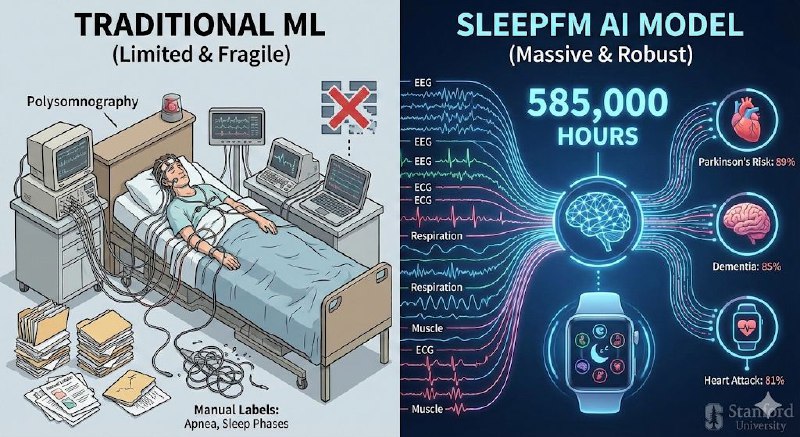
Stanford trained SleepFM model (fundamental for predicting a range of pathologies) from atrial fibrillation and myocardial infarction to dementia and Parkinson's disease.
🔴 Why traditional ML models fail despite having gigabytes of data?
Polysomnography is the "gold standard" for studying sleep: a person is fitted with sensors (EEG, ECG, respiration, muscles) and gigabytes of raw signals are recorded.
But in the ML world, this data is used ineffectively. Existing models were trained on small datasets for specific tasks (finding apnea, determining sleep phases).
A huge amount of physiological information about a patient's health was simply ignored, because it's impossible to manually label hundreds of hours of recordings for each disease.
Moreover, if the EEG sensor was mounted slightly differently in one clinic or fell off, the usual model would break down.
🟢 How training on 585k hours possible without human labels?
At the university, they realized that they didn't need human labelers, they needed volumes. They collected a huge dataset of 585,000 hours of sleep recordings from more than 65,000 patients and invented a unique SSL learning algorithm for the future model.
1️⃣ LOO-CL (Leave-One-Out Contrastive Learning)
Instead of teaching the model to predict a diagnosis, they made it solve a puzzle: the system receives input signals from 3 modalities (heart, muscles, respiration) and must predict the embedding of the fourth (brain waves).
This forces the neural network based on 1D CNN and Transformers to learn deep, hidden connections between physiological processes.
2️⃣ The second feature is Channel-Agnostic Attention.
The models don't care about which sensors are connected and in what order. If a channel fails or is absent, attention pooling simply redistributes weights, and inference continues.
3️⃣ SleepFM has learned to read sleep not just for insomnia.
Having received a single night of recordings as input, the model predicts the risk of 130 diseases, and it does this more accurately than specialized models trained with a teacher: the risk of Parkinson's disease is detected in 89% of cases, dementia in 85%, and the probability of a heart attack in 81%.
Such diagnostics could move from labs to smartwatches with development of wearable electronics, and tests shown that noise of sleep signals can hide a patient's entire medical record.
Details #news #AI #ML
••••••••••••••••••••••••••••••••••••••
🤖 Data Science, ML & Big Data with @DataXplore