Perfect channel to learn Data Analytics, Data Sciene, Machine Learning & Artificial Intelligence
Admin: @coderfun
Post #1556
2.16K
For those of you who are new to Data Science and Machine learning algorithms, let me try to give you a brief overview. ML Algorithms can be categorized into three types: supervised learning, unsupervised learning, and reinforcement learning.
1. Supervised Learning:
- Definition: Algorithms learn from labeled training data, making predictions or decisions based on input-output pairs.
- Examples: Linear regression, decision trees, support vector machines (SVM), and neural networks.
- Applications: Email spam detection, image recognition, and medical diagnosis.
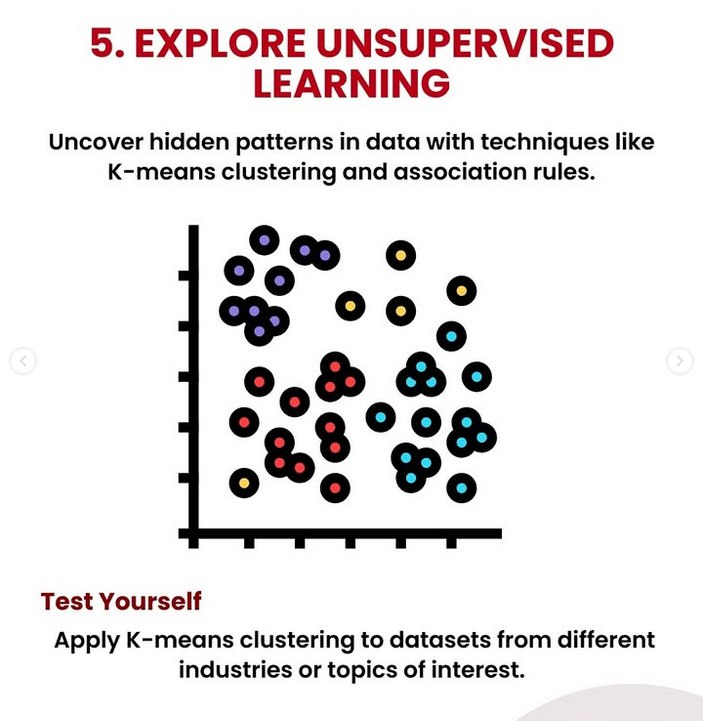
2. Unsupervised Learning:
- Definition: Algorithms analyze and group unlabeled data, identifying patterns and structures without prior knowledge of the outcomes.
- Examples: K-means clustering, hierarchical clustering, and principal component analysis (PCA).
- Applications: Customer segmentation, market basket analysis, and anomaly detection.
3. Reinforcement Learning:
- Definition: Algorithms learn by interacting with an environment, receiving rewards or penalties based on their actions, and optimizing for long-term goals.
- Examples: Q-learning, deep Q-networks (DQN), and policy gradient methods.
- Applications: Robotics, game playing (like AlphaGo), and self-driving cars.
Best Data Science & Machine Learning Resources: https://topmate.io/coding/914624
Credits: https://t.me/datasciencefun
Like if you need similar content
ENJOY LEARNING 👍👍
1. Supervised Learning:
- Definition: Algorithms learn from labeled training data, making predictions or decisions based on input-output pairs.
- Examples: Linear regression, decision trees, support vector machines (SVM), and neural networks.
- Applications: Email spam detection, image recognition, and medical diagnosis.
2. Unsupervised Learning:
- Definition: Algorithms analyze and group unlabeled data, identifying patterns and structures without prior knowledge of the outcomes.
- Examples: K-means clustering, hierarchical clustering, and principal component analysis (PCA).
- Applications: Customer segmentation, market basket analysis, and anomaly detection.
3. Reinforcement Learning:
- Definition: Algorithms learn by interacting with an environment, receiving rewards or penalties based on their actions, and optimizing for long-term goals.
- Examples: Q-learning, deep Q-networks (DQN), and policy gradient methods.
- Applications: Robotics, game playing (like AlphaGo), and self-driving cars.
Best Data Science & Machine Learning Resources: https://topmate.io/coding/914624
Credits: https://t.me/datasciencefun
Like if you need similar content
ENJOY LEARNING 👍👍
- 👍 4
- ❤ 1