TGViewer
Channel Public Channel
Data science/ML/AI

Data science/ML/AI

@datascience_bds

Data science and machine learning hub

Python, SQL, stats, ML, deep learning, projects, PDFs, roadmaps and AI resources.

For beginners, data scientists and ML engineers
👉 https://rebrand.ly/bigdatachannels

DMCA: @disclosure_bds
Contact: @mldatascientist
Subscribers
14.1K
Photos
611
Videos
7
Links
341

Showing posts older than #895 · Back to latest

Older Posts 20 shown
Post #893 2.27K
Dropout Explained Simply

Neural networks are notorious for overfitting ( they memorize training data instead of generalizing).
One of the simplest yet most powerful solutions? Dropout.

During training, dropout randomly “drops” a percentage of neurons ( 20–50%). Those neurons temporarily go offline, meaning their activations aren’t passed forward and their weights aren’t updated in that round.

👉 What this does:

✔️ Forces the network to avoid relying on any single path.
✔️ Creates redundancy → multiple neurons learn useful features.
✔️ Makes the model more robust and less sensitive to noise.

When testing happens, dropout is turned off, and all neurons fire but now they collectively represent stronger, generalized patterns.

Imagine dropout like training with handicaps. It’s as if your brain had random “short blackouts” while studying, forcing you to truly understand instead of memorizing.

And that’s why dropout remains a go-to regularization technique in deep learning and even in advanced architectures.
  • ❤ 7
Post #892 2.06K
Importance of Statistics and Exploratory Data Analysis
  • ❤ 4
Post #891 2.25K
  • 🔥 5
  • ❤ 2
Post #890 2.31K
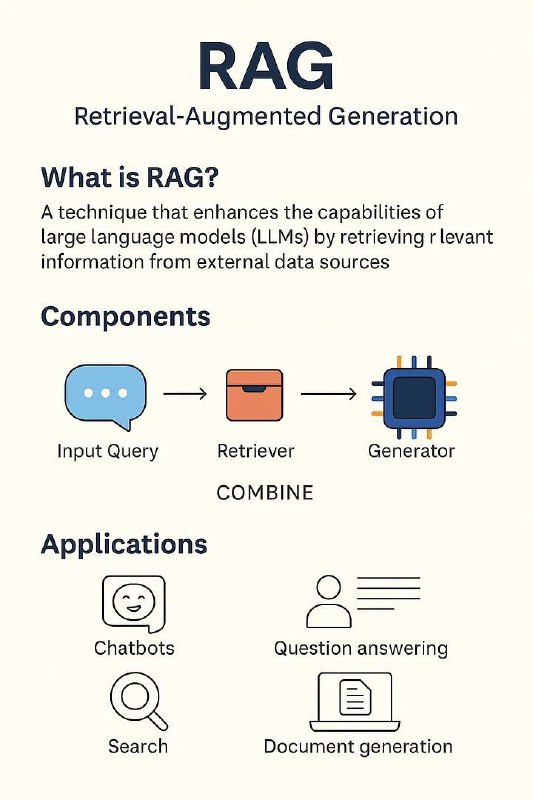
What is RAG? 🤖📚

RAG stands for Retrieval-Augmented Generation.
It’s a technique where an AI model first retrieves relevant info (like from documents or a database), and then generates an answer using that info.

🧠 Think of it like this:
Instead of relying only on what it "knows", the model looks things up first - just like you would Google something before replying.

🔍 Retrieval + 📝 Generation = Smarter, up-to-date answers!
  • ❤ 4
  • 🔥 3
Post #888 2K
  • ❤ 5
  • 😁 2
  • 👍 1
Post #885 2.36K
🚀 Fast-Track Machine Learning Roadmap 2025

Mindset: Build first, learn just-in-time. Share progress publicly (GitHub + posts). Consistency > cramming.

Weeks 1–2: Master Python, NumPy, Pandas, EDA, and data cleaning. Mini-win: load CSVs, handle missing data.

Weeks 3–6: Learn ML fundamentals with scikit-learn — train/test splits, cross-validation, classifiers (LogReg, RF, XGB), and regressors. Project: spam classifier or house price predictor.

Weeks 7–10: Dive into deep learning — tensors, autograd, PyTorch. Build CNN or text classifier + track experiments (Weights & Biases).

Weeks 11–12: Specialize (NLP, CV, recommenders, MLOps) and ship a niche AI app.

————————

Weekly Routine: 
Mon-Tue: Learn concept + code example 
Wed-Thu: Build feature + log metrics 
Fri: Refactor + README + demo 
Sat: Share + get feedback + plan fixes 
Sun: Rest & review

————————

Portfolio Tips: Clear READMEs, reproducible env, demo videos, honest metric analysis. Avoid “math purgatory” and messy repos. Ship small every week!

————————

This approach gets you practical, portfolio-ready ML skills in ~3-4 months with real projects and solid evaluation for 2025 job markets!
  • ❤ 12
Post #884 2.03K
3 Types of Machine Learning
  • ❤ 7
Post #883 2.23K
R Cheatsheet - Part 3
  • ❤ 4
Post #882 2.17K
Projects To Learn AI and LLM Engineering
  • ❤ 6
Post #881 2.02K
PCA Dimensionality Reduction Cheatsheet
  • ❤ 7
Post #880 2.13K
R Cheatsheet - Part 2
  • ❤ 6
Post #879 2.14K
The Curse of Dimensionality 🧩

Here’s something that trips up many beginners:
More features ≠ always better.

When your dataset has too many features (dimensions), weird things happen:

⛔️ Distances between points become meaningless.
⛔️ Models struggle to generalize.
⛔️Training time explodes.

👉 Solution: techniques like PCA, feature selection, or just collecting smarter data instead of more data.

Remember: Adding noise isn’t adding information.
  • ❤ 3
Post #878 2.12K
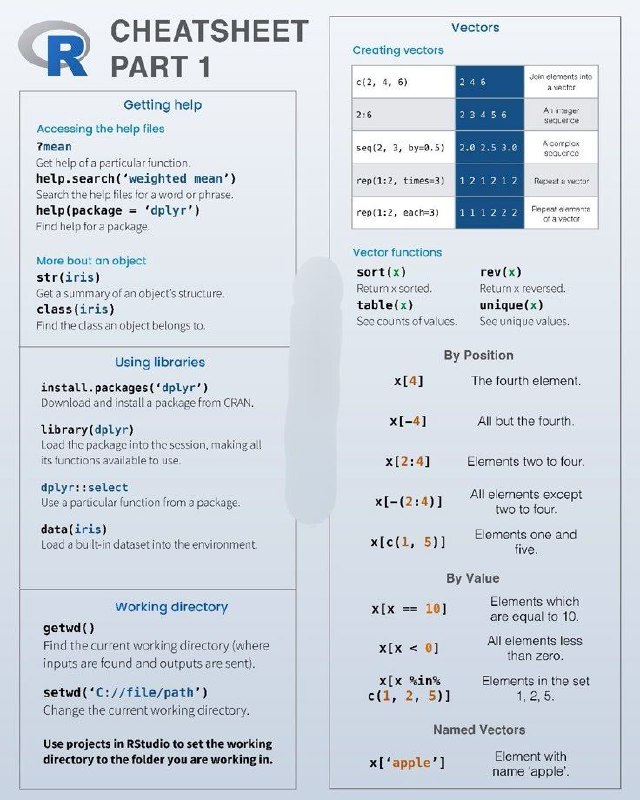
R CHEATSHEET - Part 1
  • ❤ 7
  • 👏 1
Post #877 2.13K
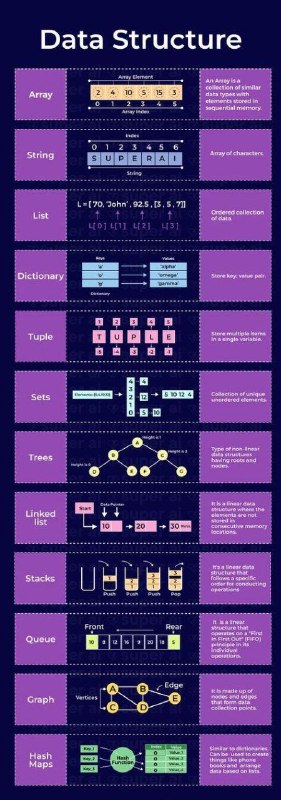
Data Structure
  • ❤ 6
Post #875 2.24K
Overfitting vs Underfitting 🎯

Why do ML models fail? Usually because of one of these two villains:

Overfitting: The model memorizes training data but fails on new data. (Like a student who memorizes past exam questions but can’t handle a new one.)

Underfitting: The model is too simple to capture patterns. (Like using a straight line to fit a curve.)

The sweet spot? A model that generalizes well.

Note: Regularization, cross-validation, and more data usually help fight these problems.
  • ❤ 13
Post #874 2.12K
AI vs ML vs Deep Learning 🤖

You’ve probably seen these 3 terms thrown around like they’re the same thing. They’re not.

AI (Artificial Intelligence): the big umbrella. Anything that makes machines “smart.” Could be rules, could be learning.

ML (Machine Learning): a subset of AI. Machines learn patterns from data instead of being explicitly programmed.

Deep Learning: a subset of ML. Uses neural networks with many layers (deep) powering things like ChatGPT, image recognition, etc.

Think of it this way:
AI = Science
ML = A chapter in the science
Deep Learning = A paragraph in that chapter.
  • ❤ 10
  • 👏 3
Older posts →
Threads Profile ViewerView any public Threads profile without an account.Open ThreadLook →Writing with AI? Make it sound human.Metric37 rewrites AI drafts so they read naturally. Free AI detector, 1,500 words free.Try Metric37 →