Monolithic VS Microservices Architecture. Which one are you using? 🤔
In the realm of software architecture, the choice between Monolithic and Microservices can shape the destiny of your application. Let's break down the key differences in a nutshell! 🧩
1. Monolithic Architecture 🏰
- One Big Castle: Monoliths are like a majestic castle, where all components (database, server, user interface) are tightly knit into a single structure.
- Unified & Simple: Easy to develop and deploy due to its unified structure. Changes are made in one place, making coordination a breeze.
- Scaling Challenges: Scaling can be a challenge. When one aspect needs upgrading, the entire application must be scaled, even if only a small part requires more resources.
2. Microservices Architecture 🌐
- City of Specialized Buildings: Microservices resemble a bustling city, with each service as a specialized building handling a distinct function.
- Scalability & Flexibility: Offers scalability on a per-service basis. If one part of the application needs more resources, you can scale just that service.
- Increased Complexity: As the number of services grows, managing the communication between them can become complex. Decentralization brings its own set of challenges.
Ever wondered how your computer securely communicates with a remote server? 🤔
Let's dive into the magic behind SSH and unravel its secrets. 🔍💻
1. What is SSH? 🤷♂️ SSH, or Secure Shell, is a cryptographic network protocol that enables secure communication between two devices over an unsecured network. It's like a secure tunnel for your data! 🚇🔒
2. Key Players: Public and Private Keys 🗝 SSH uses a pair of cryptographic keys – a public key (shared with the world) and a private key (kept super-secret). 🤫 When you connect, these keys perform a digital handshake to ensure a secure connection. 🤝🔑
3. The Handshake Dance: Authentication 💃 The handshake involves your computer proving its identity using the private key, and the server verifying it using the corresponding public key. Think of it as a secret password exchange, but way cooler! 😎🕵️
4. Encryption Enchantment: Securing the Chat 🛡 Once the handshake is complete, SSH wraps your data in layers of encryption, ensuring that even if someone intercepts it, they'll find nothing but gibberish. 🤐📡
5. Port Perfection: Default Port 22 🚪 SSH communicates through port 22 by default. It's like the entrance to your secure data party! 🎉🚪 But beware, changing ports adds an extra layer of security. 🕵️♀️🔐
SSH is the superhero of secure communication, ensuring your data remains confidential, and the connection is trustworthy. 🦸♂️💼 Next time you SSH, remember the cryptographic dance happening in the background, making it all possible! 🕺🌐
🌐 Public vs Internal Load Balancers: Unveiling the Power of Balance! 🔄
Load balancing is the unsung hero of seamless digital experiences, and choosing between public and internal load balancers can be a game-changer. Let's dive into the key differences in a nutshell! 🚀
🌍 Public Load Balancers: - Audience: Everyone, Everywhere! - Designed to distribute incoming traffic across public-facing servers. - Ideal for applications accessible over the internet, such as websites or APIs. - Acts as the gateway, directing external requests to the right internal resources.
🏢 Internal Load Balancers: - Keep it in the Family: - Tailored for distributing traffic within a private network or data center. - Perfect for applications serving internal users or specific services behind the scenes. - Enhances security by keeping sensitive systems shielded from the public eye.
🤔 How to Choose? - Public: - Opt for when your services need to be accessible from the internet. - Ideal for handling high volumes of external traffic. - Best suited for public-facing applications like websites or APIs.
❤ public: An access modifier keyword that indicates the class (MainClass) is accessible from outside the package.
❤ class: A keyword used to declare a class in Java. MainClass: The name of the class. It follows the naming conventions for classes in Java.
❤ { and }: Curly braces define a block of code. In this case, they enclose the body of the class.
❤ public: An access modifier keyword indicating that the main method can be called from outside the class.
❤ static: A keyword indicating that the main method belongs to the class itself rather than to an instance of the class.
❤ void: A keyword indicating that the main method does not return any value.
❤ main: The name of the method. It is the entry point for the Java program.
❤ (String[] args): The method parameter list. String[] args is an array of strings that can be used to pass command-line arguments to the program.
❤ System.out.println("Hello, World!");: A statement that prints the string "Hello, World!" to the console. System.out is an object representing the console output, and println is a method to print a line.
NoSQL databases provide flexible data models ideal for diverse data structures and scalability.
1. Key-Value: Simple, uses key-value pairs (e.g., Redis). 2. Document: Stores data in JSON/BSON documents (e.g., MongoDB). 3. Graph: Manages complex relationships with nodes and edges (e.g., Neo4j). 4. Column Store: Optimized for analytics, organizes data by columns (e.g., Cassandra).
SQL databases, like RDBMS and OLAP, provide structured, relational storage for traditional and analytical needs
1. RDBMS: Traditional relational databases with tables (e.g., PostgreSQL & MySQL). 2. OLAP: Designed for complex analysis and multidimensional data (e.g., SQL Server Analysis Services).
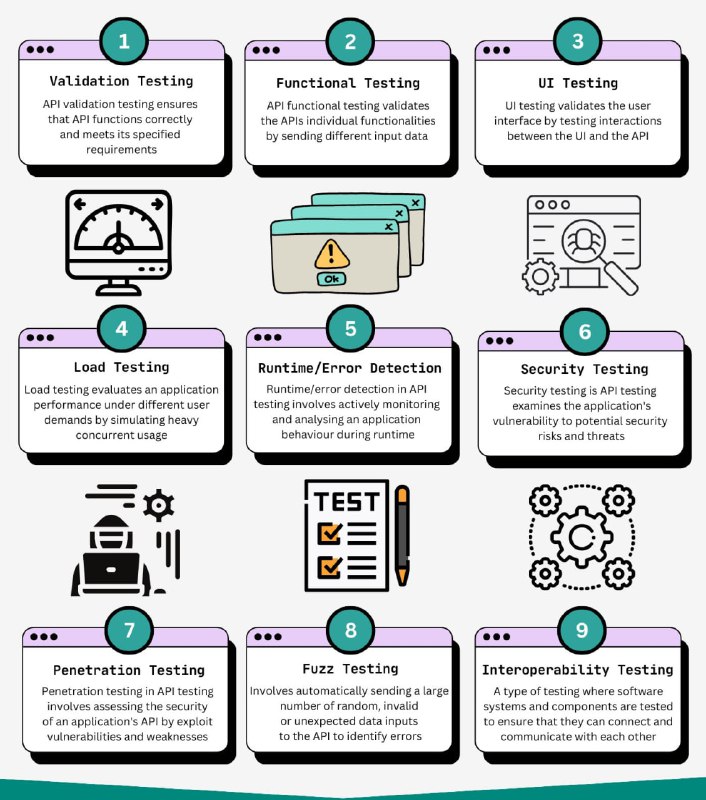
➡️ 1. Unit Testing: Involves testing individual components or functions of an API in isolation to ensure they function correctly and produce the expected output.
➡️ 2. Functional Testing: Focuses on testing the overall functionality of the API, verifying that it performs as intended and produces accurate results.
➡️ 3. Integration Testing: Tests interactions between different components or services within an API to ensure they work together seamlessly and communicate effectively.
➡️ 4. Load Testing: Evaluates the API's performance under heavy load by simulating a large number of concurrent requests to identify potential bottlenecks and optimize resource usage.
➡️ 5. Security Testing: Aims to identify vulnerabilities in the API by testing for potential security risks, such as unauthorized access, data leakage, or injection attacks.
➡️ 6. Stress Testing: Pushes the API beyond its limits by applying extreme conditions, such as high traffic or limited resources, to determine how well it can handle such scenarios.
➡️ 7. Negative Testing: Involves deliberately sending invalid or incorrect inputs to the API to verify that it responds appropriately with error messages or other expected behaviors.
➡️ 8. Boundary Testing: Focuses on testing the limits of the API's inputs, such as minimum and maximum values, to ensure it handles these boundaries correctly.
➡️ 9. Usability Testing: Evaluates the user-friendliness of the API by assessing how easily developers can understand its documentation, endpoints, and responses, ultimately enhancing the developer experience.
➡️ Python and Java are both popular and powerful programming languages, each with its own unique strengths. Python is known for its simplicity and readability, making it an excellent choice for beginners and rapid development. Its concise syntax allows developers to express concepts with fewer lines of code, promoting faster iteration and prototyping. Python's extensive library ecosystem empowers developers to access a wide range of pre-built tools for various tasks.
➡️ On the other hand, Java is recognized for its platform independence and robustness. It's a statically-typed language, which means errors can be caught at compile time, enhancing code reliability. Java's "write once, run anywhere" philosophy enables applications to run on different platforms without modification, thanks to the Java Virtual Machine (JVM). This also makes Java well-suited for building large-scale, performance-critical applications.
➡️ In summary, Python emphasizes simplicity, readability, and rapid development, while Java prioritizes platform independence, robustness, and performance. The choice between the two largely depends on the project's requirements and the developer's preferences.
✅ Maintainability: Changes in one layer won't lead to a domino effect of changes throughout the codebase. 🔄🚫
✅ Testability: Each layer is testable in isolation, making it easier to ensure your code works as expected. ✔️🧪
✅ Scalability: You can swap out components without disrupting the entire system. It grows with your project! 📈🔄
✅ Adaptability: Technology evolves, but your core business logic remains intact. Upgrades are smoother and less painful. ⚙️🔧
📚 Layers of Clean Architecture:
- Entity Layer: The core business logic lives here. It represents the heart of your application. ❤️🧠 - Use Case Layer: This layer holds application-specific use cases and business rules. It orchestrates interactions between entities and ensures they stay clean and focused. 🤝📋
- Interface Adapters: These adapters bridge the gap between the use cases and the external world, like user interfaces and databases. They keep things flexible and adaptable. 🌐🔌
- Frameworks & Drivers: The outermost layer deals with frameworks, tools, and external systems. It's where you connect to databases, APIs, and UI frameworks. 🖥🔗
CI/CD example for API written in Java/Spring Boot.
👉 CI/CD stands for Continuous Integration/Continuous Deployment. It is a software development process that involves automating the building, testing, and deployment of code changes.
🏭 The CI/CD pipeline can be thought of as a factory assembly line, where each step is automated to ensure the code is high quality and ready for deployment.
🛠 The pipeline starts with Continuous Integration, where code changes are automatically built, tested, and merged into a shared repository. This step helps catch errors early and ensures the code is stable and functioning correctly.
📦 Once the code has passed the integration tests, it moves on to Continuous Deployment. This step involves automatically packaging and deploying the code changes to a staging or production environment.
👀 Automated testing is performed at each stage of the pipeline to ensure that the code meets the required standards and that the new changes do not break any existing functionality.
🚀 The ultimate goal of a CI/CD pipeline is to speed up the software development process, reduce errors, and quickly deliver new features and improvements to users.