Post #461
375
Does big data serve policy? Not without context. An experiment with in silico social science
Authors: Graziul, Chris; Belikov, Alexander; Ishanu Chattopadyay; Ziwen Chen; Hongbo Fang; Anuraag Girdhar; Xiaoshuang Jua; P. M. Krafft; Max Kleiman-Weiner; Candice Lewis; Chen Liang; John Muchovej; Alejandro Vietos; Meg Young and James Evans
Source: Computational and Mathematical Organizational Theory; Vol.: 29; Issue: 1; Pp.: 188-219;
DOI: 10.1007/s10588-022-09362-3; March 2023
SFI Taxonomy: Models, Tools, and Scientific Visualization (Human Social Dynamics)
Abstract:
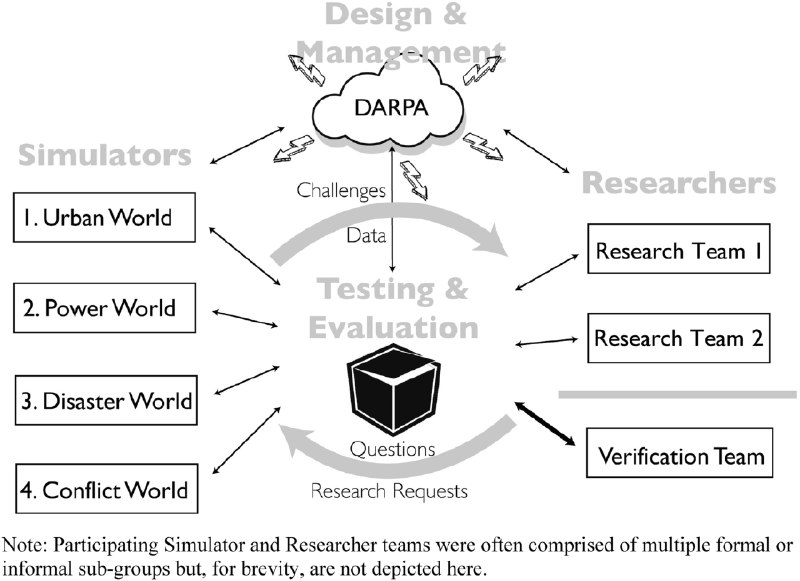
The DARPA Ground Truth project sought to evaluate social science by constructing four varied simulated social worlds with hidden causality and unleashed teams of scientists to collect data, discover their causal structure, predict their future, and prescribe policies to create desired outcomes. This large-scale, long-term experiment of in silico social science, about which the ground truth of simulated worlds was known, but not by us, reveals the limits of contemporary quantitative social science methodology. First, problem solving without a shared ontology-in which many world characteristics remain existentially uncertain-poses strong limits to quantitative analysis even when scientists share a common task, and suggests how they could become insurmountable without it. Second, data labels biased the associations our analysts made and assumptions they employed, often away from the simulated causal processes those labels signified, suggesting limits on the degree to which analytic concepts developed in one domain may port to others. Third, the current standard for computational social science publication is a demonstration of novel causes, but this limits the relevance of models to solve problems and propose policies that benefit from the simpler and less surprising answers associated with most important causes, or the combination of all causes. Fourth, most singular quantitative methods applied on their own did not help to solve most analytical challenges, and we explored a range of established and emerging methods, including probabilistic programming, deep neural networks, systems of predictive probabilistic finite state machines, and more to achieve plausible solutions. However, despite these limitations common to the current practice of computational social science, we find on the positive side that even imperfect knowledge can be sufficient to identify robust prediction if a more pluralistic approach is applied. Applying competing approaches by distinct subteams, including at one point the vast TopCoder.comglobal community of problem solvers, enabled discovery of many aspects of the relevant structure underlying worlds that singular methods could not. Together, these lessons suggest how different a policy-oriented computational social science would be than the computational social science we have inherited. Computational social science that serves policy would need to endure more failure, sustain more diversity, maintain more uncertainty, and allow for more complexity than current institutions support.
Authors: Graziul, Chris; Belikov, Alexander; Ishanu Chattopadyay; Ziwen Chen; Hongbo Fang; Anuraag Girdhar; Xiaoshuang Jua; P. M. Krafft; Max Kleiman-Weiner; Candice Lewis; Chen Liang; John Muchovej; Alejandro Vietos; Meg Young and James Evans
Source: Computational and Mathematical Organizational Theory; Vol.: 29; Issue: 1; Pp.: 188-219;
DOI: 10.1007/s10588-022-09362-3; March 2023
SFI Taxonomy: Models, Tools, and Scientific Visualization (Human Social Dynamics)
Abstract:
The DARPA Ground Truth project sought to evaluate social science by constructing four varied simulated social worlds with hidden causality and unleashed teams of scientists to collect data, discover their causal structure, predict their future, and prescribe policies to create desired outcomes. This large-scale, long-term experiment of in silico social science, about which the ground truth of simulated worlds was known, but not by us, reveals the limits of contemporary quantitative social science methodology. First, problem solving without a shared ontology-in which many world characteristics remain existentially uncertain-poses strong limits to quantitative analysis even when scientists share a common task, and suggests how they could become insurmountable without it. Second, data labels biased the associations our analysts made and assumptions they employed, often away from the simulated causal processes those labels signified, suggesting limits on the degree to which analytic concepts developed in one domain may port to others. Third, the current standard for computational social science publication is a demonstration of novel causes, but this limits the relevance of models to solve problems and propose policies that benefit from the simpler and less surprising answers associated with most important causes, or the combination of all causes. Fourth, most singular quantitative methods applied on their own did not help to solve most analytical challenges, and we explored a range of established and emerging methods, including probabilistic programming, deep neural networks, systems of predictive probabilistic finite state machines, and more to achieve plausible solutions. However, despite these limitations common to the current practice of computational social science, we find on the positive side that even imperfect knowledge can be sufficient to identify robust prediction if a more pluralistic approach is applied. Applying competing approaches by distinct subteams, including at one point the vast TopCoder.comglobal community of problem solvers, enabled discovery of many aspects of the relevant structure underlying worlds that singular methods could not. Together, these lessons suggest how different a policy-oriented computational social science would be than the computational social science we have inherited. Computational social science that serves policy would need to endure more failure, sustain more diversity, maintain more uncertainty, and allow for more complexity than current institutions support.