The director's cut on critical feeds from InfoSec world 🌎
Main Channel: @cKure
☕️ or queries email us
📨 i@ckure.org
Post #605
1.44K
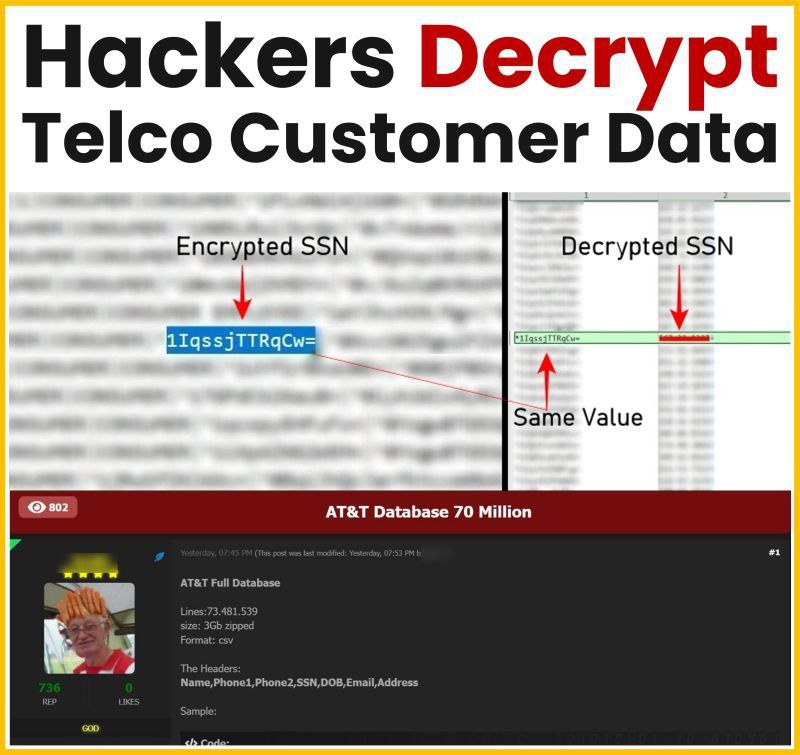
🔴 Hackers Decrypt Telco Customer Data.
👤Most sensitive data be encrypted by organizations that handle it? Yes, absolutely. Is it always encrypted?
🔥Unfortunately, not like in the recent SK Telecom HSS breach, USIM keys were reportedly stored in plain format without proper protection.
💻 Now, what happens when the stolen data is encrypted?
Time plays in the hacker’s favour. If the data has long-term value, they may invest effort in decrypting it, and that's exactly what seems to have happened here:
📂 A dataset of over 70 million AT&T customer records (some say 86 million) began circulating on cybercrime forums in mid-May 2025:
🔻Full names, birthdates, phone numbers, emails, and addresses.
🔻Around 44 million Social Security Numbers, now fully decrypted!
It’s believed the dataset originates from earlier breaches (possibly 2021), where the SSNs were encrypted. But now it’s been fully decrypted, repackaged, and released as a clean structured identity database.
🧨 Which is bad… This data has lifelong fraud potential!
Hackers can use it to bypass most legacy validation and KYC processes, from SIM swap attacks to full-scale identity theft, fraudulent loans, etc.
⚠️ A not so quiet side effect: a reminder that static data was never meant to prove identity. SSNs and similar identifiers were never meant to be authentication factors, but they’ve been treated as such for decades.
Please keep in mind:
🔻SSN + DOB + Address + Else ≠ Identity proof
🔻Any system relying on static identity data is open to impersonation and abuse.
Credits: Linkedin | Dimitry Kurbatov