TGViewer
Channel Public Channel
CIIC

CIIC

@ciic_world

Center for International Interaction and Cooperation

Join us to build the multipolar world together!

contact@ciic.site
Subscribers
1.86K
Photos
498
Videos
38
Links
320

Showing posts older than #718 · Back to latest

Older Posts 7 shown
Post #717 418
🤝 Our friends at the Gorchakov Fund have opened applications for an international round table on youth cooperation

The Youth Council of the Republic of Srpska, with grant support from the Alexander Gorchakov Public Diplomacy Fund, invites young professionals, representatives of civil society organizations, and volunteers to take part in the international round table “Youth of the Balkans and Russia: Public Diplomacy and Volunteering.”

The programme will focus on the exchange of experience between Russian and Balkan organizations, the development of public diplomacy and volunteering, and new formats for international youth cooperation.

🗓 September 27–28
📍 Banja Luka, Republika Srpska, Bosnia and Herzegovina

The programme includes:
🔵 presentations by Russian and Balkan organizations and an exchange of best practices;
🔵 expert lectures and working sessions on developing joint projects;
🔵 discussions on new youth and volunteer initiatives;
🔵 building long-term international partnerships and signing memoranda of cooperation;
🔵 a cultural programme.

Who can apply?
🔹 representatives of youth and civil society organizations working in international cooperation and public diplomacy;
🔹 students and professionals in international relations, political science, economics, international law, and history;
🔹 volunteers and participants in volunteer initiatives.

Participants should be 18–35 years old; for certain categories, the age limit is 45.

➡️ Apply here by September 5.

More information on participation requirements is available on the Gorchakov Fund website.
  • ❤ 4
  • ❤‍🔥 2
  • ⚡ 1
Post #716 385
🌍 New Electoral Trends within the U.S. Democratic Party

Recently, we invited the authors to contribute to our series of articles “Analysis without Borders” and received many applications from different countries. Thanks to everyone who sent us their articles, ideas and suggestions.

🇮🇷 Today we are publishing the work of our old friend from Iran. Mehdi Honardide has prepared an analysis on the dynamics of change in the US Democratic Party.

🇺🇸 New Electoral Trends within the U.S. Democratic Party

The Democratic Senate primary in Michigan on August 4 was formally a contest between two Democratic candidates. Politically, however, it became a much broader confrontation over the future direction of the Democratic Party.
Abdul El-Sayed, a physician, former public-health official and prominent progressive, defeated four-term Representative Haley Stevens, a candidate more closely aligned with the party establishment. El-Sayed campaigned on universal health-care reform, economic justice, curbing corporate influence in politics and ending unconditional U.S. military support for Israel.

El-Sayed’s victory should not be understood simply as the personal success of a progressive candidate or the defeat of a moderate Democrat. It reflects the convergence of several grievances that have become increasingly important among younger and progressive Democratic voters: dissatisfaction with the political influence of corporations and major donors, demands for broader access to health care and economic security, and growing opposition to Washington’s approach to Israel and Gaza.

The role of younger voters is particularly significant. During the primary campaign, El-Sayed drew large crowds at university events, where students and young voters became an important component of his grassroots coalition.

For part of this generation, Gaza is not simply a foreign-policy issue. It has become a broader political symbol—representing concerns about Washington’s foreign-policy establishment, the influence of lobbying networks and the perceived distance between Democratic leaders and parts of the party’s younger base.

Yet it would be premature to conclude that Michigan itself has undergone a decisive ideological transformation.

El-Sayed’s primary victory was narrow, and the electorate in a party primary is not representative of the broader electorate that will vote in November. The result therefore says more about the changing balance of power within the Democratic coalition than it does about a wholesale ideological shift among Michigan voters.

El-Sayed’s central challenge will consequently be coalition expansion. He must retain the enthusiasm of progressive and younger voters while winning over moderates and independents who may be less comfortable with his ideological profile.

The Michigan primary was an important victory for the progressive wing of the Democratic Party. But the November election will answer the more consequential question: can progressive candidates transform activist energy and youth enthusiasm into a broad electoral coalition?

The real test in Michigan will be whether the “young voters, Gaza and economy” coalition can evolve from a powerful primary constituency into a broad, majority-building electoral alliance in November.

✍️ Author: Mehdi Honardide

#AnalysisWithoutBorders
  • ❤ 6
Post #710 452
🇬🇲 Russian Language in The Gambia

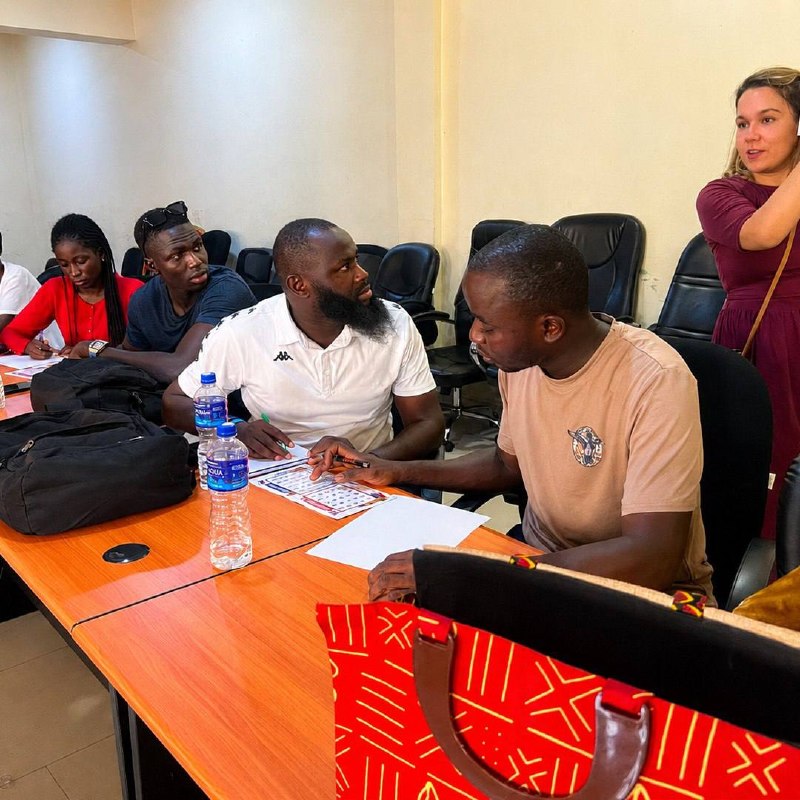
On August 17, the Volga Summer Russian Language Course launched in The Gambia — a two-week intensive Russian language program taught by an instructor from Russia. The program is designed for beginners and combines language training with an introduction to Russian culture and history, as well as opportunities to pursue higher education in Russia.

🌏 A year ago, Gibril Faal, Director of the WYF National Preparatory Committee for The Gambia, with whom we continue to cooperate today, approached us with an initiative to create more accessible opportunities for learning Russian in the country, primarily for young people planning to continue their education at Russian universities. At the same time, the initiative goes beyond a single language course: it is laying the groundwork for the further development of Russian language teaching in The Gambia and, in the longer term, may contribute to the introduction of relevant programs into the country’s education system.

🇷🇺 We were glad to assist Gibril and his team by providing informational and technical support in preparing, completing, and submitting a grant application to the Russkiy Mir Foundation. The application was successful, and the initiative is now being implemented.

The language course brings together 30 participants, while its cultural and educational program is designed to reach up to 100 people. The program includes a total of 30 academic hours of Russian language classes and 16 hours dedicated to Russian culture and history.

The first results became visible within just a few days: participants have learned the Cyrillic alphabet, can write their names in Russian, and are already beginning to read simple phrases.

🤝 The next step is to continue this work and develop dialogue with the relevant Gambian authorities on expanding opportunities to study Russian in the country. For us, it is especially important to see an idea brought to us a year ago become a real educational initiative today — one that contributes to strengthening humanitarian and educational ties between Russia and The Gambia.
  • ❤ 12
  • 🔥 3
  • 👍 2
Post #704 419
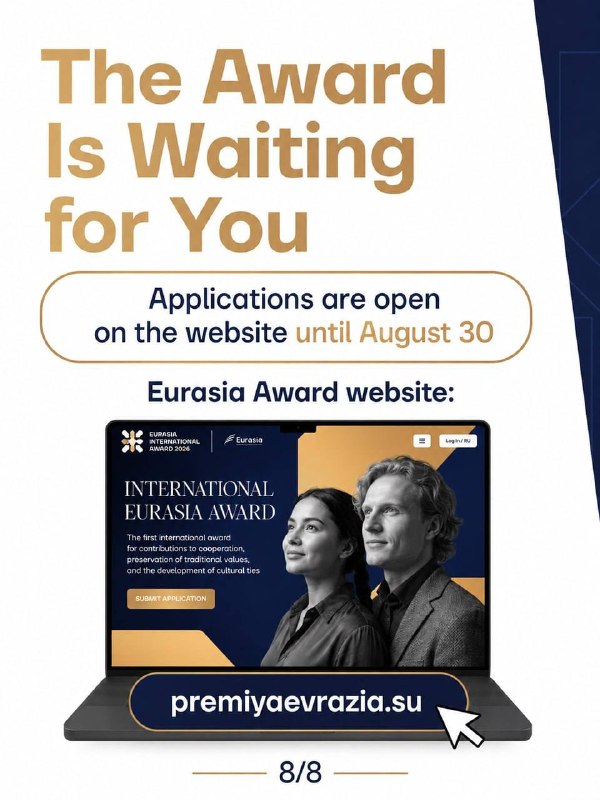
The Eurasia Award is for you!

We are proud partners of the Award and support those who advance cooperation across Eurasian nations.

💙 The Award welcomes projects of any scale, in any field. What matters most is their real impact and tangible results

Forget the hesitation — your project deserves the spotlight!

Applications are open until August 30

🔥 Submit your application today! The review committee will even help you polish and improve it.

↗️ Submit an application
  • ❤ 3
  • 🔥 1
Post #700 375
🌍 August 19 — World Humanitarian Day

This day recognizes those who help people affected by emergencies, conflicts, and humanitarian crises. Today, humanitarian work also means building long-term cooperation with local communities.

🌏 For CIIC, this is part of our practical work. This year, we signed a cooperation agreement with the International Humanitarian Corps, bringing together Russian organizations engaged in international humanitarian activities.

😊 We are also developing humanitarian initiatives together with Rossotrudnichestvo.

🇰🇿 In Kazakhstan, with the support of Rossotrudnichestvo and CIIC, a social taxi project was launched in Uralsk. Two vehicles were provided to create jobs for drivers with hearing impairments. The idea is simple: not one-off assistance, but a sustainable model that supports both employment and social inclusion.

🇧🇾 In Belarus, CIIC supported Rossotrudnichestvo’s humanitarian project “Let Everyone Receive Help!”. Bicycles and e-bikes were provided to social workers in the Bereza District, helping them reach elderly people and those living alone in remote communities more quickly.

📚 Another area of joint work is the international “Guardians of Memory” project, which brings together young historians, researchers, archivists, and journalists from different countries around the preservation of historical memory.

🌐 Humanitarian cooperation in Russia involves a wide range of actors: the Russian Ministry of Foreign Affairs, Rossotrudnichestvo and its network of Russian Houses, EMERCOM of Russia, the Ministry of Science and Higher Education of the Russian Federation and Russian universities, the Ministry of Culture of the Russian Federation and cultural institutions, as well as charitable foundations, humanitarian and volunteer organizations, NGOs, and expert centers.

Each brings something different to the table — from emergency response and direct assistance to education, culture, youth initiatives, and public projects. Working together makes it possible to move beyond individual activities and build lasting ties between countries and communities.

💫 Humanitarian cooperation is not only about being there when help is needed. It is also about creating solutions together that continue to work long after a particular project has ended.
  • 🔥 5
  • ❤ 4
  • 💯 2
Post #699 367
Analytics without Borders: Join #ciic_friends

Dear friends, we are very grateful to you for your participation in the development of our professional community.

🔥 For the most active and talented, we decided to launch the #ciic_friends section, in which we will publish analytical materials from our subscribers.

Send your works and topics
to us in the telegram channel and do not miss the release of your materials 💬

⭐️ Would you like to participate?
  • ❤ 11
Post #693 455
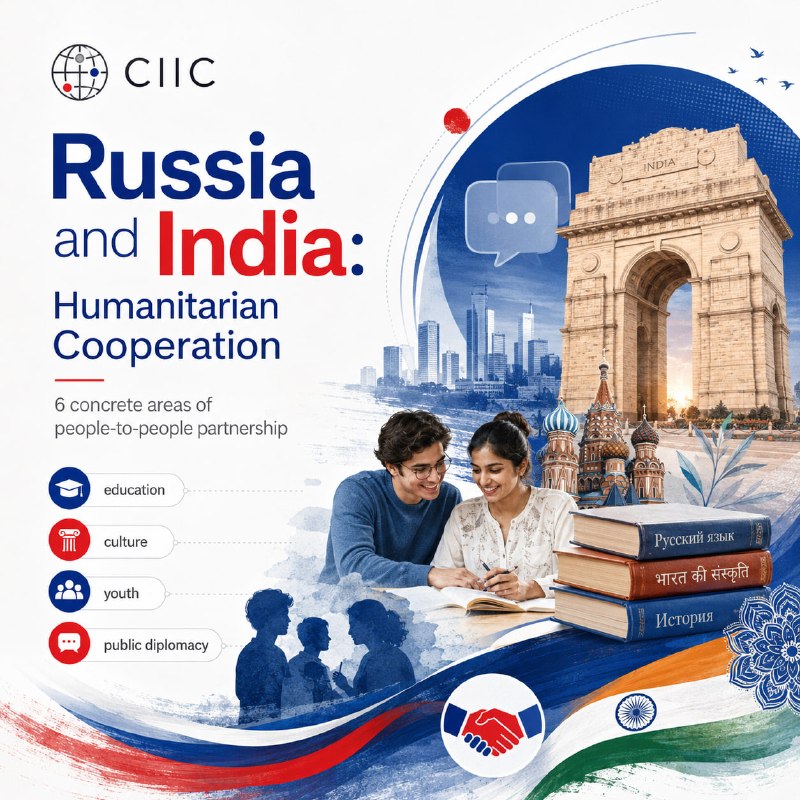
🇮🇳 India celebrates Independence Day — and we invite you to look at Russia–India relations through concrete humanitarian projects

August 15 is a good occasion to speak not only about India’s history, but also about how ties between our countries are developing today beyond the sphere of high-level politics. In the case of Russia and India, it is particularly clear that humanitarian cooperation is not built around a single project, but across several established areas of engagement.

😊 Rossotrudnichestvo plays an important role in this work. Its representative office in India develops educational, cultural, and youth programs, while the network of Russian Houses includes five locations — in New Delhi, Chennai, Kolkata, Mumbai, and Trivandrum. They host Russian language courses, educational presentations, cultural events, youth programs, and other initiatives that form a permanent infrastructure for humanitarian ties between Russia and India.

📚 In 2026, a new Centre for Russian Language and Culture opened at Gujarat University — another platform promoting Russian education and culture in India.

🎓 University cooperation is expanding as well. The Second Indo-Russian Education Summit in New Delhi brought together more than 70 Russian and Indian universities and provided a platform for discussing academic mobility, joint programs, and new partnerships.

👥 Youth engagement is another important area. The Second Russia–India Youth Forum brought participants together around science, innovation, culture, public diplomacy, and volunteering. More than 1,200 people expressed interest in taking part.

🎭 Culture remains one of the most accessible and enduring languages of dialogue: Russian language courses, film screenings, exhibitions, meetings with students, as well as literary and educational programs are regularly held at Russian Houses across India.

We have selected six projects and areas of cooperation that best demonstrate what Russia–India humanitarian partnership looks like in practice today.

Find out more in our cards⬆️
  • ❤ 6
Older posts →
Threads Profile ViewerView any public Threads profile without an account.Open ThreadLook →Writing with AI? Make it sound human.Metric37 rewrites AI drafts so they read naturally. Free AI detector, 1,500 words free.Try Metric37 →