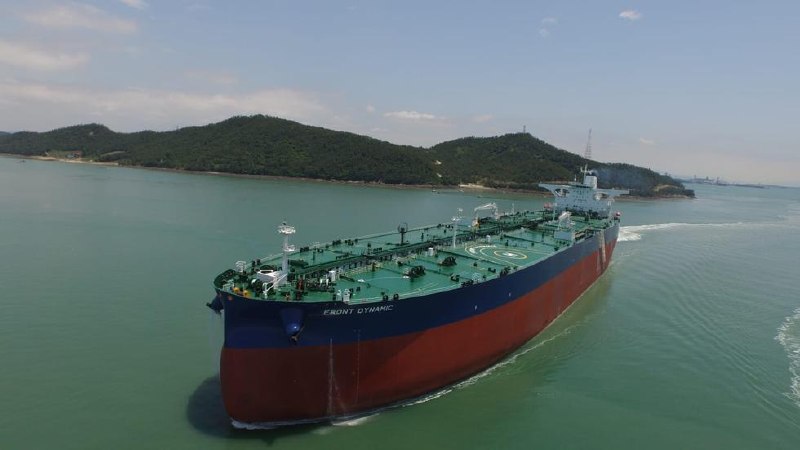
🛢 Goldman Sachs estimates that insurance rates for VLCCs will reach $200k in 2027 and up from $150k in 2026
Record-high rates and an ageing fleet give the oil shipping companies good incentives to order new ships, and according to Goldman Sachs, the oil tanker is now taking an increasingly large part of the order entrance at shipyards.
Container ships accounted for the largest part of new orders in 2024–25, but the tankers are now taking a larger share of the contracting.
According to the investment bank, the order input has historically shot speed when “dynamic RoI” – expected timecharter earnings over the next twelve months divided by the current new construction price – is around 20 percent. For VLCCs, that figure is now 59 percent.
Goldman Sachs assumes VLCC rates of $150,000 the day in 2026, $200,000 in 2027 and $140,000 in 2028. It provides a dynamic RoI of 41, 55 and 38 percent respectively.
Today, the spot rates for VLCCs are $640,000 the day outside the Strait of Hormuz and $1.3 million for sailing through the strait, according to the ABG Sundal Collier.
Around 19 percent of the tanker fleet is already over 20 years old, and oil tankers now have a record high average age. About 43 percent of the fleet will be older than 15 years at the end of 2026, while the order book is equivalent to around 24 percent of the current fleet.
By 2030, 43 percent of the tanker fleet is estimated to be over 20 years, against an order book equivalent to 26 percent of the fleet. Many of the ships from the previous delivery peak in 2006–12 are thus approaching the replacement age.
The analysts, led by Herbert Lu, are expecting the rise of the shipyards to last until 2032.
“Our analysis of fleet age shows that 43 percent /29 percent of tankers/bulkships will be over 20 years old in 2030, against existing orders of 26 percent /15 percent, and another 5 percent/7 percent of tanker/bulkships incremental capacity will pass 20 years per year in 2031–32, providing strong underlying replacement demand that makes up 52 percent of total new orders in 2026–32,” Goldman analysts write.
🔗 https://www.finansavisen.no/shipping/2026/10/09/8386537/goldman-sachs-venter-tankrater-pa-200.000-dollar-neste-ar
Post #85359
2.86K
/CIG/ Telegram | Counter Intelligence Global 🛢 Usually, shipping a barrel of crude from the Middle East to Asia costs around $1.50–$2.50. But with VLCC rates soaring in 2026, TotalEnergies CEO Patrick Pouyanné says freight and insurance costs have surged to roughly $10 per barrel—turning transportation…