🇪🇹 🇪🇹 🇪🇹 A recently announced rebel coalition has launched a large-scale offensive against the Ethiopian federal government, which may be the first move in a renewed full-scale war in northern Ethiopia.
The rebel offensive likely aims to consolidate the TPLF's control of Tigray and pressure key federal supply lines, although strategic differences will challenge coordination among the disparate coalition members.
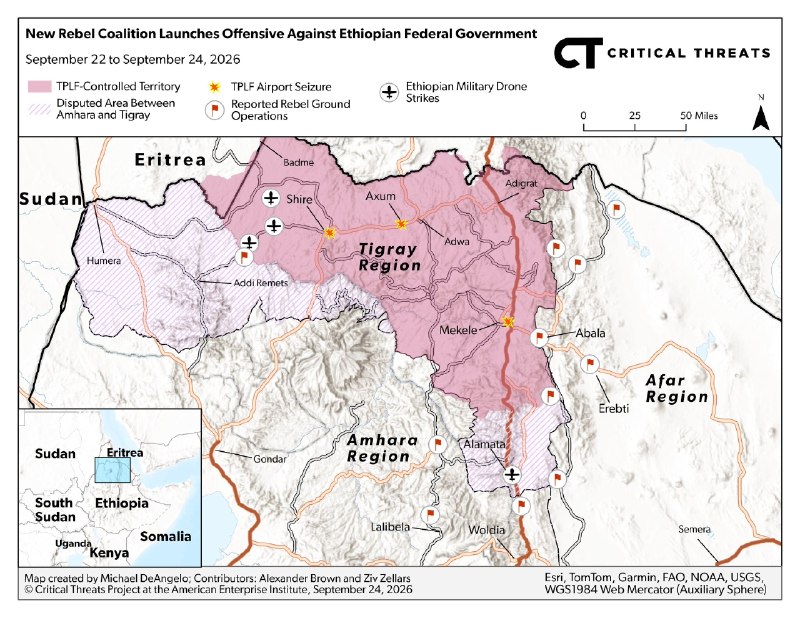
The rebel coalition's offensive began when the TPLF seized the three main airports in Tigray region on the night of September 22 to September 23.
The Afar Revolutionary Democratic Unity Front (ARDUF/Ugugumo) and the TDF—the TPLF’s military wing—then conducted offensive operations on multiple axes on the Afar-Tigray regional border in Afar, most notably capturing the district capital Abala approximately 30 miles east of Mekele, the Tigray regional capital.
The ethno-nationalist Amhara Fano National Movement (AFNM) and TDF have also clashed with the Ethiopian military (ENDF) on multiple axes near the Amhara-Tigray regional border in Amhara, but the ENDF has thus far prevented significant rebel gains.
The fighting has reportedly expanded to western Tigray, an area that the TPLF disputes due to it being largely under federal or federal-allied control.
The attacks are likely part of a premeditated rebel offensive, and the rebels have described the fighting as part of a war with the federal government.
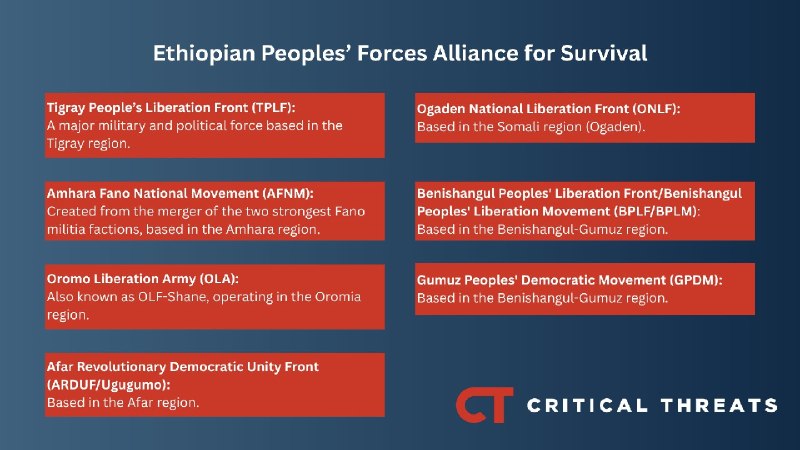
The Ethiopian Peoples’ Forces Alliance for Survival (Alliance for Survival) announced its formation on September 20 after months of discussions, with the TPLF, AFNM, ARDUF, Oromo Liberation Army (OLA), and three other groups as its initial members.
The Alliance for Survival then accused the federal government on September 23 of initiating a “renewed war” and alleged that all coalition members were counterattacking.
The rebel offensive likely aims to consolidate the TPLF’s control of Tigray and relieve federal pressure on the region.
The TPLF now effectively controls the entire Tigray region outside of disputed areas in southern and western Tigray.
Much of the fighting in Afar and Amhara is also concentrated in areas where the ENDF had deployed forces as part of a wider buildup and blockade on the Tigray regional border.
The offensive could bolster rebel supply lines while threatening vital federal road corridors.
TPLF control of regional airports opens a potential air bridge, and rebel operations along key roads could strengthen supply lines from Eritrea and Sudan.
Fighting along the north–south A2 highway in Amhara is also only approximately 30 miles north of Woldia, which is a key choke point for the entire Amhara region.
The rebel capture of Abala and further fighting east separately opens a potential rebel line of advance toward the strategic A1 highway, also known as the Ethio-Djibouti highway, which the Ethiopian federal government relies on as corridor for approximately 90 percent of its trade.
Preexisting tensions and strategic discrepancies will challenge coordination among disparate rebel coalition members, which will likely cooperate insofar as it serves their individual interests.
The three primary coalition members—the AFNM, TPLF, and OLA—have substantial differences with each other, including objectives and land disputes.
The rebel offensive has so far underscored that operational coordination in the Alliance of Survival is guided by pragmatic self-interest among coalition members.
The AFNM and ARDUF are simultaneously advancing their individual objectives separate from the TPLF, while a continued lack of involvement by the other four coalition members outside of northern Ethiopia would indicate a lack of will or capability to open additional fronts.
https://www.criticalthreats.org/analysis/ethiopia-tigray-tplf-fano-china-prc-djibouti-jnim-mali-sudan-saf-rsf-somalia-aussom
📎 Critical Threats
Post #84506
3.62K