
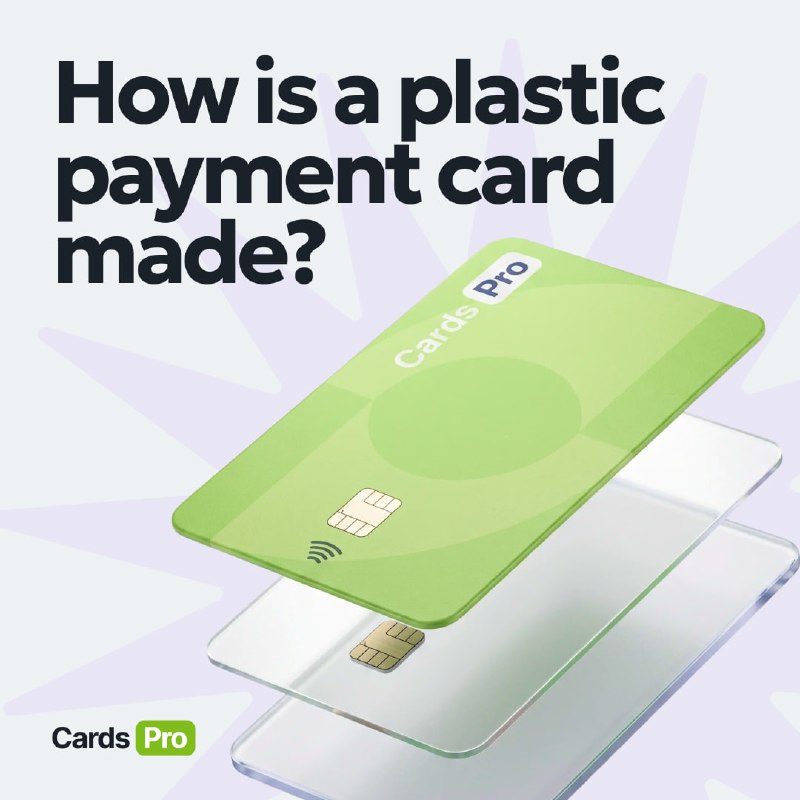
How is a plastic payment card actually made?
Surprisingly, it begins as a large sheet containing dozens of future cards.
📃 First, the design is printed
Most conventional payment cards are made from several layers of PVC or alternative composite materials. The front and back designs are printed onto large sheets rather than individual cards.
⚙ The layers are assembled
The printed surfaces, central core and transparent protective overlays are stacked together. A magnetic stripe may be added to the rear overlay, while contactless cards contain a small antenna inside the card body.
🎃 Everything is laminated
Heat and pressure fuse the layers into one solid panel. Only then are the individual cards cut out in the standard ID-1 size: 85.60 × 53.98 mm and approximately 0.76 mm thick.
🏬 The chip is installed
A precision machine mills a cavity into the finished card body. The chip module is inserted and bonded inside it. For contactless cards, it also communicates with the antenna hidden between the layers.
💵 Finally, the card is personalised
The card number, expiry date and cardholder name are printed, engraved or embossed. The chip and magnetic stripe are encoded, security elements are added, and the finished card passes visual and functional checks.
⏳ Cards were not always made this way. The Charga-Plate, introduced in 1928, was a small embossed metal plate. The first Diners Club cards in 1950 were made from cardboard, while American Express became the first major issuer to introduce plastic cards in 1959.
Chips arrived much later. French banks began deploying them during the 1980s, and by 1994 every French bank card carried one. The first global EMV specifications followed in 1996.
✅ Today, a card for online payments can skip the entire factory.
With CardsPro, businesses can issue and manage virtual cards without waiting for plastic production or delivery.
Post #452
454
- 👍 6
- ❤🔥 2
- 🙏 1