TGViewer
Channel Public Channel
Dr. Belaveshkin

Dr. Belaveshkin

@beloveshkin

Andrew Belaveshkin
MD PhD preventive medicine belaveshkin.com Making people, things, spaces and the world healthier
📖Books: The will to live, The right food at the right time
Subscribers
9.36K
Photos
1.1K
Videos
33
Links
703
Recent Posts 20 shown
Post #3476 222
In the Mediterranean, Pistacia lentiscus — the mastic tree — grows abundantly.
When its bark is gently cut, it produces an aromatic resin called masticha (μαστίχη), traditionally chewed as a natural chewing gum.
Here in Kato Paphos, these trees are everywhere. Mastic chewing is an ancient Mediterranean tradition dating back thousands of years, and mastic has been traditionally valued for its health benefits.
Unlike conventional synthetic chewing gum, natural mastic resin is plant-derived and does not contain synthetic plastic polymers.
  • ❤ 6
  • 👍 4
Post #3475 320
10 ideas for quick anti-stress.

✅1. Restore sensory contact. It is essential to focus on the external rather than on internal experiences during stress. This technique is called “5-4-3-2-1”: see 5 things, touch 4, hear 3, smell 2, taste 1. Focus on the people around you.

✅2. Physical contact. Everything directed at the body works: self-massage, rubbing the ears and the wings of the nose, kneading the hands and feet, rubbing with a towel, rollers, and so on. Temperature exposure to the body: hot bath, sauna, cold shower.

✅3. Teeth. Chewing reduces cortisol levels and increases concentration. Both chewing gum and carrots are suitable.

✅4. Breathing. “Double inhalation,” “breath holding,” “box breathing,” “slow diaphragmatic breathing,” and any other techniques that are convenient to do, also with the help of mobile applications.

✅5. Tongue. Reading aloud, reciting poetry, singing songs, swearing. Reading aloud, for example, perfectly distracts and resets. In the end, press your tongue to the palate.

✅6. Eyes. Fix your eyes on one point, for example, on the bridge of the nose, and you will see that the stream of thoughts has stopped. (EMDR) may work. Observe natural fractal surfaces: clouds, waves, flame, trees, mountains.

✅7. Motor activity. Perform monotonous actions: for example, you can finger through prayer beads, because monotonous actions unload the brain. It works well when you try to jump high or jump rope, walk, and so on.

✅8. Focus on one thought. By repeating it to yourself, you can maintain contact with reality. Focus on self-supportive inner speech: “I can handle it.” Even a simple distraction can reduce stress: for example, an elementary game of Tetris.

✅9. Posture. Straighten up, head up, shoulders open – an open posture weakens fear and the effect of stress. Try TRE (Tension Trauma Releasing Exercises) or stretching to diminish muscle tension.

✅10. Prefrontal cortex. Imagine that you are about to burst from stress, it overwhelms you… 5… 4… 3… 2… 1 – and nothing happens! Bring the thought to the point of absurdity – and you will feel better. You can imagine your fear in the form of someone or something – and “squash” it like a cockroach. Distract yourself – by playing Tetris or by taking a plank position.
  • ❤ 13
  • 👍 3
  • ❤‍🔥 1
Post #3474 645
"Think of the best, prepare for the worst, do what you must, and let come what may."

This combination of maxims grew out of Stoic ideas (duty and acceptance), then passed into the mottos of knightly houses, and from there to the Freemasons. The second half, about best and worst, comes from British literature. Either way, these are genuinely working, scientifically effective, and practical formulas.

✅ Think of the best (realistic optimism). Hold your values and goals in front of you, focus on the opportunities the situation offers, simply see the realistic possibilities and options in it — the opportunity to act on your values. Realistic optimism improves mental health and broadens perspective and effectiveness (unlike unrealistic optimism and fantasizing, which do harm).

✅Prepare for the worst (defensive pessimism). The Stoics practiced premeditatio malorum — anticipating misfortune: mentally rehearsing hard situations, imagining losing everything you have. Defensive pessimism is real, practical risk management for the health of your business and situations — it lowers the risk of failure and is good for your health (unlike total negativism).

✅Do your duty (follow your values). The concept of duty holds a large place among the Stoics, where civic duty is tied to moral duty. And virtue (virtus — courage) means carrying out your duty and following your moral values: always act with wisdom, courage, justice, and moderation. What should you do? Do what you must.

✅Let come what may (accept reality). Accepting reality is a powerful therapeutic tool that improves mental health and effectiveness. Instead of fighting reality and denying it — and "MUSTurbating" over the ideal — the best thing you can do is accept it, take responsibility for what you do, and accept what happens. And radical, unconditional acceptance of reality — amor fati — is itself the highest form of control.
  • 👍 19
  • ❤ 1
Post #3473 594
Why can’t the smartest AI model ever created do something this simple: make the company that created it profitable? 😏
  • 😁 15
  • ❤ 1
Post #3472 738
Popular Greek singer Giorgos Mazonakis died at the age of 54 after suffering cardiac arrest during an “anti-aging” plasmapheresis procedure. This is an important reminder: IV drips, plasmapheresis, and other intravenous interventions have no proven clinical benefit for healthy people, but carry real and sometimes serious medical risks. Remember the fundamental rule of asymmetry: any preventive procedure for healthy people should be extraordinarily safe. Don’t fall for the tricks of medical scammers.
  • 👍 13
  • ❤ 10
  • 💔 4
Post #3471 1.03K
“Do not decorate the walls of your house with Euboean or Spartan marble - decorate the hearts of your fellow citizens and their rulers with the fruits of Greek enlightenment: it is not stones or wood that serve as the foundation of the state, but the minds of its citizens.” - Epictetus
  • ❤ 39
  • 👍 6
Post #3469 960
Ancient philosophy is a spectrum where everyone can find their place.
  • 😁 10
  • ❤ 2
Post #3468 1.08K
Post #3467 1.32K
Social media is ultra-processed information, designed by people to trigger you, not to educate.

Like ultra-processed food, it’s engineered for endless consumption, loaded with “flavor enhancers” — outrage, novelty, status, fear — that make you crave another bite.

You don’t consume it because you’re hungry. You consume it because it was designed to make you hungry.

And just like ultra-processed food, overconsumption can come with a cost.
  • ❤ 40
  • 👍 15
  • 👏 5
Post #3466 1.01K
📖Possible Potentiating Effects of Combined Administration of Alcohol, Caffeine, and Nicotine on In Vivo Dopamine Release in Addiction-Related Circuits Within the CNS of Rats Biomedicines 2024 Nov 13;12(11):2591.
Chronic caffeine exposure potentiates nicotine self-administration in rats Psychopharmacology (Berl) 1999 Mar;142(4):327-33.
Hypothesizing Music Intervention Enhances Brain Functional Connectivity Involving Dopaminergic Recruitment: Common Neuro-correlates to Abusable Drugs Mol Neurobiol . 2017 Jul;54(5):3753-3758.
  • ❤ 1
Post #3465 974
The Sum of Pleasure. Walking through the city, I often notice a striking pattern: in sports betting and lottery kiosks, men sit holding a lottery ticket and a betting slip, with a lit cigarette in one hand and a cup of sweet coffee or a glass of alcohol in the other. It’s a perfect real-world example of what I call the sum of pleasure.

🫣This term describes the synergistic effect of combining multiple stimulants—both chemical and behavioral—that target different levels of the dopamine system: sensory, emotional, cognitive, and metabolic. When these layers of stimulation overlap, the resulting dopamine release doesn’t simply add up—it can amplify in a nonlinear way. This is why certain combinations become so powerfully reinforcing and deeply habit-forming.

🟥A well-studied example is the pairing of caffeine and nicotine. Caffeine, by blocking adenosine receptors, increases dopaminergic activity, producing both reinforcing and psychomotor-enhancing effects. Nicotine blocks dopamine reuptake and increases its release into the synapse, driving its own strong reinforcing and psychostimulant properties.

🟥When combined, caffeine and nicotine create a synergistic dopamine surge—higher than the sum of their individual effects—especially in the nucleus accumbens and striatum. This doesn’t just intensify the “hit,” it increases the addictive potential of both. Smokers, on average, consume 1.5–2× more caffeine than non-smokers. In animal studies, caffeine not only speeds up the acquisition of nicotine self-administration but also increases total intake.

🟥 In human studies, higher caffeine consumption predicts higher smoking frequency. Among adolescents, heavy intake of coffee, energy drinks, or sugary beverages is linked to a 2–2.5× greater likelihood of smoking and a 4.6× higher chance of vaping.
Negative effects also stack. Smoking plus alcohol, for example, increases depressive symptoms beyond the level seen when each is consumed alone.

🫣Other real-world “sum of pleasure” combinations include: Smoking + alcohol + endless scrolling on social media. Eating+scrolling. Sugar + caffeine (especially in energy drinks). Ultra-processed foods containing sugar, refined carbs, salt, fat, and flavor enhancers—all designed to hit multiple dopamine pathways simultaneously. Loud music + alcohol + smoking. Online shopping + fast food. Watching reels + cookies or alcohol. Add yours?

Practical rules to protect your dopamine system

✅1. The Squeezed Lemon Rule.
Think of your brain’s dopamine capacity like the juice inside a lemon. The more you “squeeze” it by stacking dopamine sources, the more you get in the moment—but you’ll have less left for everything else. This is why after a heavy “sum of pleasure” session, activities that normally bring joy can feel flat and uninteresting.

✅2. The “Don’t Mix” Rule.
Avoid stacking pleasures habitually. Take one source of enjoyment at a time, slowly and mindfully. This way, your brain learns to appreciate individual stimuli without requiring the exaggerated spike from multiple simultaneous inputs.

✅3. The Flow Rule.
When building a new habit that feels challenging, strategic stacking can help—at least in the early stages. For example, music has been shown to extend workout duration by 10–20%, increase motivation, and reduce perceived exertion. Pair caffeine + music + exercise, and you can accelerate habit formation and make the process more enjoyable.

✅4. The Golden Mean Rule.
There’s an optimal range for stimulation. Too much can raise anxiety, lower focus, and actually reduce pleasure. High caffeine doses, for instance, can impair performance in activities like crossfit. Even the presence of an especially attractive person during a workout can paradoxically decrease enjoyment of the session, likely by shifting attention and cognitive load away from the activity itself.
  • 👍 7
  • ❤ 5
  • ❤‍🔥 3
Post #3463 783
How to lose a war. The anti-vaxxer movement in the United States is not simply an internal matter, but also a consequence of a lost information war. This war began in 2014 — in the form of an informational anti-vaccine attack by russian trolls and bots, inflating anti-vaxxer sentiments, undermining trust, and polarizing the discourse.

According to research, these were millions of messages at a high frequency — on average, a russian bot wrote about vaccination 22 times more often than an ordinary Twitter user. The scale of the anti-vaccine war was large and systematic — not only the main bot factory, the Internet Research Agency (IRA), but also each intelligence service had its own bot factory that specifically attacked and undermined trust in vaccination in the United States. According to a State Department report, these platforms were News Front — FSB; New Eastern Outlook — SVR; Oriental Review — SVR; Rebel Inside — GRU. All of this happened with the complete indifference of the U.S. authorities.

It would seem that the topic for an information war was chosen rather strangely. How many other controversial issues are there in society? However, the target of the attack was chosen very precisely. A vaccine is a rare medical product that a person receives not because they are already sick, but because the state and medicine say: do this now to prevent a future risk. At the same time, it connects the individual, the state, and the larger system. It is mandatory; it immediately connects several powerful identities: parents → children → care → body→ injection→fear → medicine → state → freedom → personal choice. It has an unusual property: personal experience proves almost nothing (a headache pill relieves a headache), while a vaccination has no effect — you need trust that you have avoided a possible problem.

Therefore, an attack on vaccination makes it possible to attack not just one fact, but also the epistemic system and trust in the state as a whole. It is not simply “this is a bad vaccine,” but “Do not trust doctors, universities, pharmaceutical companies, regulators, statistics, and official sources in general.” And this is precisely what makes it potentially much more valuable for destabilizing the very system of knowledge production and trust than, for example, an ordinary political lie about some specific event.

☝️This is exactly how the “gateway conspiracy” works. Just as it is enough to punch one hole in a ship and it begins to sink, it is enough to believe in one conspiracy theory, and this leads to a subsequent strengthening of the general tendency to believe in conspiracy theories and to the acceptance of new, completely different theories and lies.

🟥One absurd belief can become a gateway: once a person accepts one falsehood against the evidence, the next falsehood faces less resistance.Moreover, studies specifically tested the direction over time, rather than simply the correlation “people who believe in one theory usually believe in others.”

🤔The monological belief system model suggests that developing a belief in one conspiracy theory will cause them to be more likely to believe in others. Events unfold as follows: first lie → acceptance of a false explanation → change in the criterion of what is considered possible/credible → the next lie encounters less resistance.

🚩Therefore, the anti-vaxxer discourse is not simply a discussion. It is a war of annihilation, an information attack aimed at undermining states, the will to live, and the ability to think rationally.

📗Weaponized Health Communication: Twitter Bots and Russian Trolls Amplify the Vaccine Debate Am J Public Health 2018 Oct;108(10):1378–1384.
📗Russian Twitter Accounts and the Partisan Polarization of Vaccine Discourse, 2015–2017 Am J Public Health 2020 May;110(5):718–724.
📗Vaccine misinformation types and properties in Russian troll tweet Vaccine 2022 Feb 7;40(6):953-960.
📗Does Developing a Belief in One Conspiracy Theory Lead a Person to be More Likely to Believe in Others? Volume55, Issue4 June 2025 Pages 554-564
  • ❤ 11
  • 🌚 2
  • 👍 1
Post #3461 720
Criticizing is easy and pleasant, especially when a person is wrong. Angry condemnation, public ridicule, and debunking propaganda, conspiracy theories, incorrect treatment methods, and misconceptions seem important and useful. But is that really so? Real facts and observations suggest the opposite. By ridiculing and criticizing, we spread harmful ideas and memes and make their supporters even more convinced of them.
1. Reinforcing misconceptions.
Research shows that after people encounter opposing views, opponents often become even more firmly entrenched in their original views. Especially if it happened publicly, confrontationally, and with ridicule. As Juvenal correctly noted long ago, “opinions are like nails: the more you hammer them, the deeper they sink.” Therefore, you did not ridicule the lie—you only convinced the other person even more that they are right.
2. Spreading lies.
The more often you reproduce lying memes, the more widely they spread. That is why lies and propaganda are often deliberately absurd—it’s a feature, not a bug. By challenging, ridiculing, and discussing them, you only stretch the lie to a new audience and charge it with even more emotion (like a Trojan horse), carrying it where the lie itself cannot get.
The more absurd the lie, the more deeply it can hook you emotionally — and the more deeply you may remember it. It doesn’t matter whether you laugh at it or hate it. You’re helping it stick. Frequent repetition only increases trust and improves recognition. “There’s no bad publicity except an obituary notice.”
What should we do?
1. The first medical principle — do no harm. Maintain mental hygiene. Do not allow evil or lies to pass through you. Do not spread them, do not make things worse. This is a very ancient Buddhist rule of mental hygiene: the metaphor of the three monkeys opposing evil: “Do not look at what is wrong, do not listen to what is wrong, do not say what is wrong.” Support and call things by their proper names — this is not true. This is evil.
2. Do medical triage. Choose those whom you can still help, where your efforts will be effective. Where the “crystallization of delusion” has already occurred, you are powerless. But where there is a willingness to talk, where there is hope — that is where you are needed. You can persuade people offline, but talking to bots carries the risk of becoming infected yourself.
3. Identify the need. And then find how to satisfy it in a better, healthier, and more effective way. A person does not consciously and deliberately choose to be wrong; they are looking for a way to satisfy their needs, often following innate instincts and cognitive biases. Recognize the need — and offer a whole spectrum of ways to satisfy it instead of a black-and-white “right-wrong.”
4. Find another Self. When propaganda or beliefs become fused with a person’s identity, they are difficult to separate. A core belief is absorbed uncritically and is not questioned; a person “merges” with it, and changing or challenging a cultural dogma means breaking that connection and “losing oneself.” After all, these are not simply views — they are part of one’s identity. Therefore, when persuading someone, it is so important to separate the person’s identity from their misconceptions and show that they are more than those misconceptions.
5. Show them a cool tribe they can join. Often, an opinion or position is not simply a personal choice, but a marker of belonging to a certain “majority” where it is safe and where you are recognized as one of their own. Show them that there is a cooler “majority.”
6. Make changing one’s mind less painful than persisting in it. Tell your own examples from your life, when you were fooled, did not want to admit it, and were glad to “come to your senses.” Give historical examples of when people were deceived by propaganda and used. Create a feeling of joyful “Hurray, now I know how it should be, and finally I am no longer doing it wrong.”
  • 👍 7
  • ❤ 4
  • 🫡 2
Post #3460 961
🤍 Hugs aren’t the only way to stimulate oxytocin
✓ Eye-to-eye contact
✓ Affectionate touch, massage & holding hands
✓ Warm social interaction
✓ Giving and receiving compliments
✓ Expressing gratitude
✓ Deep personal conversations
✓ Laughing and singing together
✓ Synchronized movement and shared activities
✓ Caring for others
✓ Interacting with babies and children
✓ Playing with dogs
✓ Looking at cute babies, puppies & kittens
✓ Positive social interactions online
✓ Romantic intimacy and affection
  • ❤ 48
Post #3459 881
Acceptance therapy.
“Fate leads the willing and drags the unwilling.”
— Seneca, Moral Letters to Lucilius, Letter 107
Ducunt volentem fata, nolentem trahunt.

Author: Hugo Lederer.
Title: Das Schicksal (“Fate”).
Year: 1905.
  • ❤ 14
  • 👍 6
  • 🌚 1
Post #3458 795
Absurdity is a weapon.

When you drag propaganda or lies into your feed “just to laugh at them” or to say, “Look at these idiots,” the idiots are you.

The more absurd the lie, the more deeply it can hook you emotionally — and the more deeply you may remember it.

You become the Trojan horse: spreading the lie yourself and reinforcing it with emotion.

It doesn’t matter whether you laugh at it or hate it. You’re helping it stick.
  • 👍 11
  • 💯 7
  • ❤ 2
Post #3456 972
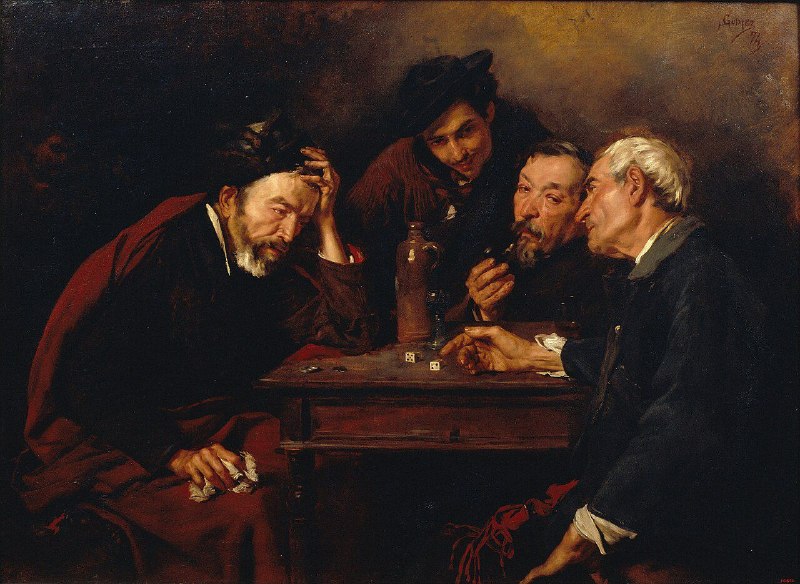
If you pick up an ordinary lottery ticket, it looks harmless compared to injectable drugs — but it can cause comparable harm. People have long noticed the corrupting influence of gambling: Plato and Aristotle criticized gambling as a vice leading to loss of self-control. In the Sigalovada Sutta, gambling is named as one of the causes of a person's downfall and is viewed as an activity that intensifies greed, attachment, and suffering. Gambling is explicitly prohibited by the Quran (5:90–91) as "an abomination from Satan's handiwork." It is no coincidence that in 1878 the US Supreme Court declared lotteries "a game that strips a person of their moral character" — but later, money won out anyway.

Why does the brain support risk-taking for uncertain reward? Evolution shaped the brain so that uncertainty itself intensifies motivation. In nature, resources are unpredictable, and if behavior extinguished after every failure, many animals simply would not have survived. As a result, uncertain reward became a powerful stimulus: the brain perceives unpredictability as a potential threat to survival and sharply amplifies dopamine-driven motivation.

This persistence is useful when we are mastering a skill. For example, learning to throw a ball into a basket: the first attempts fail, but the brain notices improvements — we miss closer and closer, receive a dopamine signal of progress, and maintain motivation. In a game of chance or online betting, things are different: the outcome does not depend on previous attempts, so a "near miss" is merely an illusion of progress, not learning.

From a neurobiological standpoint, gambling is the exploitation of the learning mechanism based on variable reinforcement: the brain begins to strive not toward winning as such, but toward the state of uncertain anticipation, which is accompanied by dopamine releases and can gradually become compulsive.

And this behavior is spreading extremely widely: casinos, betting, crypto, predictions, slot machines, sports betting, lotteries, the stock market and much, much more — all the way to the algorithms of the infinite feed in social networks.

The main problem is not simply the loss of money or time. It is the deformation of personality. Prolonged stimulation by easy dopamine destroys character, makes a person impulsive, reduces self-control, coarsens, leads to burnout, loss of interest in family, hobbies, and work, and diminishes empathy. As was wisely observed, "one of the greatest misfortunes that can befall a person is winning at the races in one's youth." Easy dopamine and the voluptuous anticipation of easy dopamine are the rust that eats away at a person's character. In the end, the casino always wins, and you always lose.

Instead of taking more risk on a screen — take more risk off of screens: go traveling, develop a skill, meet people, launch your own projects, start relationships. Where you apply real effort, learn to endure uncertainty, cope with the frustration of rejections and defeats, and develop skills — that is where your brain will be rewarded with good, useful dopamine.
  • ❤ 18
  • 👍 3
Older posts →

About this channel

How can I read @beloveshkin without a Telegram account?
TGViewer shows the public web preview Telegram publishes for Dr. Belaveshkin: recent posts, photos, videos and the subscriber count, with no app, login or account.
How many subscribers does Dr. Belaveshkin have?
Dr. Belaveshkin (@beloveshkin) has 9.36K subscribers on Telegram, refreshed roughly every 30 minutes.
Does Dr. Belaveshkin know I viewed it here?
No. Public channel previews carry no viewer identity, and TGViewer has no accounts or tracking of what you look up.
Threads Profile ViewerView any public Threads profile without an account.Open ThreadLook →Writing with AI? Make it sound human.Metric37 rewrites AI drafts so they read naturally. Free AI detector, 1,500 words free.Try Metric37 →