




Самый частый паттерн при написании логгирующей http обертки в API автотестах:
import httpx

class LogClient(httpx.Client):
    def request(self, *args, **kwargs):
        print(args, kwargs)
        response = super().request(*args, **kwargs)
        print(response.content)
        return response
Потом добавляем allure степы:
class LogClient(httpx.Client):
    def request(self, *args, **kwargs):
        with allure.step(f"Request {args}"):
            print(args, kwargs)
            allure.attach(request, name="Request")
            response = super().request(*args, **kwargs)
            allure.attach(response, name="Response")
            return response
Метод разрастается, мы опять вносим изменения в класс.
Дальше захотим добавить coverage, метрики - опять изменения.
Может быть есть способ не изменяя класс?
Решение 1: Встроенные hooks в httpx
client = httpx.Client(
    event_hooks={
        'request': [log_request],
        'response': [log_response]
    }
)
httpx уже поддерживает event hooks.
Можем передать функции, которые вызовутся до/после запроса.
Решение 2: Своя реализация
А что если захотим свой клиент?
Систему хуков можно внедрить в любой клиент - к БД или другому ресурсу.
Рассмотрим на примере httpx, как будто там нет хуков:
from typing import Callable
import httpx
from httpx import Request, Response

class Client:
    def __init__(self):
        self._on_request_callbacks = []
        self._on_response_callbacks = []
        self._client = httpx.Client()

    def add_request_hook(
        self, callback: Callable[[Request], None]
    ) -> None:
        self._on_request_callbacks.append(callback)

    def add_response_hook(
        self, callback: Callable[[Response], None]
    ) -> None:
        self._on_response_callbacks.append(callback)

    def _run_hooks(self, value, hooks):
        for hook in hooks:
            try:
                hook(value)
            except Exception as e:
                print(f"Hook error: {e}")

    def request(self, method, url, **kwargs) -> Response:
        request = self._client.build_request(
            method=method, url=url, **kwargs
        )

        self._run_hooks(request, self._on_request_callbacks)
        response = self._client.send(request)
        self._run_hooks(response, self._on_response_callbacks)

        return response
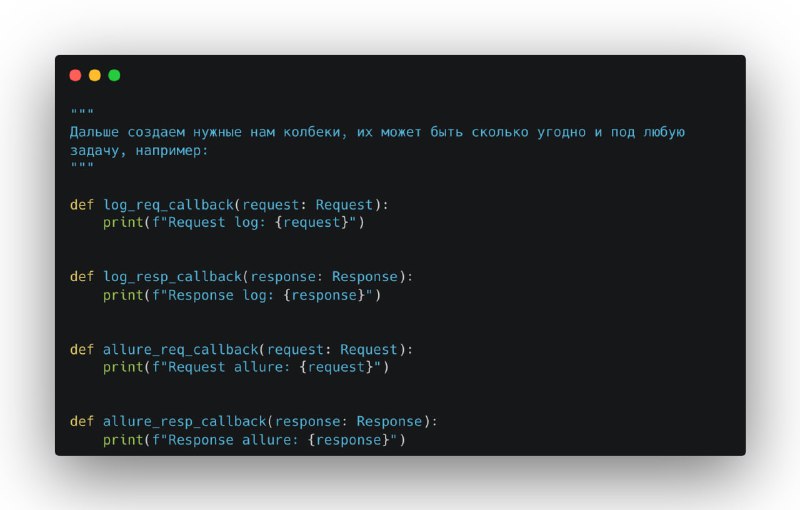
Создаем колбеки:
def log_req(request):
    print(f"→ {request.method} {request.url}")

def log_resp(response):
    print(f"← {response.status_code}")

def allure_req(request):
    allure.attach(str(request), name="Request")

def allure_resp(response):
    allure.attach(response.text, name="Response")
Регистрируем и используем:
client = Client()
client.add_request_hook(log_req)
client.add_request_hook(allure_req)
client.add_response_hook(log_resp)
client.add_response_hook(allure_resp)

client.request("GET", "https://httpbin.org/get")
Результат:
→ GET https://httpbin.org/get
← 200
Что получается?
Мы один раз описали интерфейс для регистрации хуков, и теперь можем добавлять сколько угодно логики, не внося изменений в класс. Код становится более стабильным и расширяемым.
——————————-
📱 TG-сообщество
📱 Обучение
📱 Отзывы