TGViewer
Channel Public Channel
AI, Python, Cognitive Neuroscience

AI, Python, Cognitive Neuroscience

@ai_python_en

Subscribers
3.45K
Photos
1.1K
Videos
47
Links
891

Showing posts older than #1860 · Back to latest

Older Posts 20 shown
Post #1855 923
In statistical modeling, apparent violations of distributional assumptions (e.g., normality, Poisson) may result from heterogeneity we haven't accounted for.

In plain English, these violations may result from outliers, for example. Outliers can tell us a lot about are data (e.g., why most people are this way and not that way). They may also be hinting that something is amiss with our data.

Violations of distributional assumptions may also tell us we haven't thought about the problem enough! For example, we may be trying to force a one-size-fits-all model on our data. But different types of consumers may have different motivations, so a regression model that aims at the middle may miss most of them. People also transition in and out of different "states" because of marriage, promotions, childbirth, etc.

One reason predictive analytics often goes wrong is because of people working in factory-like (or sweatshop-like) environments being forced to crank out as many models as possible as quickly as possible.

Well-trained analysts given more time to think about the data and business problem can extract more value from the same data. So the problem may lie more with the execution than the idea itself.

✴️ @AI_Python_EN

Post #1854 907
For Who Have a Passion For:

1. Artificial Intelligence
2. Machine Learning
3. Deep Learning
4. Data Science
5. Computer vision
6. Image Processing
7. Cognitive Neuroscience
8. Research Papers and Related Courses

https://t.me/DeepLearningML
Post #1852 943
This is our new paper at KDD, proposing a new dataset for US traffic records with several attributes. We also did some data analysis to show its potential for further uses in AI and data mining. Hope to see you at KDD 19

https://www.youtube.com/watch?v=FhWO_uTf2Ho&t=2s

✴️ @AI_Python_EN
YouTube Short and Long-term Pattern Discovery Over Large-Scale Geo-Spatiotemporal Data Authors: Sobhan Moosavi, Mohammad Hossein Samavatian, Arnab Nandi, Srinivasan Parthasarathy and Rajiv Ramnath More on https://www.kdd.org/kdd2019/
Post #1846 785
How to ship ML in practice:

1/ Write a simple rule based solution to cover 80% of use cases

2/ Write a simple ML algorithm to cover 95% of cases

3/ Write a filtering algorithm to route inputs to the correct method

4/ Add monitoring

5/ Detect drift

...

24/ Deep Learning

✴️ @AI_Python_EN
Post #1845 786
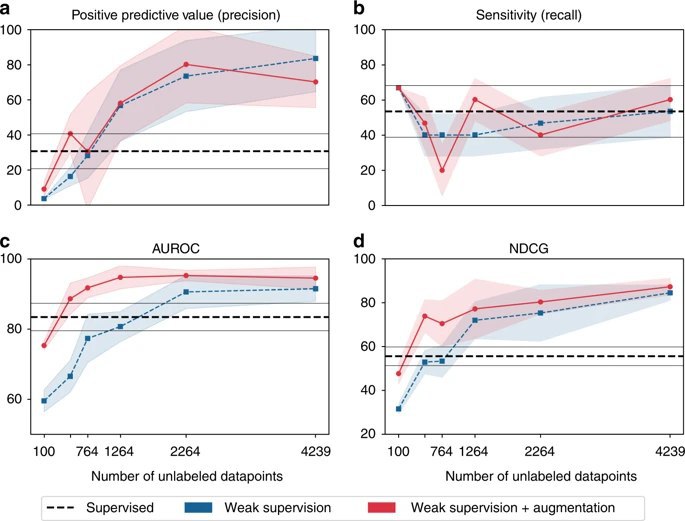
how weak supervision can train deep learning models using unlabeled cardiac MRI sequences/videos

Key idea: use Snorkel to transform cardiologist domain knowledge into labeling functions --simple rules which capture information about our task-- to take advantage of the massive scale of unlabeled imaging data available in biobank.

This lets us rapidly build training sets for classification tasks such as bicuspid aortic valve, where a Snorkel-based approach improved our end model F1 performance by 64%.

This lets us rapidly build training sets for classification tasks such as bicuspid aortic valve, where a Snorkel-based approach improved our end model F1 performance by 64%.
https://www.nature.com/articles/s41467-019-11012-3

✴️ @AI_Python_EN
Post #1841 836
Have you heard of "R-Transformer?", a Recurrent Neural Network Enhanced Transformer

Recurrent Neural Networks have long been the dominating choice for sequence modeling. However, it severely suffers from two issues: impotent in capturing very long-term dependencies and unable to parallelize the sequential computation procedure.

Therefore, many non-recurrent sequence models that are built on convolution and attention operations have been proposed recently.

Here the authors propose the R-Transformer which enjoys the advantages of both RNNs and the multi-head attention mechanism while avoids their respective drawbacks.

The proposed model can effectively capture both local structures and global long-term dependencies in sequences without any use of position embeddings. They evaluated R-Transformer through extensive experiments with data from a wide range of domains and the empirical results show that R-Transformer outperforms the state-of-the-art methods by a large margin in most of the tasks.

Github code: https://lnkd.in/dpFckix

#research #algorithms #machinelearning #deeplearning #rnn

✴️ @AI_Python_EN
Older posts →
Threads Profile ViewerView any public Threads profile without an account.Open ThreadLook →Writing with AI? Make it sound human.Metric37 rewrites AI drafts so they read naturally. Free AI detector, 1,500 words free.Try Metric37 →